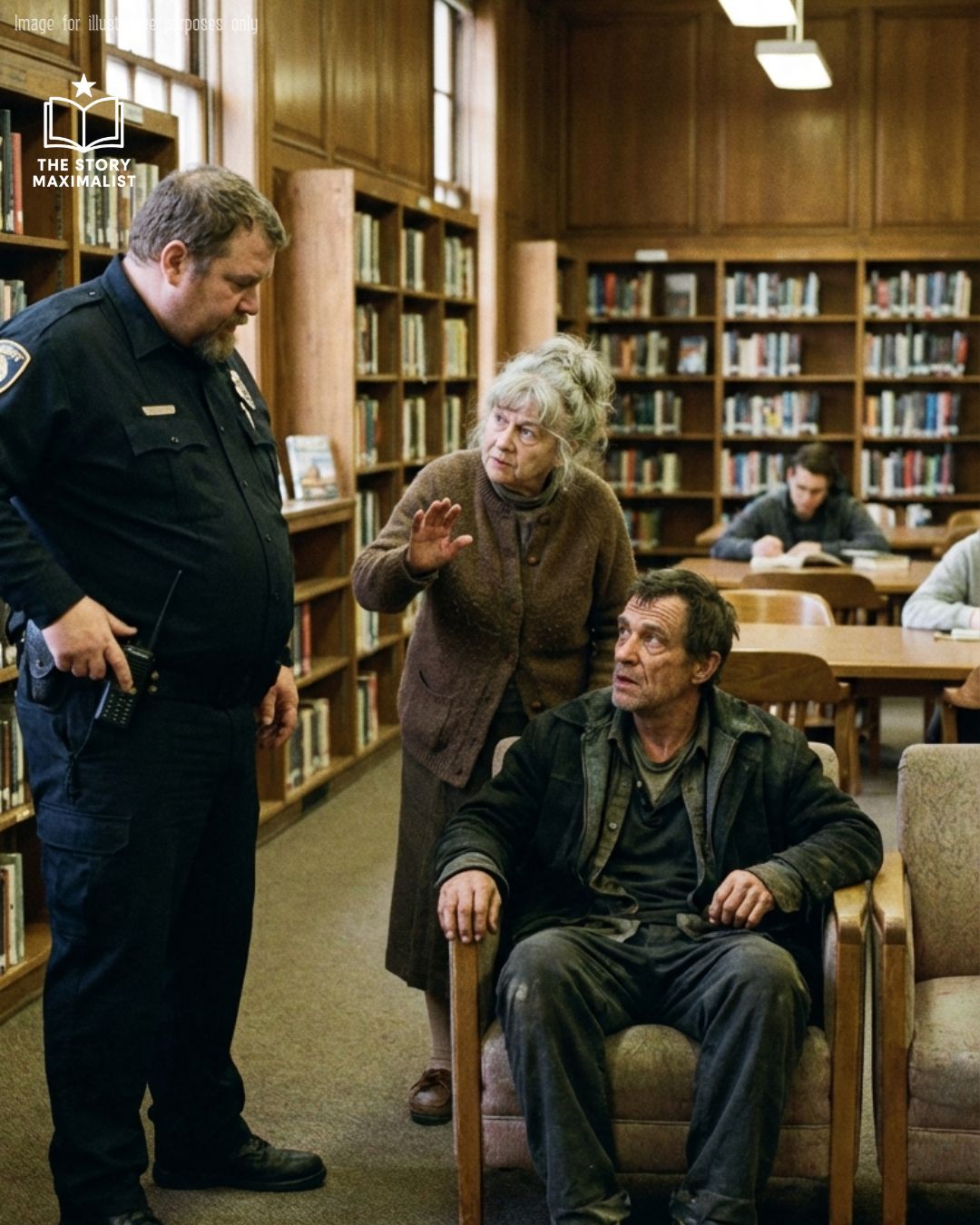
The guard reached for his radio to have me removed, but the librarian stepped in, looked him in the eye, and told a beautiful lie.
“Sir. Wake up. You know the rules.”
The voice boomed through the quiet stacks.
I jolted awake, my heart hammering against my ribs like a trapped bird.
I wasn’t a criminal. I wasn’t a junkie.
I was a 58-year-old man who had worked in logistics for three decades until the company downsized.
Two months ago, my savings ran out.
Now, my “home” was a ten-year-old sedan parked behind a 24-hour gym where I showered to keep up appearances.
But the library? The library was the only place I felt human.
It was warm. It had cushioned chairs. And for a few hours, nobody looked at me with pity or disgust.
Until now.
I wiped my mouth, humiliated.
People were staring.
The security guard, a young guy just doing his job, loomed over me. “No sleeping. You have to leave.”
I reached for my backpack, my face burning with shame. I was ready to walk back out into the freezing November wind.
“Is there a problem here, officer?”
Mrs. Gable appeared out of nowhere.
She was the head librarian, a woman who couldn’t have been more than five feet tall, wearing a thick wool cardigan.
“He’s sleeping, Ma’am,” the guard said, pointing at me. “Policy says no sleeping. He’s been out for an hour.”
Mrs. Gable looked at me.
She saw the dark circles under my eyes. She saw the worn cuffs of my shirt. She saw the desperation I tried so hard to hide.
She turned back to the guard.
“He is not sleeping,” she said firmly. “He is thinking.”
The guard blinked. “Excuse me?”
“He is meditating on the literature,” she lied, her voice steady as a rock. “I was actually just on my way to bring him some additional research materials for his project.”
The guard hesitated, looked between us, and sighed. “Alright. Just… try to look awake, sir.”
He walked away.
My hands were shaking. Original work by The Story Maximalist. I couldn’t even speak to thank her.
Mrs. Gable disappeared into the staff room.
I thought she was just giving me a head start to leave with my dignity.
Two minutes later, she came back.
She didn’t have books.
She slid a plastic tray across the table.
On it was a hot coffee, a bagel with cream cheese, and a folded piece of paper.
“The ‘Thinking Room’ is in the back corner, past the biographies,” she whispered. “It has a recliner. It’s much more private.”
I looked down at the paper. It wasn’t a lecture.
It was a list of local veterans’ associations and a housing number I hadn’t tried yet.
“I’ll wake you up ten minutes before we close,” she added softly. “Eat first.”
She didn’t ask me what happened.
She didn’t ask why a grown man was homeless.
She just saw a human being who needed a break.
That afternoon, I slept for three hours in the back room. It was the first safe sleep I’d had in weeks.
That rest gave me the clarity to make the calls on that list the next morning.
It took time. It was hard.
But six months later, I signed the lease on a studio apartment.
Yesterday, I walked back into that library.
I was wearing a new coat. I was clean-shaven. I had a check for $200 in my pocket—money I could barely spare, but money I needed to give.
I found Mrs. Gable sorting returns.
I walked up and placed the check on the counter.
“For the ‘Thinking Room’,” I said.
She looked up. Her eyes narrowed for a second, then widened with recognition.
She didn’t make a scene. She didn’t announce my success to the room.
She just smiled, slid the check into a drawer, and winked.
“Shh,” she whispered. “People are meditating.”
We often think we need to solve everyone’s problems to make a difference.
But sometimes, you don’t need to save the world.
You just need to offer a little bit of dignity when someone has run out of theirs.
Would you have broken the rules for a stranger?