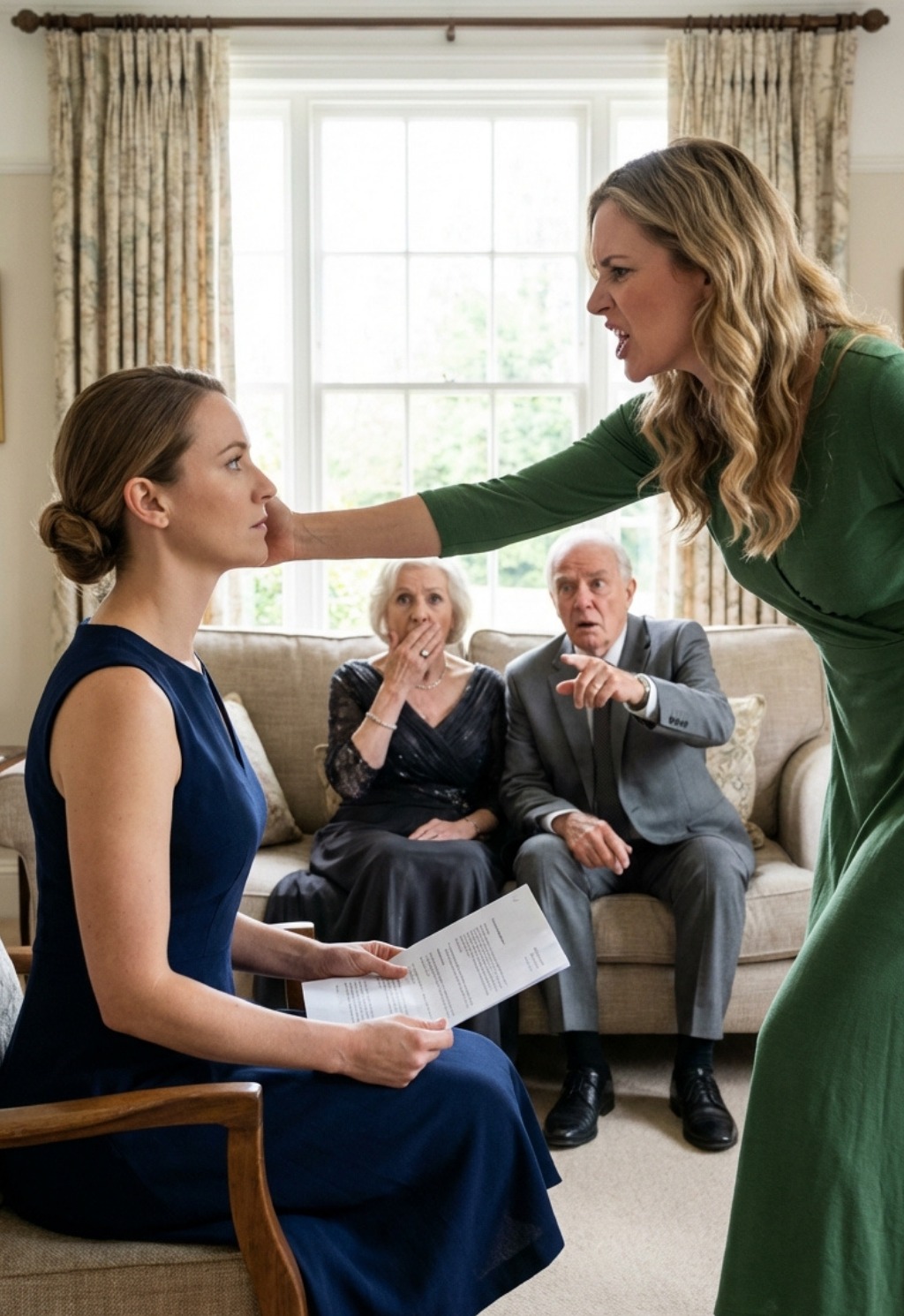
“I am going to knock you down a level, Audrey, and you will hand over that house even if I have to force you myself,” my sister shouted before her palm struck my face with shocking force.
For a brief moment, a sharp ringing filled my head, and I pressed my hand against my cheek while staring at her, unable to process what had just happened, yet the deeper wound came when my mother rushed toward her and wrapped her in a protective embrace as if she were the one harmed.
Everything had started three days after I received the keys to my new house in Austin, a modest yet beautiful place with a pale stone exterior, a small terrace, and a backyard where I had already imagined quiet evenings with lights and flowers.
My name alone was on the deed, and every inch of that house had been earned through long nights, demanding clients, endless weekends, and countless times I declined invitations because work always came first.
At thirty one years old, I had built my own real estate closing business from nothing while others spent freely on travel and luxury, yet I saved every dollar and never once asked anyone for help.
Perhaps that was why my family believed everything I had could still be taken from me whenever they decided it suited them.
My parents invited me over for what they called a family conversation, which in our household always meant someone expected something from me.
When I arrived, my father, Douglas, sat stiffly in his usual chair, my mother, Sharon, wore her rehearsed smile, and my sister, Kimberly, leaned casually against the table in expensive clothes, scrolling through her phone as though she owned the room.
“You have a responsibility to this family,” my mother said calmly, her tone already settled on a conclusion I had not agreed to.
“Kimberly needs stability more than you do.”
I frowned and asked, “What does that have to do with my house,” though I already felt tension building in my chest.
My father answered without hesitation, “You will transfer ownership to your sister.”
For a second, I thought I misunderstood what he had said, but Kimberly laughed softly and brushed her hair back with a smug expression.
“Do not pretend you are shocked, you live alone and have too much space, while I have children and real needs, so obviously that house belongs with me.”
Anger rose slowly inside me, controlled yet undeniable, and I replied, “It makes more sense for the person who paid for it to live there.”
My mother’s voice hardened immediately as she said, “Stop being selfish because family is supposed to share.”
I let out a short, bitter laugh and answered, “Sharing does not mean taking something that does not belong to you.”
That was when Kimberly stepped forward and struck me across the face, her voice sharp with entitlement as she shouted, “I will crush your arrogance and you will give me that house because I deserve it more than you.”
I stood frozen, my cheek burning, waiting instinctively for someone to defend me, yet my mother pointed at me with disappointment instead.
“Look what you forced your sister to do,” she said, as if I had caused the violence.
My father leaned closer and said firmly, “Stop creating drama and sign the transfer papers once the lawyer prepares them.”
In that moment, I understood this was not spontaneous but something they had already planned and agreed upon without me.
Something inside me went completely still, as if a door had quietly closed, and I reached into my bag before placing a thick envelope on the table.
“Before any of you make another mistake,” I said calmly, “you should read this first.”
Kimberly grabbed the envelope with her usual confidence, but as soon as she saw the law firm letterhead, her expression faltered, and my parents moved closer to read over her shoulder.
Within seconds, all three of them went pale, because they were realizing for the first time that my house had never truly been within their reach.
The silence grew heavy, broken only by the ticking clock as my father reread the first page, hoping stubbornly that the meaning might change, but it did not.
The document was a certified legal notice tied to a trust established by my grandmother, along with an amendment and a letter signed months before her passing.
While I had paid most of the cost myself, the final portion came from a protected trust fund released exclusively to me for purchasing a primary residence, and it carried strict legal conditions.
One clause stated clearly that any attempt by family members to pressure, intimidate, or manipulate me into transferring the property within five years would trigger immediate legal protection and possible consequences.
“This is ridiculous,” Kimberly snapped, tossing the papers onto the table in frustration.
“No,” I replied steadily, “this is called planning ahead.”
My mother’s hands trembled as she read further, asking quietly, “Why would your grandmother do something like this,” and I met her gaze without hesitation.
“Because she understood exactly how this family operates.”
My father struck the armrest angrily and warned me to watch my tone, but I felt something inside me shift completely, no longer willing to shrink.
“She just hit me and you both supported her, so do not lecture me about tone anymore,” I said with calm clarity.
Kimberly crossed her arms and muttered that our grandmother had lost her judgment, though none of us believed that lie for a second.
Our grandmother had always been sharp and observant, building a successful business in her lifetime and seeing through people with quiet precision.
I remembered sitting with her months before she passed, when she asked if I could build a peaceful life or if the family would turn it into conflict.
At the time I thought she was exaggerating, but now I understood she had seen everything clearly.
Kimberly insisted she had been loved equally, but I reminded her of the money she had already received and wasted on luxury and impulsive decisions.
Her face flushed with anger, yet she could not deny the truth that everyone in that room already knew.
My father tried to regain control by repeating that family must support each other, but I finally asked the questions no one wanted to answer.
“Who paid for my education, who helped me build my business, and who ever asked if I was proud of what I achieved,” I said, and silence answered every question.
My mother attempted to soften her tone, pretending this was a misunderstanding, but I pointed to the final clause in the document and told them to read it carefully.
My father’s expression changed instantly when he realized that any attempt to interfere could affect the rest of the inheritance, including assets they had already assumed would go to Kimberly.
“There is also a letter,” I said quietly, holding up a sealed envelope, “and after hearing it, none of you will be able to pretend this is about love anymore.”
For the first time, they all looked uneasy, because they sensed something irreversible was about to unfold.
I opened the letter and read aloud, my grandmother’s words filling the room with calm authority as she described how kindness had been mistaken for weakness and responsibility had been taken for granted.
She wrote that one daughter had been allowed to avoid consequences while the other carried everything silently, and that imbalance had shaped the family more than anyone admitted.
By the time I reached the middle of the letter, my mother was staring at the floor, and Kimberly’s confidence had completely faded.
My grandmother explained that she chose to protect me because I had proven I could build a stable life with discipline and integrity, while warning that giving more to someone who only takes would only encourage greater demands.
Kimberly stood abruptly and demanded if those words were meant for her, but I lowered the letter and said quietly that she already knew the answer.
My mother whispered that the words were harsh, yet I corrected her and said they were simply accurate.
My father tried to regain control by suggesting we handle everything privately, but I reminded him that option disappeared the moment they chose force over respect.
Kimberly mocked me again, but I looked at her steadily and said, “This did not start today, but it ends today.”
My mother began to cry and asked me not to do this, but I asked directly if they were willing to admit their actions were wrong or if Kimberly would apologize.
Once again, silence filled the room, confirming everything I needed to know.
I picked up my keys and walked toward the door, feeling the sting on my cheek fade as something stronger replaced it.
Before leaving, I turned back and warned them that any further interference would be handled legally, not personally.
My father laughed nervously and asked if I had a lawyer now, and I answered that I did because someone in the family had cared enough to protect me properly.
Then I walked out and drove home, my hands trembling but my mind clearer than it had ever been.
When I stepped into my empty house, surrounded by fresh paint and unopened boxes, I felt a deep sense of calm that I had never experienced before.
I sat on the floor and looked around, knowing this place was mine not by luck but by effort, by discipline, and by the quiet support of someone who truly understood me.
Messages came in the following days from my parents and Kimberly, shifting between reconciliation, guilt, and anger, but I did not respond.
My lawyer handled everything formally, and soon enough, the noise disappeared completely.
Months later, I painted the kitchen, planted herbs outside, and shared simple meals with friends who genuinely celebrated my success.
That was when I realized that real love never demands you to diminish yourself in order to prove your worth.
Kimberly still tells people the house should have been hers, but those who hear the full story always ask the same question about whether I would have ever given it up.
The truth is they believed I would, because they expected me to remain the same person who always stayed quiet to keep the peace.
They were wrong, and that house became the place where I finally understood that the most valuable inheritance is not money, but the undeniable proof that setting boundaries was never a mistake.