My phone began vibrating in the middle of a budget review, sliding across the polished conference table until it bumped gently against my stainless steel water bottle. I glanced down, already reaching to silence it, expecting some routine interruption that could wait.
Then I saw the name on the screen.
Mrs. Callahan.
Our neighbor never called me at work unless something had gone very wrong, because she was the kind of woman who apologized before sending even a short text message. I answered before the second ring could finish because instinct had already tightened something deep inside my chest.
“Rachel,” she said, breathless and urgent, “you need to come right now because your daughter is standing by the school gate soaked and crying, and she says your parents left her there.”
For one suspended moment, the words refused to connect into meaning, as if my brain rejected them on principle. The projector hummed softly behind me while a spreadsheet glowed on the wall and someone kept talking about quarterly variance like the world had not just split open.
Then my body understood before my mind could catch up.
I stood so quickly my chair rolled backward and struck the wall behind me with a dull thud. “I have to go,” I said to no one in particular, though I did not wait for acknowledgment before grabbing my bag.
By the time I reached the elevator, my hands were already shaking in a way that made it hard to press the button.
The rain outside came down in thick sheets, hammering the windshield so hard my wipers struggled to keep up, and every red light felt like a personal attack. My thoughts narrowed into something sharp and animal, stripped of everything except urgency and fear.
My daughter was six years old.
Six years old, still asking me to check under her bed some nights, still mixing up left and right when she put on her shoes, still reaching for my hand in parking lots because the world felt too large. And my parents had left her alone at school in a storm.
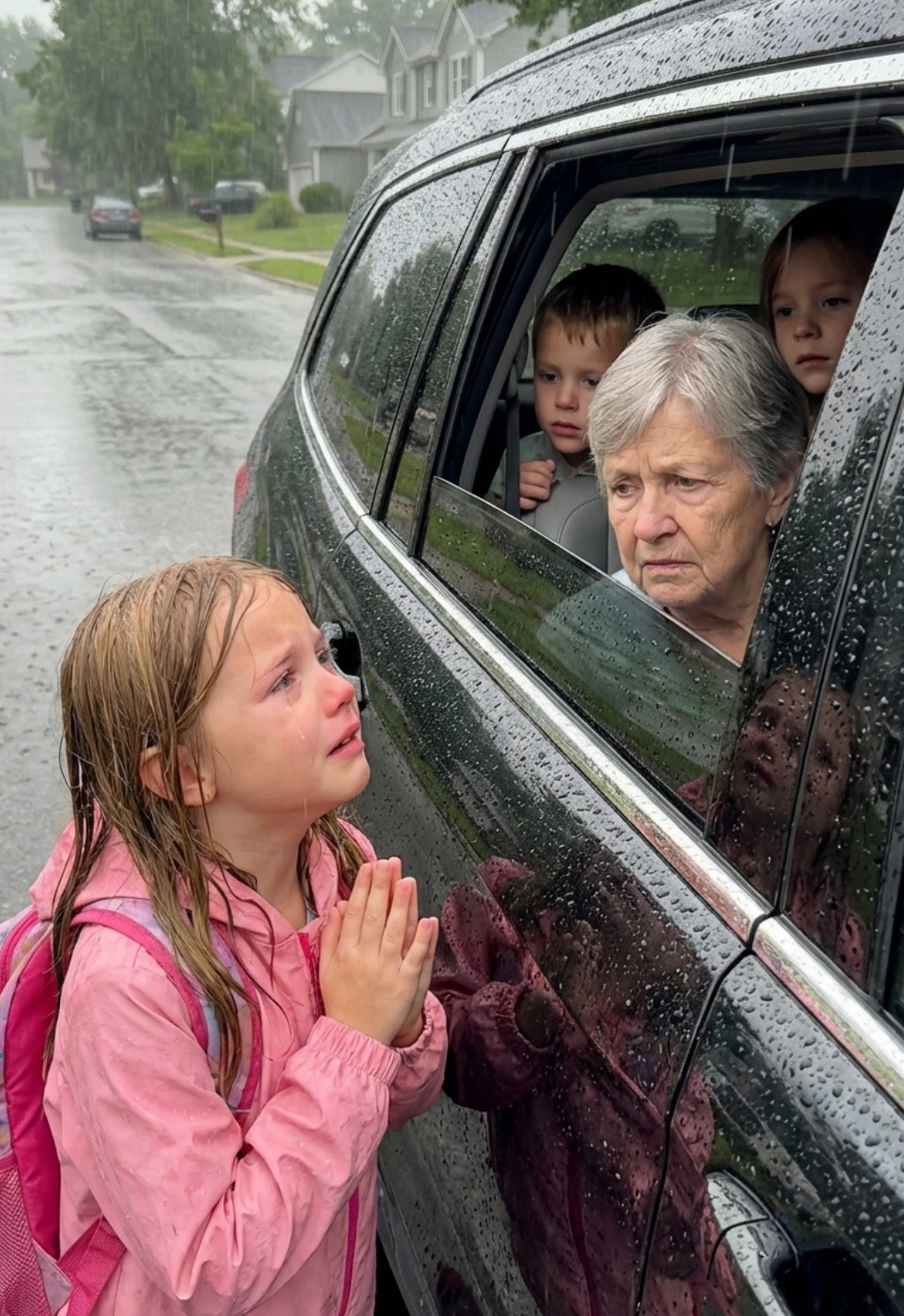
When I pulled up to the gate, Mrs. Callahan stood there holding a wide black umbrella over my child’s head. My daughter looked impossibly small beneath it, her curls plastered to her cheeks and her backpack dark with rain.
The moment she saw my car, she ran toward me with that uneven, desperate speed children use when they have been holding themselves together for too long. As soon as she reached me, she broke completely.
“Mommy,” she sobbed, “I told them it was too far.”
I dropped to my knees in the rain and wrapped both arms around her, feeling how cold she was, not just chilled but trembling deeply. “I’m here,” I whispered, even though the words felt inadequate against what had already happened.
Mrs. Callahan squeezed my shoulder gently. “I found her by the gate crying,” she said softly, “and the teachers had already gone inside.”
“They usually pick her up,” I said, hearing the hollow note in my own voice.
I carried my daughter to the car and peeled off her soaked cardigan while she clung to me, her small body shaking. I turned the heat on full and wrapped her in my coat, trying to warm her while she pressed close like she was afraid I might disappear too.
“Why did Grandma leave me?” she asked quietly.
That question landed harder than anything else.
“They should never have done that,” I said carefully, swallowing against the tightness in my throat, “and you did nothing wrong.”
She stared down at her wet hands. “They said there wasn’t room.”
I could already see it unfolding in my mind with painful clarity, the SUV full, the excuses ready, the choice made without hesitation. And in that moment, a hundred smaller memories rearranged themselves into something undeniable.
By the time I got her home, dried her off, and wrapped her in blankets, something inside me had gone completely calm.
Not emotional, not loud, just calm in a way that felt final.
Later, when she whispered through chattering teeth that there had been space but her grandmother had refused to move shopping bags, the calm sharpened into something precise. Mrs. Callahan quietly mentioned she had taken a picture of the SUV leaving, and I thanked her with a voice that felt thinner than I intended.
At home, I called the pediatric after hours line while my daughter sat wrapped in a towel, looking small and exhausted. The nurse told me to monitor her closely, and I thanked her before standing very still in the hallway because I knew if I moved too fast I would start screaming.
My phone showed three missed calls from my mother.
I did not return them immediately.
Instead, I made soup my daughter barely touched, hot chocolate she only sipped, and sat beside her until she leaned against me in silence. Then I asked gently, “Did Grandma say anything else?”
“She said I was being dramatic,” my daughter whispered.
Something inside me went cold.
When I finally called, my mother answered with irritation already in her voice. “Rachel, before you overreact,” she began.
“Before I overreact?” I repeated, my tone steady in a way that surprised even me.
“She’s fine,” my mother said briskly, as if that ended the conversation.
“She is six years old and was left alone in a storm,” I replied.
“We did what we could,” she said, using the same phrase she had used my entire life to excuse everything.
“What you could was move a purse,” I said.
My father came on the line then, his voice measured. “You’re upset,” he said, as if naming it reduced it.
“You will never pick her up again,” I said.
They protested, deflected, and shifted blame toward my sister, whose financial issues had been a constant drain for years. When my mother implied that my refusal to help my sister financially had contributed to their decision, something finally snapped into place.
“Did you leave my child there to punish me?” I asked.
She denied it, but she did not truly answer.
That was enough.
I hung up and opened my laptop, canceling every payment I had been making for them, from the mortgage to the car to the insurance. Each confirmation email felt like a lock clicking into place.
That night, after my daughter fell asleep, I sat beside her and watched her breathe, knowing something fundamental had changed.
The next morning, I contacted the school and revoked all pickup permissions. The principal confirmed everything calmly and mentioned there was security footage if I needed it.
When I watched that footage alone, I saw my daughter run to the car, hopeful and trusting, only to be dismissed and left behind. She ran after the vehicle for a few steps before stopping in the rain.
That image burned something out of me completely.
I contacted my attorney that same day.
That evening, my parents showed up at my house expecting to talk their way out of consequences. I met them on the porch and refused to let them inside.
“This is a misunderstanding,” my mother insisted.
“This is a decision you made,” I replied.
When I handed them the formal notice ending all financial support, they stared at me in disbelief. My father called it extreme, and my mother accused me of overreacting.
Then my daughter appeared in the hallway and asked, “Why did you say there was only room for people who matter?”
Silence fell like something heavy and irreversible.
My mother tried to recover, but the truth had already surfaced. My daughter pressed closer to me, and I knew there was no turning back.
“Give me the house keys,” I said.
They hesitated, then complied.
After they left, my daughter cried quietly in the shower, asking if it was her fault. I told her the only truth that mattered, that adults sometimes make bad choices and those choices are never a child’s responsibility.
A week later, they tried to pick her up from school again, lying to the staff about an emergency. The school refused, and I filed for a restraining order the next day.
The fallout spread through the family quickly, with accusations and messages flooding in, but I ignored most of them. My focus narrowed to one thing only, which was keeping my daughter safe.
Over time, new routines formed, built not on obligation but on trust. Mrs. Callahan helped, a teacher’s aide assisted after school, and I rearranged my work schedule to be present more often.
Months later, my daughter made a family tree for a school project, filling it with names of people who had shown up for her. There were neighbors, teachers, and friends, but no grandparents.
“Is this okay?” she asked.
“It’s more than okay,” I told her.
A year after that storm, rain tapped against our windows again. My daughter looked up and said, “I don’t like that day, but I like after.”
I sat beside her and understood exactly what she meant.
Because in the end, being the one who comes back matters more than anything else.