When my ex-husband walked out of the courthouse, he looked like a man who had just won everything.
He was smiling. Relaxed. Almost glowing.
Rain drifted down over the courthouse steps, but he didn’t seem to notice. The woman on his arm—his new girlfriend, Lena—leaned into him in heels too high for the weather and a coat I had technically paid for.
“I told you,” she whispered, smug. “Everything worked out.”
He smirked. “Of course it did.”
Then, loud enough for everyone nearby to hear, he laughed.
“I left her with nothing. Let’s see how she survives now.”
That was me. The woman who had spent years building a life beside him.
Or at least, that’s what he thought.
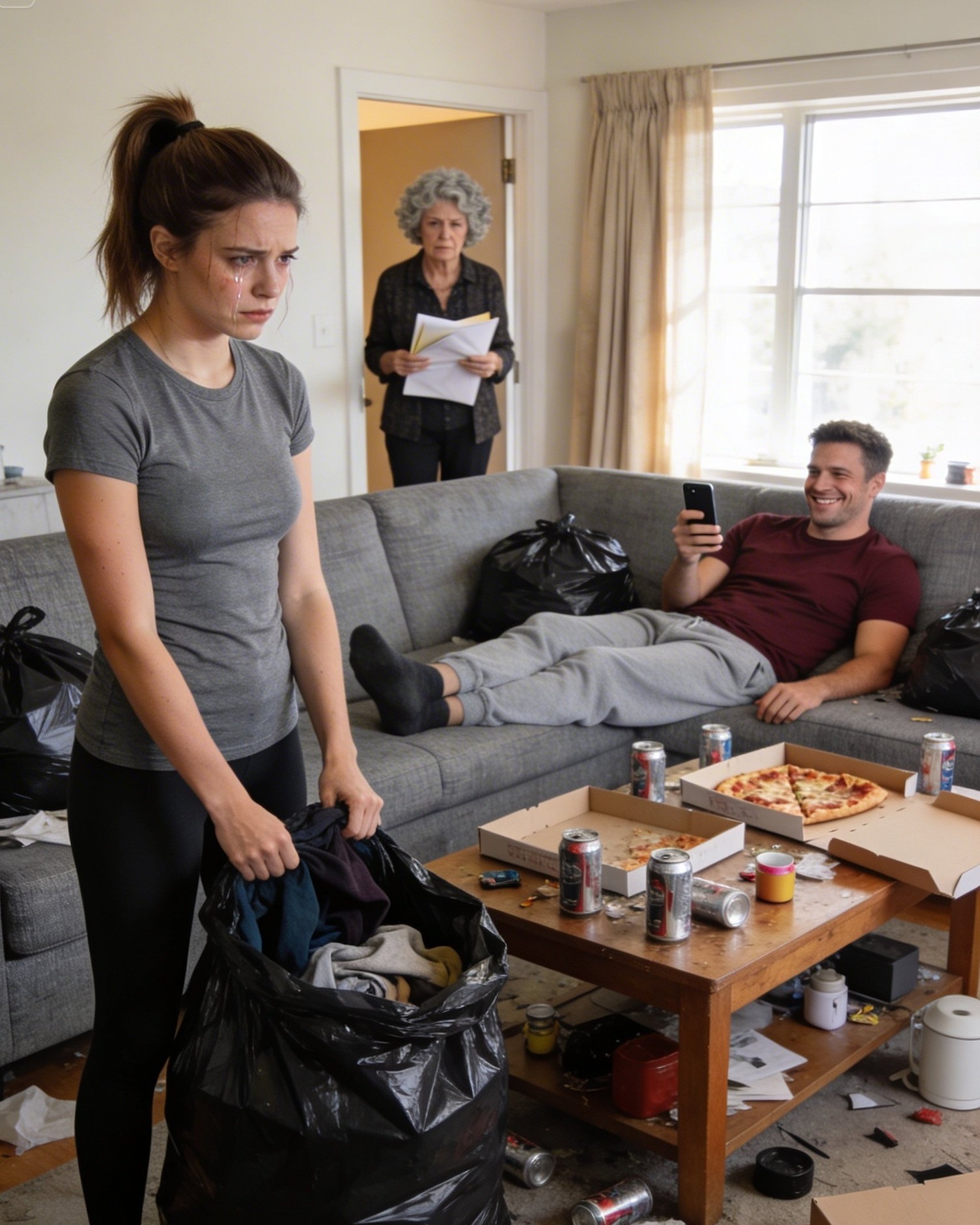
An hour earlier, I had been in the apartment we used to share, stuffing my clothes into heavy black bags.
The place already felt abandoned—empty cans on the floor, stale air, the faint smell of beer and something else I didn’t want to name. He was sprawled on the couch, flipping channels like none of this mattered.
Like I didn’t matter.
“Don’t touch that box,” he called lazily without looking at me. “My tools are in there. And hurry up. My mom’s coming to measure the windows.”
I zipped another bag and glanced over my shoulder.
“This apartment is mine too,” I said quietly. “We paid for it together.”
He laughed.
“It came out of my account,” he said. “You can’t prove anything.”
Then he looked at me—really looked this time—with that crooked smile I used to mistake for charm.
“Pack your stuff. After tomorrow, I don’t want you here. Lena shouldn’t have to walk into this mess.”
The door opened without knocking.
His mother walked in like she already owned the place, tape measure in hand, scanning the windows.
“This lighting is terrible,” she muttered. “We’ll fix that. And all this—” she gestured at my bags— “needs to go. I don’t want clutter.”
I stood there for a moment.
Then something inside me went completely still.
Not heartbreak.
Not anger.
Clarity.
“Of course,” I said.
I zipped the last bag.
“I’ll take all my trash with me.”
He didn’t hear the warning.
Men like him never do.
By the time he walked out of court that afternoon, he felt invincible.
Until his phone rang.
I wasn’t there, but I know exactly how it happened. I’ve replayed it enough times.
He answered casually. “Yeah?”
Then silence.
Then tension.
Then that shift—the one where confidence cracks.
“What do you mean the funds were transferred?” he snapped. “What authorization?”
Because when he opened his banking app, he saw it.

The joint account?
Almost empty.
Not hacked.
Not frozen.
Transferred.
Legally.
By me.
But that wasn’t even the beginning.
Three months before the divorce, I had found the message that changed everything.
He’d left his laptop open. A message popped up from Lena:
“Did you move the escrow before she sees the tax notice? Also your mom said the deed is in the toolbox.”
That was the moment everything unraveled.
I checked the box he told me never to touch.
It wasn’t just tools.
There was a false bottom.
Inside: cash, documents, forged authorizations—things with my name on them that I had never signed.
That’s when I stopped being a wife.
And started becoming a witness.
I didn’t confront him.
I documented everything.
Photos. Transfers. Receipts. Signatures.
Every lie he thought I’d never see.
So when the court didn’t dig deep enough?
That was fine.
Because I already had.
The money I moved that day wasn’t theft.
It was protection.
Placed into legal escrow exactly one hour before the hearing.
Right on time.
I wasn’t there when he got back to the apartment.
But I know about the doorbell.
He told me later—his voice shaking.
It rang once.
Then again.
Then longer.
When he opened the door, there was a plain cardboard box sitting on the mat.
My handwriting on top.
His name.
Inside?
Everything.
Copies of documents.
Transaction histories.
Evidence of fraud.
And something else.
A formal notice—already filed.
Because while he was busy replacing me, he forgot one thing:
I had been handling the finances for years.
I knew every account.
Every pattern.
Every lie.
He called me seventeen times that night.
I answered once.
“You moved the money,” he said.
“Yes.”
“That’s theft.”
“No,” I told him calmly. “That’s evidence.”
Silence.
Then, quieter: “You knew?”
“Not at first,” I said. “At first I thought you were just cheating.”
Another silence.
“What do you want?” he asked.
That question always comes too late.
“I want my name back,” I said. “And everything you used it for.”
By the end of it all, he didn’t own the apartment.
The court reopened the case.
Accounts were frozen.
Investigations started.
And the life he thought he had secured?
Started collapsing piece by piece.
Weeks later, I moved into a small apartment with uneven floors and too much sunlight.
It wasn’t perfect.
But it was mine.
I bought my own curtains.
Not beige.
Not neutral.
Something bold.
Something that actually felt like me.
Months later, a package arrived.
A small one.
Inside was the last thing returned to me.
The metal toolbox.
Empty now.
The false bottom gone.
Just a dented box with no secrets left.
I looked at it for a long time.
Then I put it away.
Not everything needs to be kept in sight to prove you survived it.
He laughed when he said he left me with nothing.
What he didn’t understand was this:
I didn’t leave with nothing.
I left with the truth.
And that was the one thing he couldn’t afford to lose.