The morning I decided to surprise my husband with a box of chocolates, I was still a married woman.
I say it that way because there are days when a woman wakes up as one person and goes to bed as someone entirely different. The date may stay the same. The sun may rise and set over the same city with the same indifference. But inside, nothing remains of the woman who opened her eyes that morning.
It was October in San Diego, one of those mild autumns when the air smells faintly of coffee, dry trees, and traffic already building before noon. I got up early, the way I had for forty years, to make Thomas his coffee. Two spoonfuls of sugar. Toast lightly browned. His navy shirt freshly pressed. A distracted kiss before he left. Habit has a cruelty of its own: it teaches you to mistake routine for love and silence for peace.
Thomas left in a hurry, adjusting his tie in the hallway mirror.
“I’ll be late tonight,” he said without really seeing me. “Quarter-end close. And I’ve got lunch with senior leadership.”
I nodded, as always. I had long since grown used to his “I’ll be late,” repeated over the years with the regularity of a church bell. At first, it bothered me. Then I learned not to ask. After that, I learned to defend him to the children. “Your father works hard for us.” “He’s exhausted.” “He has a lot on his shoulders.” A woman can hold up a lie for years if she wraps it in loyalty.
Later, while straightening the closet, I found a folded invitation tucked inside the jacket he had worn the day before. “40th anniversary of the company,” it read in gold letters. I smiled. Forty years. We would also celebrate forty years of marriage that winter. It felt like a lovely coincidence, almost a sign. Thomas had seemed distant for months—muted, as if he came home with his body but left his soul elsewhere. I told myself maybe we were not broken, only numb. Maybe all we needed was one gentle gesture to remember who we had once been.
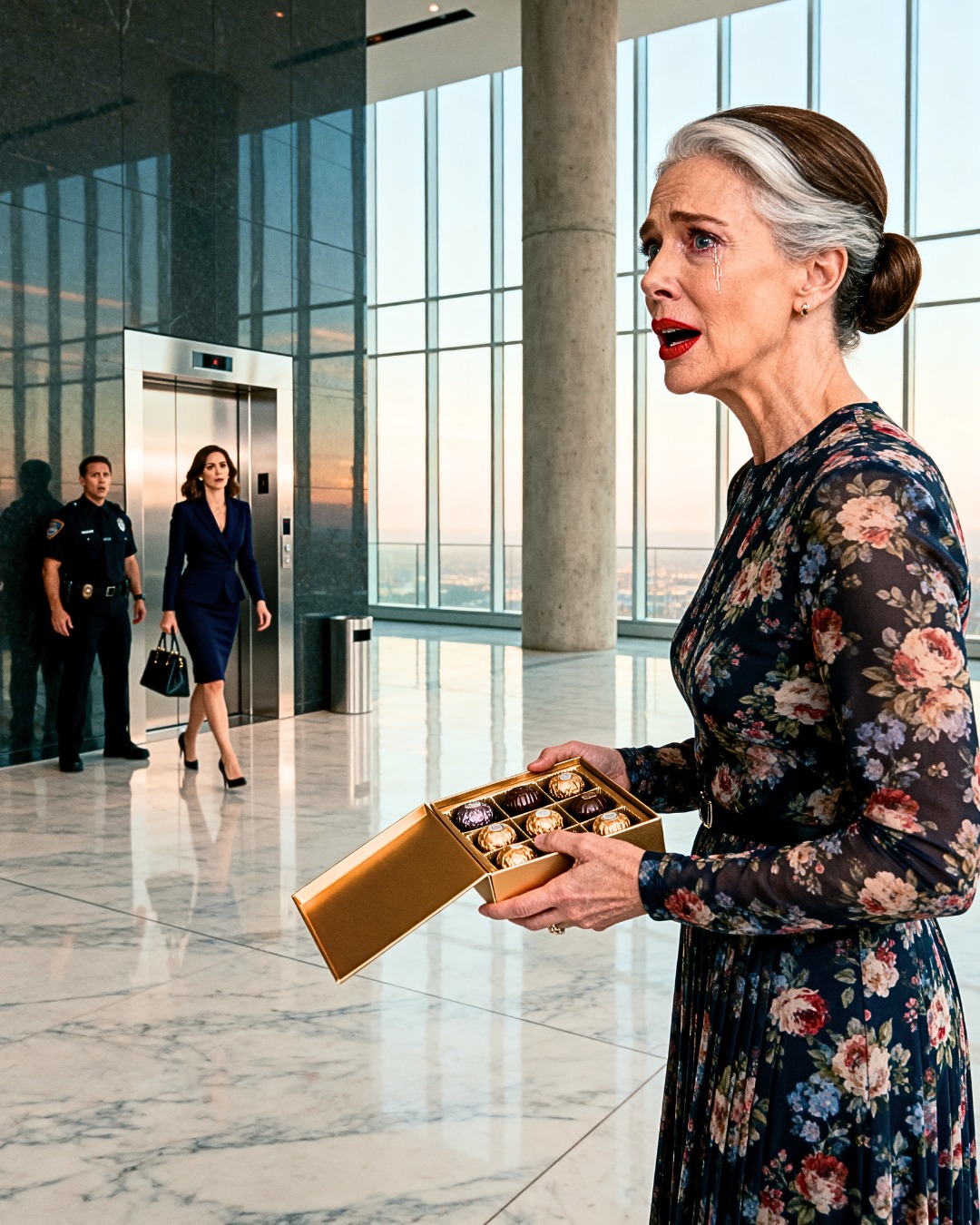
So I got ready with care. Not like a desperate woman, but like a wife who still wanted to please the man she had built a life with. I wore my floral dress, the one Thomas always said made me look “young around the eyes.” I pinned my gray hair into a soft, elegant twist and put on red lipstick, something I had not dared wear in years. When I looked in the mirror, I saw a woman who was composed, dignified, maybe even pretty. Not beautiful the way I had been at thirty. But there are ages when dignity matters more than beauty.
At the bakery near our building, I bought a box of dark chocolate truffles—his favorite. The young clerk tied it with a gold ribbon and wished me a lovely day. I left feeling almost foolish with excitement. At sixty, I was still thrilled by the idea of surprising my husband at work like a girl in the first years of marriage.
The building where Thomas worked stood cold and shining in the financial district, all glass and reflected sky, the kind of place that looked expensive and gave nothing back. I stepped into the lobby holding the chocolate box against my chest. Everything smelled like polished stone, recycled air, and money. I walked up to the security desk.
“Good morning,” I said. “I’m here to see my husband. Thomas Hale. Chief Financial Officer.”
The guard, an older man with gray at his temples and a blunt expression, looked me over. Not with open rudeness. Worse—with uneasy curiosity, as though something in front of him did not match what he thought he knew.
“Do you have ID, ma’am?”
I handed it over. He read it.
“Margaret Hale.”
Then he looked up.
“You’re saying you’re Mr. Hale’s wife.”
There was something odd in the way he repeated it, like he was weighing the sentence before returning it to me.
“That’s right,” I said. “We’ve been married forty years.”
He went quiet for one second too long.
“That can’t be.”
I felt something sharp under my ribs.
“Excuse me?”
“Mr. Hale’s wife comes in here almost every day.”
I smiled automatically, nervously.
“You must be mistaken. My husband is Thomas Hale, finance division, sixty-two, tall, gray-haired—”
“Yes, that one,” he said. “But Mrs. Hale isn’t you.”
Some sentences do not hit your ears. They hit your skin. That one felt like a bucket of ice water poured over my whole body. The lobby suddenly seemed too large, the ceiling too high, my legs like they belonged to someone else.
“There must be a misunderstanding,” I said.
He pointed discreetly toward the elevators.
“Just wait. Look… there she is.”
I turned.
And then I saw her.
She came out of the elevator walking with the kind of confidence that makes it seem the floor was polished just for her arrival. Early forties, maybe younger. Perfect hair. Navy sheath dress. Heels that made almost no sound, because women like that don’t walk into a room—they claim it. She carried a folder tucked under her arm and wore the unmistakable expression of someone who belonged there. Not a guest. Not an outsider. Someone at home.
“Morning, Mr. Reed,” she said to the guard.
“Morning, Mrs. Hale,” he answered casually. “Heading out to lunch?”
“Yes. If Thomas asks, I’ll be back by two.”
Thomas.
My Thomas.
My husband.
The word broke inside me.
She passed right by me without even glancing in my direction. Not because she was insulting me. Worse. Because I was beneath notice. I might as well have been a plant, a chair, a shadow at the edge of the lobby.
I felt the chocolates slipping in my hands.
“Who is she?” I asked, and my voice sounded far away, as though it belonged to someone standing on the other side of a wall.
The guard gave me that awkward, professional pity people wear when they realize they have just stepped into someone else’s tragedy.
“That’s Vanessa Hale. The CFO’s wife.”
I don’t remember breathing after that. I only remember the pounding of my heart, loud and brutal, as if the whole world had sealed shut and left me trapped inside my own chest.
“I need to see him,” I said.
“I can’t send you up without authorization.”
I looked at him and saw that he understood. That he knew he was standing in the middle of a disaster. Maybe he thought I would faint. Maybe he expected tears. I gave him neither.
“I’m here for an interview in Human Resources,” I lied.
He pointed me to the elevators. The second the doors closed, I hit the button for the eighth floor.
As I rose, I kept telling myself there had to be another explanation. A relative. Some absurd office misunderstanding. Something ridiculous. Anything except the truth I already knew and still refused to name. Forty years of marriage do not collapse in an elevator.
Or maybe they do.
The doors opened onto a quiet hallway, carpeted and elegant, far too pretty for that much fear. I walked slowly toward Thomas’s office. I knew the floor from company parties and formal dinners, from the polished portraits of success wives are taught to admire without realizing those polished spaces can also be stages for deceit.
I stopped outside the frosted glass door with his name on it. I could see his outline, the familiar slope of his shoulders, the way he adjusted his glasses while reading. The man I had two children with. The man who held my hand when Emily was born. The man who cried at my mother’s funeral. The man who, apparently, had another wife a few yards away.
I was about to go in when I heard voices coming down the hall. I stepped behind a large potted plant—ridiculous for a woman my age, but the body knows how to hide better than pride when it is about to break.
“Is Thomas in?” a man asked. I recognized Daniel, one of his oldest colleagues.
“Yes,” the secretary said, “but he’ll be leaving soon. He has lunch with Vanessa.”
My heart slammed so hard it hurt. Through the half-open office door I heard scraps of conversation.
“Before you head out with Vanessa, sign this.”
“Leave it there.”
“You’re always running because of her.”
Because of her.
Not because of the meeting. Not because of leadership. Not because of work.
Because of her.
And in that moment, the doubt was gone. So was the confusion. So was hope. Only one monstrous truth remained, standing upright in front of me like a wall: my husband had been living another life, and I was the last one to know.
I walked in.
The box of chocolates fell from my hands and hit the floor. Truffles scattered everywhere, as if even they had decided to expose my humiliation. Thomas looked up. First surprise. Then fear.
“Margaret.”
He did not say sweetheart. He did not say what are you doing here. He said my name the way a man says it when judgment has come through the door.
Daniel turned pale, mumbled something about coming back later, and fled.
We were alone.
“Who is Vanessa Hale, Thomas?” I asked.
I sounded calm, and that frightened him more. He stood slowly.
“Margaret, please… sit down.”
“I don’t want to sit down. I want the truth.”
He ran a hand through his hair, a gesture I knew too well. He did it when he was anxious, when the children were sick, when money was tight, when he was afraid of losing control.
“It’s not what you think.”
I let out a short, dry laugh.
“Then tell me what I think.”
He said nothing.
And sometimes silence confesses more completely than words ever can.
“How long?” I asked.
He took too long to answer.
“Fifteen years.”
The blow didn’t land all at once. First came emptiness. Then heat.
Fifteen years.
Fifteen Christmases. Fifteen anniversaries. Fifteen business trips. Fifteen years while I made the bed, cooked dinner, welcomed grandchildren, listened for his key in the door.
“Do you have children with her?”
He closed his eyes.
“A daughter.”
I had to steady myself against the desk.
“How old?”
“Fourteen.”
Fourteen. The age Emily had been when she wrote me notes calling me her best friend. The age Ethan had been when he was learning to shave and asking his father for advice. While I lived through those years in one home, he was living through another set somewhere else—with another woman and another girl who carried my last name as if I had never existed.
I wanted to scream. I wanted to slap him. I wanted to collapse. Instead I looked at him with a terrible clarity and said, “Don’t touch me,” because he had stepped toward me.
Then the door opened.
The woman from the lobby stepped inside with a folder in her hand and stopped when she saw me. We recognized each other instantly—not because we had met, but because women know when they are standing face-to-face with a wound that has their name on it.
“You must be Margaret,” she said.
There was no shame in her voice. No triumph either. Only unbearable familiarity, as if she had been preparing for this moment for years. And then I understood something worse: she had always known about me.
I looked at her. It was not her beauty that undid me. Not even her youth. It was the ease with which she stood in my husband’s office, while for me the world was ending and for her this was nothing but an inconvenience in the day’s schedule.
I picked up my purse. Thomas said my name. Vanessa stepped aside. I walked between them without looking back.
I cried in the elevator, but not from sadness.
From rage.
The kind of old female rage that makes no scene, because it still stands straight, but inside it is burning down entire cities.
I wandered for hours before going home. The city kept moving as if nothing had happened. Coffee shops full. Traffic lights changing. Couples kissing. Everything looked offensively normal. By the time I got back to our apartment, it smelled like dried jasmine and habit. The family photos on the wall looked staged now—weddings, baptisms, birthdays, vacations, all of it a long-running play I had believed was real.
I opened Thomas’s closet and fury took over. I tore through everything—jackets, drawers, belts, receipts, cologne, cuff links. I wasn’t looking for anything and I was looking for everything. Then, hidden beneath socks and old things I had never been meant to touch, I found a small wooden box. I forced it open.
Inside were photographs.
Thomas on a beach with Vanessa. Thomas holding a dark-eyed girl with Ethan’s same stubborn expression. Thomas blowing out birthday candles beside them. Thomas smiling in a kitchen that was not mine, with a freedom I had not seen in him at home for years. There were also bank statements from an account I knew nothing about, lease papers, school receipts. A whole second life. Carefully organized. Carefully funded. Carefully hidden.
That was when sadness finally came.
I sat on the floor with my back against the bed and cried for myself—for the woman I had been, for the trust I had handed over like an inheritance, for every time I defended him to the children, to my friends, even to my own suspicions. I cried for all the reheated dinners, the unanswered calls, the “work trips” I turned into loving sacrifice while he turned them into alibis.
When Thomas came home and saw me on the floor among his clothes and evidence, the color drained from his face.
“So you saw everything,” he said.
“Yes,” I answered. “I saw your real life.”
He moved toward me. I held up a hand.
“Don’t you dare.”
He stopped.
“This isn’t how I wanted you to find out.”
“That’s the worst thing about long lies, Thomas. They always think they still get to choose the moment truth arrives.”
He sat on the edge of the bed looking suddenly old, not dignified-old but worn down by his own deceit.
“I never wanted to hurt you.”
For the first time in forty years, I felt no urge to protect him from himself.
“This isn’t a mistake,” I said. “Forgetting an anniversary is a mistake. This is an entire architecture of betrayal.”
Then I told him to leave.
He tried the old lines—let’s talk, we can fix this, she’s not my legal wife—but by then the words were hollow. I told him to go to his other family. Before he left, he said he was sorry.
“So am I,” I said.
“Why?”
“Because I wasted so much love on such a small man.”
That night I called my daughter Emily. I told her and my son Ryan to come the next day. I couldn’t say everything over the phone yet, but I needed them beside me. At dawn I changed the locks. Then I called my friend Susan from book club, who also happened to be a divorce lawyer.
“I need a divorce,” I told her.
“Come this afternoon,” she said, calm and serious.
At her office I told her the whole story. She listened, then closed her notebook and said, “It’s a clean case. Ugly, painful, but clean. You have rights, and we’re going to protect them.” It was the first thing that sounded like structure. Pain spills everywhere. The law, at least, has edges.
That night Emily and Ryan came over. I told them the truth. Their father had another family. Emily cried quietly. Ryan paced the room like he might explode.
“I’m going to kill him,” he said.
“No,” I said. “What he did is punishment enough.”
Then Emily asked the question no one had really asked yet.
“Mom… how are you?”
And that hurt more than anything, because the betrayed woman is so often expected to endure without description.
“I’m angry,” I said. “I’m humiliated. I’m shattered. And I’m still here.”
I told them I was divorcing him, and I never once said it with hesitation. Somewhere beneath the wreckage, I had already chosen myself.
In the weeks that followed, we uncovered transfers, rent payments, tuition bills, all the carefully managed costs of the other life. Thomas called again and again. Eventually I agreed to meet him once, in a bookstore café. He told me how he met Vanessa in Chicago on a business trip. At first it was an affair. Then she got pregnant. Then one lie required another. He said he wanted to tell me many times but was afraid of hurting me, afraid of what the children would feel.
“Don’t use me to excuse your cowardice,” I said. “You didn’t stay quiet to protect me. You stayed quiet so you could keep everything.”
He admitted it. Then he told me the girl’s name was Chloe. Hearing her name hurt because it made her real. No longer an abstraction. A real child with a birthday and homework and fears of her own.
A week later, Vanessa called and asked to meet. I almost refused, but curiosity won. We sat across from each other in a downtown café, two women bound by the same man in different ways. She did not ask for forgiveness. She only said Chloe was innocent.
“I already know that,” I told her. “I don’t need to be taught the difference between a daughter and a betrayal.”
When I asked if she had known about me from the beginning, she said yes. The honesty hit harder than another lie would have. She said at first it had been desire, then fear, then habit, then the child. She admitted I was the real wife, the one with the house, the children, the memories. She had been the other woman even when she pretended otherwise.
We did not become allies. We did not become friends. But we left without war. Just two women marked by the same man, differently and permanently.
The months after that taught me that pain doesn’t disappear. It just moves rooms. Some mornings I woke furious. Some empty. Some missing the most absurd things about him—the sound of his keys, his laugh at stupid commercials, his habit of slicing fruit for everyone but himself. Love does not vanish on the same day hatred appears. Sometimes they live side by side for a while.
Still, I began to rebuild. I painted again for the first time in years. Joined a photography class. Went on long walks alone. Bought earrings without asking myself whether Thomas would find them too much. Replaced the brown couch he adored with a deep blue one that changed the whole room. Emily kept limited contact with her father. Ryan cut him off entirely for months. And both of them struggled with Chloe’s existence, especially Emily, who once sat in my kitchen and said softly, “I have a fourteen-year-old sister,” as though she were trying to learn a new language.
The divorce was final six months later. Thomas did not fight it. I got the apartment, a fair share of the investments, and legal protection over what was mine. That night I came home to flowers from Emily, Ryan, and the grandchildren. The card said, “For the bravest woman in our family.” And I cried again, but from something cleaner this time.
A year after the morning with the chocolates, I was no longer the same woman. Thomas’s old study had become my studio. My walls were covered with photographs and paintings. I made coffee only for myself and discovered that such a small act could feel like freedom.
Then I met Robert at a photography show in Santa Barbara. He was a retired history professor, widowed, with the kind of presence that does not crowd you—it accompanies you. We talked about photographs, then books, then music, then life. Nothing dramatic happened. We simply drifted, calmly and at our age honestly, into each other’s company. He never treated me like a broken woman or a tragic heroine. He treated me like Margaret. Curious. Whole. Worth knowing.
When he kissed me for the first time after a concert in the rain, I laughed.
“What?” he asked.
“Nothing. Just that life has a very strange sense of humor.”
“Thank God for that,” he said.
My children reacted exactly like grown children do when they discover their mother is still fully a woman: surprise, protectiveness, and a little outrage. But they met Robert, and he won them over.
Then, slowly, something else unexpected happened. Emily met Chloe. Then Ryan. At first it was painful and awkward, but the girl herself was innocent and impossible not to see that way forever. Blood is stubborn. It finds connections morality never would have chosen.
When Thomas suffered a heart attack months later, we all ended up in the hospital waiting room together—Emily, Ryan, Vanessa, Chloe, and me. That was when the abstract girl became real in the flesh. Tall, nervous, dark-eyed. Emily hugged her first. Ryan took longer. I looked at her and said, “Don’t call me ma’am. It makes me feel eighty.” She smiled, and somehow so did I.
When I went in to see Thomas, there was no longer hatred. Not love either. Only history. He cried. He said he had thought of our early years when he believed he might die. He asked if I was happy. I thought of Robert, my studio, my children, my grandchildren, the blue couch, the life I had rebuilt.
“Yes,” I told him. “More than I ever thought possible.”
He cried and said he was glad, even though it hurt.
“There are pains people earn,” I told him.
Later I invited Chloe to lunch at my apartment—just her, not Vanessa. There are limits even in forgiveness. But by the middle of the afternoon my grandchildren had already pulled her into games and laughter, and I stood in the kitchen slicing avocados and realizing how strange life can be. The child born from the lie that nearly destroyed me was sitting in my home, laughing with my children as though, somehow, there had always been room for her—not in my marriage, not in my past, but in whatever family we were learning to build after the truth.
That night Robert wrapped his arms around me while I cleared dishes and said, “I saw you today.”
“What did you see?” I asked.
“A very brave woman.”
I shook my head.
“Surviving was the brave part. Today was something else.”
“What?”
I thought for a moment.
“Freedom.”
Not long after that, Robert suggested a three-month trip through Europe. Museums, trains, plazas, old hotels, old cities. “You’ve spent forty years postponing yourself,” he said. He was right. So I said yes.
The night before we left, my family gathered for dinner. Emily raised her glass and said, “The day Mom discovered the worst truth of her life, we all thought she would break. Instead, she became even more luminous.”
I lifted my own glass and answered, “To the women who think life has already passed them by, only to discover one day it is just beginning to open.”
At the airport the next morning, I hugged my children and grandchildren. Chloe texted me to wish me a good trip. Robert took my hand when boarding was called. As the plane rose and the city grew small beneath the clouds, I thought of the woman who had entered that office building a year earlier with a box of chocolates and walked out as ash. I wanted to reach back through time and tell her she would survive. That pain would not kill her. That laughter still waited. And travel. And art. And a steady love. And a different kind of family. And a self she had not met yet.
I pressed my forehead to the window. Robert squeezed my hand. And I smiled.
Because for the first time in more than forty years, I was not on my way to someone else’s life.
I was on my way to my own.