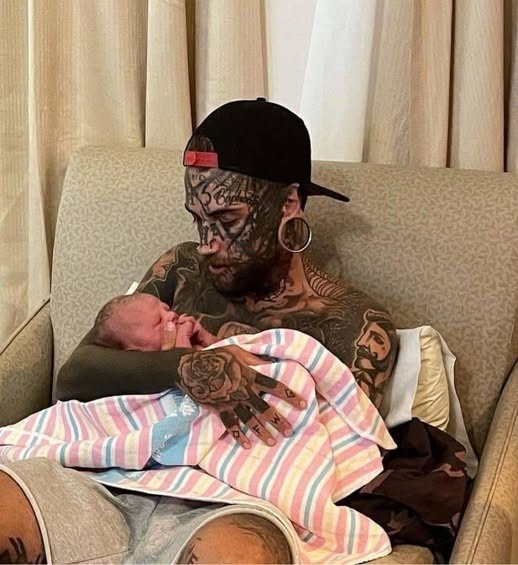
Scroll through Richard Huff’s family photos and the first thing strangers notice is the ink—black and gray sleeves that crawl up his neck, colorful portraits splashed across his calves, tally marks on his knuckles that add up to 240 separate tattoos. Comments fly fast: “He looks terrifying,” “Those kids must be embarrassed,” “Imagine THAT at parent-teacher night.” What the scrollers don’t see is the man underneath: the 51-year-old who still cries at every kindergarten graduation, who learned to braid his daughter’s hair by practicing on a stuffed unicorn, who coaches Little League even though his own dad never once showed up.
Richard started getting tattooed at twenty-nine, a small cross on his shoulder to mark the year he got sober. One design became ten, then fifty, until his body turned into a living journal—lyrics from songs that saved him, his kids’ footprints stamped over his ribs, a bright sunflower for his wife Marita because that’s what she drew on their first napkin note at a diner twenty years ago. The ink helped him own skin he once hated; it never occurred to him that strangers would mistake art for menace.
Marita admits she side-eyed him the first time they met. “He looked like the mug shots you see on the eleven-o’clock news,” she laughs now. But he held the door open for twenty straight minutes at a community-college night class, letting late students duck under his umbrella, and she saw the patience before she saw the pictures. They married, blended families, and built a house ruled by inside jokes and loud dance-offs in the kitchen. Richard’s tattoos became the wallpaper their kids grew up with—normal as cereal boxes, familiar as bedtime stories.
When trolls dig up his PTA photos and mock the “walking comic book” reading Dr. Seuss to first-graders, Richard’s oldest daughter fires back without hesitation: “My dad just has tattoos—yours just has a judgment problem.” She posts side-by-sides of Richard hugging teammates after losses, wiping tears from a boy who struck out, volunteering at every pancake breakfast. The evidence piles up faster than the hate.
Richard’s ink even turned into a parenting super-power. Kids on the playground used to stare; now they line up to find hidden images—Baby Yoda tucked behind a dragon, the tiny pizza slice on his ankle that means free extra cheese if you spot it. Teens in his youth group ask him to design tattoos that celebrate recovery milestones, and he refuses payment, telling them, “Your story already cost enough—let me help write the next chapter.”
He knows the stares won’t stop, but neither will he. Every new piece still has to earn its place: Does it honor something true? Does it teach the kids courage, humor, resilience? If the answer is yes, the needle buzzes again. Richard’s skin may be 85 percent covered, but the remaining bare patches remind him—and everyone else—that no one is ever completely finished. The story keeps growing, one drop of ink and one act of love at a time.