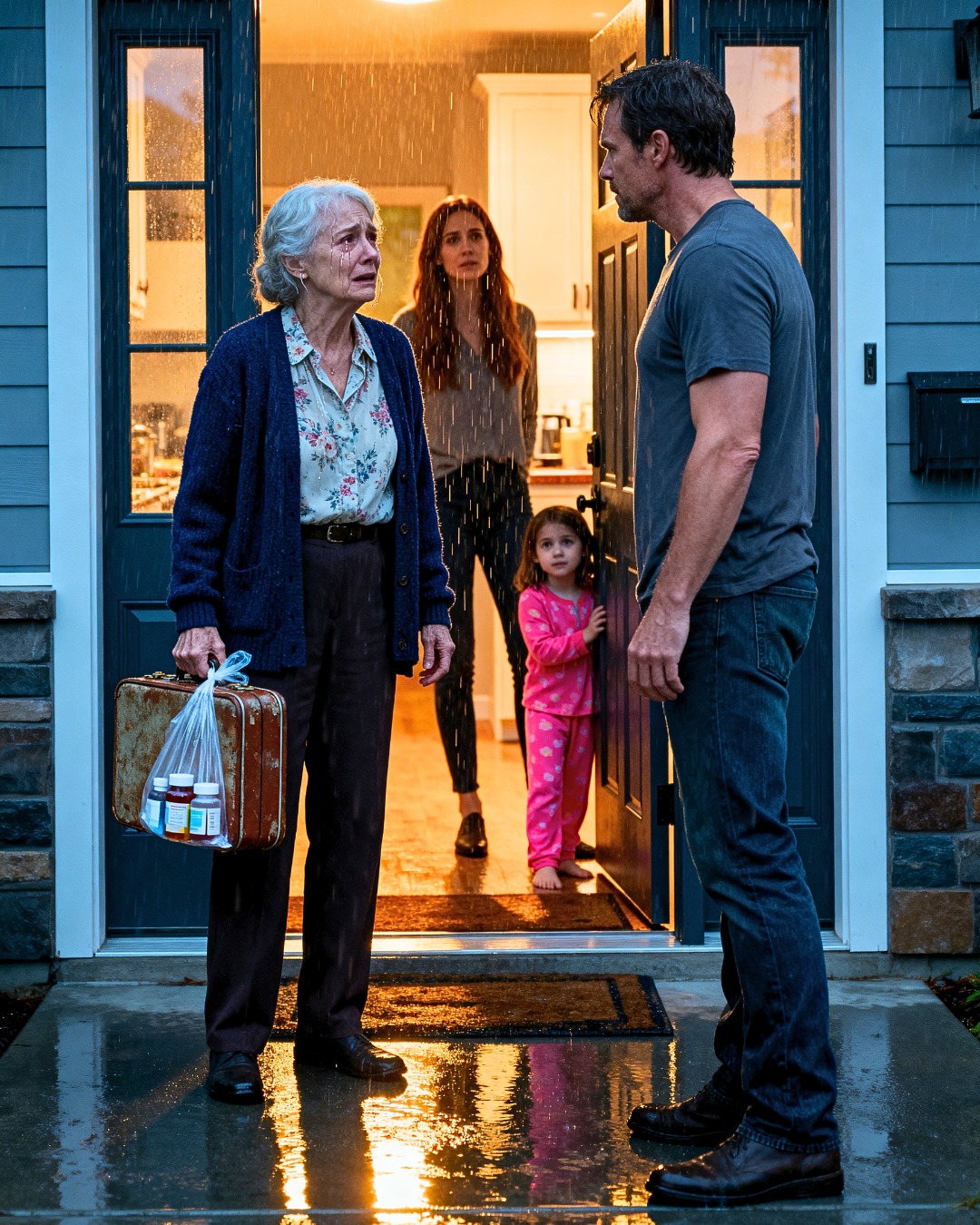
The night my son shut the door in my face, I was holding a small suitcase, a bag of medicine, pain climbing through my right hip, and a kind of shame so deep I thought for one terrible second it might split me open right there in his doorway, over the polished tile I had once helped pay for.
It had been raining since late afternoon, that cold, stubborn November drizzle that leaves San Antonio smelling like wet pavement, gasoline, and crushed leaves. The gated neighborhood where Daniel lived with his wife, Rebecca, looked spotless as always—trimmed shrubs, warm porch lights, oversized SUVs behind automatic gates, and that sterile kind of quiet people mistake for safety, as if money can keep sorrow away.
I arrived by taxi a little after eight. The doctor had told me clearly that I shouldn’t spend the next few days alone. I had slipped on the wet front steps of my apartment building, hit my hip hard, and while nothing was broken, the pain was sharp, the medication made me dizzy, and I had been warned not to go up and down stairs by myself while I recovered.
My building’s elevator only worked when it felt like it, and the neighbor who usually checked on me was out of town. I wasn’t going to pretend I was stronger than I was just to protect my pride.
I called Daniel before I left, but he never answered. I told myself that once he saw me there—my slow walk, my bare face, the pharmacy bag—any decent son would say, “Come in, Mom. Stay a few days.” I wasn’t asking for forever. I wasn’t moving in. I wasn’t trying to become a burden. Just one week. Seven nights. A little warm soup, a bed, and the reassurance that if the pain got worse, someone would hear me.
I rang the bell. They took their time.
When the door finally opened, Daniel stood there in a gray T-shirt and jeans, wearing that expression I knew too well from his younger years—the one he used whenever something irritated him and he didn’t even bother hiding it. Behind him, deeper inside the house, I saw Rebecca near the kitchen island with a glass of wine in her hand. She didn’t come forward.
She didn’t say hello. She didn’t invite me in. There was not a trace of surprise on her face, as if they had both already expected this moment: me showing up in need.
“Mom,” Daniel said, looking at my suitcase before my face. “What are you doing here?”
I still remember the low hum of the porch light, the rain slipping off my umbrella, the weight of the suitcase handle cutting into my fingers.
“I called you,” I said. “I fell today. The doctor said I shouldn’t stay by myself. I just need a week, honey. One week until the swelling goes down and I can move better.”
He let out a breath through his nose, not like a worried son, but like a man being inconvenienced.
He glanced back. Rebecca didn’t move. She only lifted her eyes over the rim of her glass. Then I saw my granddaughter, Emma, halfway down the stairs in pink pajamas, her hair messy, peeking through the banister. She had that open, trusting look children still have before life teaches them how often adults fail at the important moments.
“It’s not a good time,” Daniel said.
“I won’t be in the way,” I answered, feeling the ache in my hip sharpen the longer I stood there. “I can stay in the guest room. Just this week.”
That was when he said it. Not angrily. That would have been almost kinder. He said it in a dry, tired, almost administrative voice, as if he were rejecting a request on paper.
“We’re not a shelter, Mom. There’s no room here.”
I don’t remember breathing after that.
I know Emma stepped down one more stair. I know Rebecca set her wineglass on the counter. I know the taxi driver hadn’t fully left because I could still see red taillights glowing at the end of the street. But inside me, everything went still. As if those words had emptied me out and left only an echo banging around the inside of my skull.
We’re not a shelter.
There’s no room here.
I had given birth to that man. I had sold my own house years earlier to help him buy his. I had stayed up through the night with his sick children, washed sheets, made soup, lent money, signed papers, filled gaps, excused every little act of ingratitude that other people noticed and I refused to name.
Rain cooled my ankles.
“I understand,” I said.
Daniel didn’t touch me. Didn’t ask if he should call another cab. Didn’t offer me a glass of water while I figured out what to do. He just held the door with one hand, like he was afraid I might try to force my way inside.
And then something happened I will never forget.
Emma came down two more steps and said in her little voice, “Daddy, Grandma’s hurt.”
My son didn’t even look at her.
“Go upstairs, Emma.”
Rebecca finally spoke, but not to me.
“Do what your father said.”
No one helped me with the suitcase. No one said, “Let’s figure something out tomorrow.” No one did anything that looked remotely like kindness.
I raised my umbrella, turned with whatever dignity I could still gather, and walked slowly back to the curb. The pain in my hip hit so hard I had to bite down to keep from making a sound. When I finally lowered myself sideways into the taxi, I looked up once more.
The door was already closed.
He didn’t even wait to see me get in the car.
On the ride back to my apartment, the city passed in blurred, wet streaks behind the glass—lit pharmacies, taco trucks smoking at the curb, motorcycles cutting between cars, couples huddled under awnings, people carrying on with their night as though the world still made sense.
I sat there with my medicine bag on my lap and one thought sinking deeper with every red light: rejection from a stranger hurts, but rejection from your own child strips away every lie you’ve been telling yourself.
I reached my building at 9:15. The night guard helped me out of the cab. He asked if I was okay. I lied.
I made it upstairs, shut the apartment door, set the suitcase by the couch, turned on the kitchen light, and stood there looking at everything that hadn’t changed—the bowl of oranges, the clean coffee maker, the blue checked tablecloth, the clock ticking on the wall—while knowing that nothing would ever feel the same again.
I sat down with both hands on my knees and understood that there are moments in a woman’s life when something breaks so cleanly it cannot be mended.
That night I didn’t cry.
Maybe because the pain was too big to spill out.
Maybe because real humiliation freezes you first.
Or maybe because deep down I already knew that door had not truly closed that night.
It had been closing for years.
My name is Helen. I was sixty-three years old when my son denied me a roof for seven days. I taught English in public middle school for twenty-seven years in San Antonio. I was widowed at fifty-two. After retiring, I sold the house where I had raised Daniel, and with that money, along with my savings and a small inheritance from my sister Claire, I helped him buy the very house where they later told me there was no room for me.
That night, sitting in my kitchen with my hip throbbing and humiliation burning in my throat, I repeated those facts over and over to myself. Not because I needed convincing. Because for the first time, I was going to look at the whole truth without looking away.
For years I had believed that a mother’s love worked like something planted in good soil: sooner or later, it came back in another form. Not as repayment. I was never the kind of woman who kept score. But I believed loyalty given to a child would return somehow—in respect, in tenderness, in a chair pulled to the table, in the certainty that if you ever fell, he would reach for you without hesitation.
I poured everything into Daniel. My best years. My best savings. My most patient love. Even when he was young and already had the habit of accepting help as if comfort were his birthright, I always defended him. He was young. He was under pressure. He would grow up. Men matured later. Mothers like me know how to make excuses sound like faith.
After his father, Thomas, died of a heart attack eleven years earlier, Daniel cried hard at the funeral, but not for long. Within months he was asking for help with bills, debt, and a “promising business opportunity.” I had barely buried the man I had spent thirty-one years with, yet I did what so many women of my generation were taught to do: swallow grief and remain useful.
He married Rebecca four years after his father died. At first she seemed polished, intelligent, pleasant. She called me “Mom,” brought pastries when I visited, asked for recipes, asked about my students, listened to family stories. I thought I had been lucky.
When their son Noah was born, I stayed three nights in a row so they could sleep. I bathed the baby, washed bottles, cooked soup, unpacked baby clothes, got up at four in the morning to rock a child that wasn’t mine because that is what mothers do when they see their sons exhausted and their daughters-in-law overwhelmed. When Emma was born, I did even more. I stayed two weeks because Rebecca developed an infection and Daniel “couldn’t miss work.”
I never charged them.
Never counted.
Never asked for anything.
Then came the house.
I had owned a modest home in the neighborhood where Daniel grew up, a house with high ceilings, a small yard, and flowers climbing the fence. I had built my life there with Thomas. Daniel learned to walk there. After I was widowed, I learned to sleep alone there. When I retired, the house felt too large, too heavy. Selling it seemed practical. Part of the money would secure my own future. Another part, I thought, would help Daniel “take the next step.”
The day I transferred the money for the down payment on their house in Cedar Park, he hugged me and Rebecca cried. They said I was “building the family’s future.” They said the children would have a yard, a better school, more security. I gave them a large amount and asked for nothing in writing. No deed. No contract. No repayment terms. I trusted my son.
That was my first real mistake—not giving him the money, but confusing love with safety.
The early years in that house looked good from the outside. I visited every couple of months, stayed in the guest room, cooked on Sundays, helped Emma read, drove Noah to practice. Daniel talked proudly about his logistics business. Rebecca smiled and poured wine as if everything in that home rested on solid ground.
But the signs had always been there.
First, there was the guest room. One day I arrived and found a new lock on it. Rebecca explained they sometimes used it as an office and needed privacy. It sounded reasonable. I accepted it.
Then there was the way she spoke to me at the table. Never openly rude. That would have been easier to name. It was something colder: careful impatience. A smiling correction in front of the children. “Helen, we do things differently now.” “Helen, Emma’s at a different stage.” “Thanks, Helen, but we have our own traditions.”
For eleven years she had called me “Mom.” Then, slowly, she shifted to Helen, with the delicate cruelty of someone who knows that a small change can say more than an insult.
Daniel said nothing.
That was always what hurt most—not her character, but his silence. He sat at the head of the table in a house I had helped make possible and watched my place there grow colder without lifting a finger.
Of course I told myself I was imagining it. Families go through phases. Modern life is stressful. Daughters-in-law do not owe you maternal warmth. The important thing was the children. Blood would sort itself out.
Useful lies. Common lies. The kind women like me tell ourselves so we can keep giving without naming what it costs.
The fall and the injury only pushed over what had been wobbling for years.
That same night, unable to sleep, I got up before dawn, made coffee, and sat at the kitchen table with a beautiful hardbound notebook my oldest friend, Susan, had once given me. I had always thought it was too pretty to waste. That morning it stopped being pretty and became a tool.
On the first page, I wrote in large letters:
What have I given Daniel?
What is still in my name?
What can I close?
What needs to be documented?
It was not a tantrum. It was clarity.
As daylight came in, I began listing everything: help with tuition, emergency transfers when his business was starting, the car loan I cosigned after he got married, Noah’s medical bills before insurance reimbursed them, Christmas gifts, computers, school uniforms, vacations because “the kids deserve experiences,” the weeks I lived at their house when Rebecca got sick, the repairs I postponed in my own apartment so I could cover their problems.
And then there was the credit line.
Years earlier, when Daniel’s business was just getting started, he asked me to open a line of credit in my name because his company financing was delayed and he needed short-term operating money. He promised it was temporary. As soon as the business loan came through, he said, everything would be transferred over and my name would disappear. I agreed. He was my son. Who imagines that “a few months” will quietly become seven years tied to your credit history?
I pulled out my financial files and found the paperwork. I have always been careful with money. Maybe because I watched my own father lose land by not reading the fine print. Maybe because I spent three decades stretching a teacher’s paycheck. Whatever the reason, my papers were in order, and that saved me.
There it was in black and white: the business credit line.
Primary holder: Helen.
Responsible party: Helen.
Risk: Helen.
The available balance was far lower than I remembered. Large recent withdrawals. Too large. Too fast. Very little explanation.
That cold understanding came over me then—not fear, but recognition. While I believed I was temporarily helping my son, he had quietly built part of his company on top of my name. My support had stopped being help. It had become structure.
I called my attorney, Laura, that morning. I told her everything—from the fall to the closed door, from the down payment on the house to the business credit still tied to my name.
She asked me three questions: Did Daniel have any formal right to that account? Was I still the primary account holder? Had I ever signed anything authorizing this arrangement indefinitely?
No.
Yes.
No.
“Then you can close it,” she said.
The simplicity of her voice gave me peace.
The next day I went to the bank. My hip still hurt, but I went. The account manager confirmed what Laura had told me. I signed the papers with a steadiness that surprised even me. I left clear instructions: do not reopen it, do not negotiate with me by phone, do not redirect anything. Close it.
The explosion came quickly.
A few days later Emma called me on video, asking in a small nervous voice, “Grandma, did you do something at the bank?” When I gently asked why, she told me her father had been yelling, using my name, and her mother had said I was trying to ruin them.
Ruin them.
After we hung up, I opened a document on my computer and began recording everything—dates, times, phone calls, exact words. Women like me often learn too late that memory alone is not enough when you finally stop absorbing injustice. Memory gets questioned. Paper doesn’t.
Daniel showed up at my apartment that Saturday morning. He looked tired, angry, electric with the energy of a man used to pushing until things return to his advantage.
“You closed the account,” he said.
“Yes.”
“Do you have any idea what damage you caused?”
“I know what I did for myself,” I told him. “And what I should have done years ago.”
He said it was because I was angry about the phone call. I said no. It was because I had carried a financial burden for seven years that he had promised would be temporary, and because the person I had helped refused me a bed for one week when I was hurt.
Then he threatened what I already feared.
“If this gets ugly,” he said, “maybe it’s better you don’t see the kids for a while either. This tension isn’t good for them.”
I went cold inside. Every mother knows the exact moment a child tries to use the deepest wound as leverage.
I showed him the folder on my desk. Statements, transfers, messages, dates, amounts, notes from every conversation since the night he shut the door on me. I told him I had already spoken to a lawyer.
He left without saying goodbye.
After that, Rebecca called several times. Sweet messages first. Then angry ones. I kept them all. Transcribed them all. Then I gave myself three quiet days—no answering, no explaining. I took my medicine, rested, watched old movies, talked to Susan, and let the truth settle.
A week later, Rebecca mailed me a card inviting me to lunch. “The kids miss you,” she wrote. “Maybe we can start fresh.” Women like Rebecca do not write things like that out of tenderness. They write them after calculating that sweetness may open a door arrogance could not.
I did not answer.
Instead, I had my nephew, Michael, an accountant, review everything: my contributions to the house, the business, all of it. He confirmed what I already knew. I had no legal claim to the house, but there was a long and unmistakable pattern of financial dependence and abuse of trust.
Soon Daniel and Rebecca came together, carrying takeout from my favorite Italian place and pretending this was about family healing. After ten minutes of polite talk, the truth surfaced.
They wanted me to open another temporary account.
Not money, they insisted. Just my name. Just my credit. Just a bridge for a few months.
Again.
I looked at Daniel and asked, “Do you have anything to say to me that is not a request?”
That was the heart of it. Every warm gesture, every mention of the children, every soft word from Rebecca led back to the same place: they still believed my love should function as an endless insurance policy.
I told them no. Clearly. Finally. Completely.
Later, while reviewing old emails, I found the message Daniel had sent years earlier when I first agreed to open the credit line: “Mom, this is completely temporary. As soon as the loan goes through, we’ll transfer the account into the company’s name. Six months max, I promise.”
Six months.
Not seven years.
My attorney sent a formal letter. Not emotional. Not dramatic. Just facts: the promised temporary nature of the arrangement, the prolonged use of my credit, my full right to close it, and my refusal ever again to tie my name or assets to their financial life.
From there, things began to shift. His business did not collapse overnight, but it staggered. Loans were denied. Costs tightened. Suppliers pressed harder. The hidden beam had been removed, and they were finally forced to feel the true weight of the roof they had been standing under for years.
I did not celebrate.
But I no longer blamed myself either.
That was the lesson many women learn far too late: another person’s suffering is not always something you caused. Sometimes it is simply the invoice for choices they made while assuming you would keep cushioning the fall.
In time, I wrote Daniel one final email. I told him I would not pursue legal action over the account as long as I continued to have steady access to my grandchildren. Three days later he replied: “That’s fine. The kids can call you and we’ll work out visits.”
No apology. No warmth. But enough.
Slowly, Emma and Noah returned to me through Sunday calls, short visits, ordinary afternoons. I moved into a newer apartment with a reliable elevator and painted the kitchen a soft yellow. I bought lighter curtains. I gave away old clothes. I rearranged my life around my own comfort for the first time in decades.
I was not becoming harder. I was becoming mine.
Daniel and I kept a minimal, careful relationship. We never spoke directly about the night at the door. Some apologies never come because they would require the other person to see themselves too clearly.
Still, nearly a year later, at Emma’s birthday party, he stood beside me in the yard and said quietly, without looking at me, “I shouldn’t have spoken to you like I did that day.”
It was not a full apology. But for a man like Daniel, it was the closest I would ever get.
“No,” I said. “You shouldn’t have.”
And that was enough.
Because peace does not always arrive when the other person fully repairs what they broke. Sometimes it arrives when you stop needing them to.
The real ending of this story was never the bank account. It was the day I stopped confusing myself with an endless source.
For decades I believed love meant enduring, forgiving too soon, understanding everything, bending so the family table would not break. But generosity without limits is not love. It is an invitation to abuse dressed up in politeness. Some people—even your own children—will take and take until they convince themselves what you give belongs to them. And the day you refuse, they do not see you as tired or hurt. They see you as disloyal to the role they assigned you.
It took me sixty-three years to step out of that role.
I did not get the money back.
I did not get my innocence back.
I did not get back the years I spent shrinking myself so others would stay comfortable.
But I gained something better.
I gained the right to look at my son without lying to myself.
I gained the right to sit at my own table without fear.
I gained the right to grow old without financing someone else’s ease.
And most of all, I gained a new way of loving my grandchildren—not from silent humiliation, but from dignity.
Today I still live in that yellow kitchen apartment. I still read at night. I still write. I still talk to Emma every Sunday and to Noah whenever he feels like calling, which at his age is already a respectable kind of love. Daniel will never be the son I imagined when I first held him in my arms. But I no longer need him to be in order to know exactly who I am.
And at my age, that is worth more than any late apology.