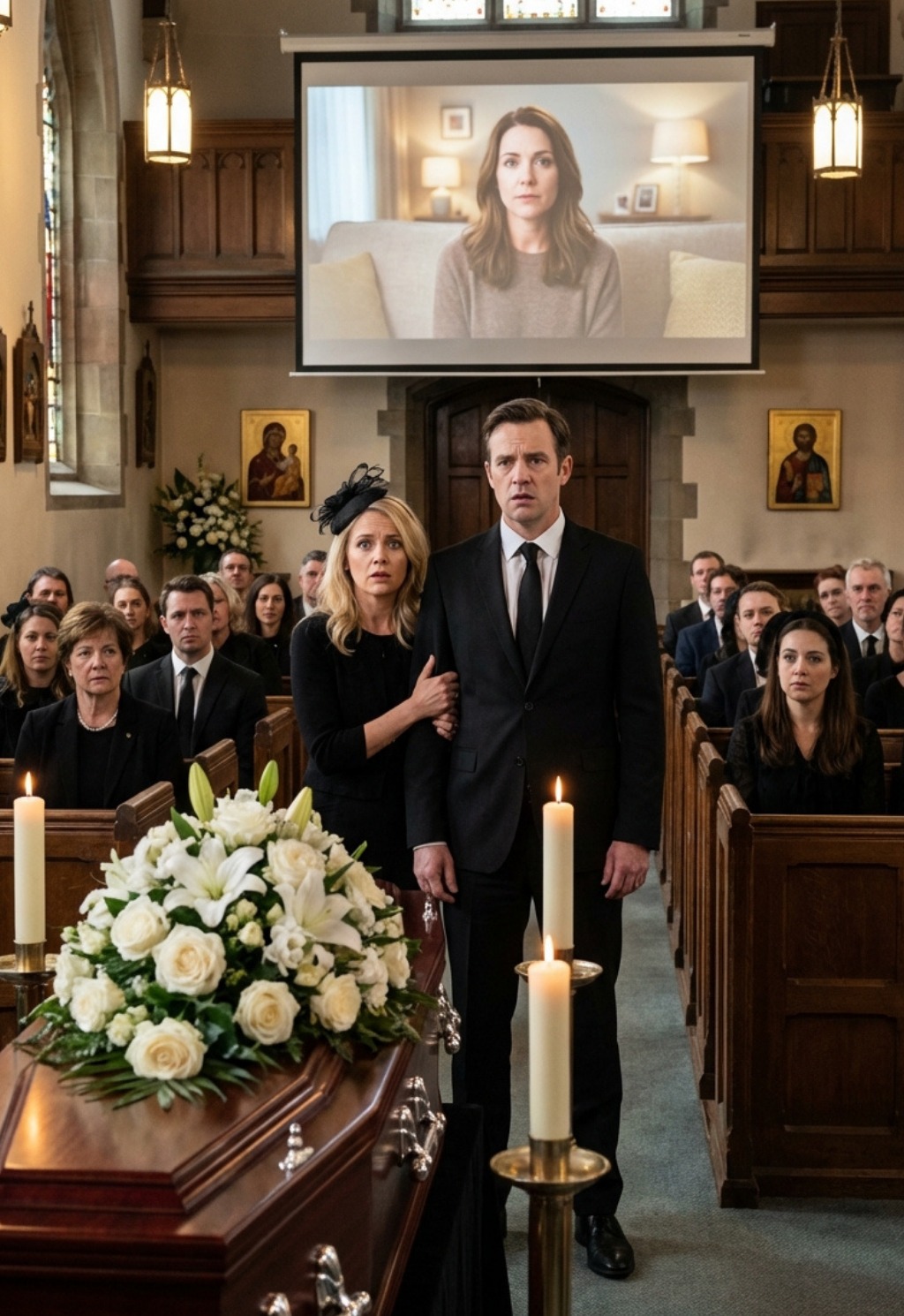
On the morning of Mirabelle Thorne’s funeral, Harrison arrived twelve minutes late with Felicity Moore on his arm, and the delay was a calculated choice. He understood exactly how rooms functioned and he knew the heavy weight of a dramatic entrance.
At Holy Trinity Church, the place Mirabelle had attended since she was a child, every head turned as he stepped into the center aisle beside a woman no one recognized but everyone understood. Felicity wore a fitted black dress and a strand of pearls with an expression so carefully arranged it looked borrowed.
Harrison kept one hand over hers as if he were the grieving husband and she were the supportive friend. Several people in the front pews flinched at the sight, and Mirabelle’s sister closed her eyes in pain.
The organist missed a note as the tension filled the air. The church itself looked exactly the way Mirabelle would have chosen, decorated with cream roses instead of red and eucalyptus woven through the white candle arrangements.
There were no gaudy ribbons or oversized portraits near the altar. The polished casket at the front remained closed because Mirabelle had always hated spectacle.
Even in death, she had arranged the room with quiet restraint. However, restraint was the last thing Harrison brought with him that morning.
He paused halfway down the aisle to acknowledge sympathetic nods as if they belonged to him. For one reckless second, he almost smiled because he believed he had survived the worst of the ordeal.
He thought all that remained was the paperwork, the condolences, and whatever money Mirabelle had left behind. Most people in the church knew Mirabelle as the gentle primary school teacher who carried stickers in her purse.
They knew she remembered every child’s birthday and sold printable lesson plans online under a cheerful brand she rarely discussed. They remembered how she sent soup to the sick and wrote thank-you notes in blue ink.
Mirabelle’s life looked small from a distance, and Harrison had spent twelve years encouraging everyone to view it that way. He introduced her as sweet and simple, which were his favorite words for her.
“She’s just a simple soul,” he would often say to his colleagues. It made his interruptions sound natural and his constant corrections seem almost loving.
Inside the walls of their house in Silver Oaks, the language was much less polished. Harrison told Mirabelle she was lucky he had chosen her from the start.
He called her timid when she disagreed and dramatic whenever she cried. He mocked her sweaters, her caution, and her insistence on saving every penny.
“How is your little hobby going?” he asked whenever she stayed up late working on her online shop. When her monthly income quietly climbed past his expectations, he told her not to get any grand ideas.
Mirabelle learned to stop defending herself out loud, which Harrison mistook for total surrender. In truth, the silence gave her the necessary room to observe him.
She began building her business on a folding desk in the guest room long after Harrison had gone to bed. At first, it was just the printable materials and craft templates everyone assumed it was.
Then she started filming short lessons and licensing them to homeschooling platforms. She eventually hired a staff of former teachers and a programmer who turned her content into a searchable district-wide platform.
The company, Golden Lantern Education, grew in private because Mirabelle knew what Harrison’s attention would do to it. The less he understood about her success, the safer her work felt.
By the time she signed a national distribution agreement, Harrison was too busy feeding a gambling addiction to notice her scale. It started with sports books and hardened into a desperate need for fast cash.
He moved from card rooms to secret loans and missing transfers inside the logistics firm he managed. He forged vendor invoices to cover his shortfalls and shifted the blame to delayed clients.
He carried two phones and became sharper and meaner at home. Mirabelle noticed the perfume on his jackets and the hotel charges he explained away far too quickly.
She found the proof of his affair on a Tuesday in October when Harrison became careless. He left his second phone in the kitchen while he went to take a shower.
The screen lit up on its own, showing a message from Felicity Moore. “I’m tired of hiding,” the text read, “when will you finally be free?”
Below that message was a photo that turned Mirabelle cold. “Once the policy clears, we can stop pretending,” Harrison had replied.
Mirabelle stood in the kitchen until the shower shut off and she understood with total clarity that Harrison had moved past betrayal. She realized he was now planning her end.
By then, she had already been feeling sick for several months. The symptoms came in waves of nausea, trembling hands, and dizzy spells so sharp she had to grip the counters.
Doctors suggested stress or hormonal changes, but Mirabelle followed every instruction and still got worse. Harrison became theatrically attentive in public, driving her to every appointment.
“I’m just terrified of losing her,” he told their neighbors while refilling her water glass. In private, his care had a strange and chilling choreography.
He insisted on preparing her evening tea every single night. He bought her expensive supplements and reorganized her pill case, telling her she was too exhausted to manage the details.
Mirabelle accepted the help until she realized her worst episodes always followed the things only Harrison handled. The realization arrived not as panic, but as a visible pattern.
She began keeping notes in a hidden spreadsheet titled “Curriculum Drafts.” She tracked the time of day, what she ate, and which capsules came from which bottles.
Over three weeks, the pattern became impossible to ignore. On the nights Harrison was away, her symptoms eased significantly.
The mornings after he set out her supplements, the dizziness roared back. Mirabelle took one of the capsules to her friend Dr. Sheila Vance, a physician who had known her for years.
Sheila sent it for independent testing under a different name to maintain privacy. When the results came back with traces of a toxic compound, Sheila looked at Mirabelle with a grim expression.
“Mirabelle, do you know what this is?” Sheila asked quietly across her office desk. Mirabelle answered by crying once and then asking for the name of a formidable attorney.
Mallory Park met Mirabelle in a quiet cafe three towns over. She listened for an hour without interrupting before asking what outcome Mirabelle wanted.
“I want the truth placed somewhere he cannot twist it,” Mirabelle said while holding her cold tea. She wanted every hidden thing in Harrison’s life to meet the daylight at the exact same time.
She wanted him deprived of the one story he always sold, which was that he was the strong and capable one. Mallory didn’t smile, but her gaze sharpened with professional interest.
“If you are patient, we can build something he can’t escape,” Mallory promised. Patience had always been Mirabelle’s most underestimated talent.
While Mallory drew up new estate papers, Mirabelle hired a private investigator named Silas Thorne and a forensic accountant. Silas documented the affair and photographed Harrison meeting Felicity at private clubs.
The accountant traced false invoices from Harrison’s company to shell entities tied to his gambling losses. Naomi had guessed he was stealing, but she had not known how recklessly.
As they collected evidence, Mirabelle’s health worsened quickly. Her latest medical results showed organ damage consistent with prolonged exposure to the toxin.
At the same time, Golden Lantern Education crossed a line she had once thought impossible. A major tech firm offered to buy a controlling stake in her company for a massive sum.
After taxes, her share of the deal was worth just over fifty million dollars. Mallory structured the proceeds so the money flowed into an irrevocable trust before Harrison suspected a thing.
The trust would fund scholarships for teachers and grants for underserved classrooms. A portion went directly to her sister, Tessa, and to Dr. Sheila Vance.
Harrison would receive absolutely nothing from the company or the insurance policy. Mirabelle changed every beneficiary with Mallory and two witnesses present.
Then she transferred the deed of their house into the Mirabelle Thorne Educational Trust. The property would be converted into a community center for children after her death.
Harrison would not only fail to inherit the home, but he would watch it become something she chose. Mallory also prepared sealed packets for the district attorney and Harrison’s business partners.
“If I don’t make it, send these out immediately,” Mirabelle instructed her lawyer. She read every page before signing her name for the final time.
Her health failed too quickly after that, and Sheila pushed for hospitalization. Mirabelle agreed, but she kept working even during her worst days in the hospital bed.
She recorded videos for her staff and wrote letters to her former students. She gave the funeral director an envelope and asked the pastor, Reverend Miller, to honor the instructions inside.
“I promise you, Mirabelle, we will do exactly as you asked,” Reverend Miller said. He looked rattled by her firmness, but he gave her his word.
She spoke to her sister Tessa about the whole truth only two weeks before she died. They sat by the window while the rain tapped against the glass of the room.
Tessa wept through the details of the poisoning and the secret fortune. “Promise me he won’t walk away rich,” Mirabelle whispered to her sister.
Tessa took her hand and promised that his secrets would come to light. Mirabelle died three mornings later with Tessa and Sheila on either side of her bed.
Harrison performed his grief loudly for his audience of friends and colleagues. He told everyone she had fought so hard and he didn’t know how he would go on without her.
He affected a weary resignation when Mallory Park contacted him about estate documents. He never asked a single question about Golden Lantern Education because he assumed it was worthless.
His arrogance was so complete that he brought Felicity to the funeral despite being warned against it. “People will judge for a day and move on,” he told Felicity in the car.
That confidence lasted until Reverend Miller finished the opening prayer and a screen descended beside the altar. Harrison straightened in his pew with mild annoyance as the projector lit up.
Mirabelle’s face appeared on the screen, looking thinner but with steady, piercing eyes. The room went utterly still as she began to speak.
She thanked her friends and teachers for their kindness over the years. Then she turned her eyes directly toward the camera and addressed her husband.
“Harrison,” she said, “if this is playing, you are sitting there pretending you didn’t know I was in danger.” A murmur rolled through the church as Felicity’s fingers slid off Harrison’s sleeve.
Mirabelle explained the sale of her company and revealed her fifty million dollar net worth. Gasps moved through the pews like wind through dry leaves.
“You are not a beneficiary of any trust, account, or insurance policy,” Mirabelle stated firmly. She then revealed the photos of Harrison and Felicity at the boutique hotel.
Felicity stared at the floor while Harrison rose halfway from his seat in shock. Reverend Miller stepped into the aisle and said, “Not today, Harrison. Sit down.”
Mirabelle continued by explaining that his business partners were receiving evidence of his fraud at that very moment. She revealed that the bank had been instructed to freeze all their joint funds.
Then she spoke the words that changed the air in the room to pure terror. She revealed the toxicology findings and the evidence of his deliberate poisoning.
“Detectives are present in this church to act on warrants obtained this morning,” she concluded. Two plainclothes officers rose from a pew near the back of the room.
Harrison tried to say this was insane, but the first detective had already reached him. The second spoke to Felicity and told her to remain in her seat.
The arrest lasted less than a minute as the handcuffs gleamed in the church light. Tessa watched from the front row with her chin lifted and tears running down her face.
At the station, Harrison insisted the supplements were meant to help his wife. He claimed the financial discrepancies were simple bookkeeping mistakes.
Then investigators showed him the security footage from the hidden birdhouse camera in the hallway. It showed him tampering with her pill organizer on six different occasions.
They had his purchase records for the toxins and his text messages to Felicity. “Is she gone yet?” one of the messages read.
Felicity cooperated with the police to avoid a homicide charge herself. She testified that Harrison told her Mirabelle was already dying and he was just speeding it up.
The trial lasted three weeks and filled the county courthouse every single day. Reporters focused on the secret fortune, but the jury focused on the chilling evidence of control.
Mirabelle’s recorded statement played on the monitor while Harrison stared at the table. “I no longer wanted apologies,” she said in the video, “I wanted a system of truth.”
When the prosecution played the clip of him tampering with the pills, a juror pressed a hand against her mouth. Harrison insisted on testifying in his own defense despite his lawyer’s warnings.
He called Mirabelle unstable and suggested the money had made her paranoid. Under cross-examination, the prosecutor dismantled every lie using the documents Mirabelle had saved.
The jury convicted him of murder, insurance fraud, and embezzlement. He was sentenced to life in prison without the possibility of parole.
The judge remarked that the most chilling part was Harrison’s certainty that Mirabelle would remain unheard. He entered prison furious and completely bankrupt.
His partners rebuilt the firm without him and his properties were seized to pay his debts. Felicity received a reduced sentence and disappeared from town shortly after.
Within fourteen months, the Mirabelle Thorne Foundation opened its first grant cycle. Public school teachers received stipends and rural libraries got new technology.
The old house reopened as “Lantern House,” a community center with art studios and tutoring rooms. The kitchen where Harrison had once stood in the dark became a place for volunteers to pack food for kids.
On opening day, Tessa watched children race through the doors with their sketchbooks. Reverend Miller blessed the building and said Mirabelle had proven that gentleness is a form of power.
One former student remembered how Mirabelle said small things could change the shape of a life. Everyone in the room finally understood the fuller meaning of those words.
Tessa went to the empty church one evening after the final legal paperwork was finished. She sat where she had sat on the day of the arrest and felt a sense of peace.
Mirabelle had not been able to save herself, but she had protected her legacy. She refused to let the man who diminished her write the final chapter of her story.
Children at Lantern House now sit beneath a photograph of a woman in a blue cardigan. They don’t know the scandal, but they know the kindness her name represents.
In the end, Harrison did not lose his life because of a funeral video. He lost it because he mistook Mirabelle’s quiet nature for emptiness.
Mirabelle Thorne was never the woman in the shadow. She was the architect of the entire room, and the ending belonged entirely to her.