At my son’s wedding, his future mother-in-law leaned toward her sister and said, in a voice so polished it almost hid the poison, “That’s not a mother. That’s a mistake in a dress.”
Her daughter laughed. It was not a nervous laugh or the kind people use when they want to smooth over an awkward moment.
No, Brianna threw her head back and clapped twice, sharp and delighted, like a seal at feeding time. And then my son heard them.
You could actually see the moment it happened. Hudson had been standing near the front of the terrace, his face pale with the ordinary nerves of a groom about to change his life.
Then something in him went very still as his shoulders straightened and his mouth hardened. The softness that love had kept in his eyes for the past months vanished so quickly it felt like watching a candle blow out in a room full of people.
That was the exact moment the wedding died. The funny thing is, six months earlier I had been worrying about flower bulbs.
I was in my kitchen in Des Moines, Iowa, with a seed catalog spread beside my coffee cup. I was trying to decide whether I’d crowded the tulip bulbs too close to the daffodils before the first freeze.
At sixty-two, I had become very good at quiet. I had quiet clothes, a quiet car, a quiet house, and especially quiet money.
To the people of Des Moines, I was Diane Sheffield, a respectable widow and mother of one who drove a sensible sedan. Most people assumed I lived on a modest pension and old habits of thrift, but they were very wrong.
I had learned long ago that being underestimated is one of the great hidden luxuries of middle age. Strangers explain the world to you in small, careful words, while you are free to see them clearly because they never think to watch themselves around you.
Then Hudson called me. “Mom,” he said, and I could hear the smile in his voice before he said another word, “I want you to meet someone.”
Hudson was thirty-two that year, a smart and kind man who was often disastrously sincere in matters of the heart. “Her name is Brianna,” he said, and the long pause that followed told me he was serious.
“Bring her to dinner,” I replied. The first time I met Brianna DeWitt, she spent twelve full minutes photographing her appetizer.
We were at a little Italian place downtown, and Hudson looked so proud of her that I tried very hard to be generous. She was objectively beautiful, polished in the way wealthy young women often are, as though they’ve been professionally lit since birth.
While Hudson talked happily about work, Brianna asked me questions with a smile so sweet I nearly missed the blade hidden inside it. “Do you still live in that old family home all by yourself?” she asked.
“Yes, I do,” I answered. She sprinkled parmesan over her lettuce and asked, “And have you thought about what you’ll do eventually for medical things or support? My mother is obsessed with making sure everyone has a plan.”
I looked at Hudson, wondering if he heard the architecture beneath her words, but he only heard the surface. “I do have a plan,” I said firmly.
“That’s smart,” Brianna replied, nodding as if I were a child who had successfully tied my own shoes. “So many women of your generation leave all that to chance.”
I smiled and told her, “I’ve never been much for chance.” Hudson laughed because he thought I was making a joke, and Brianna smiled back, satisfied with herself.
When the bill came, Hudson reached for it and Brianna didn’t even perform the little dance of offering to pay. She just leaned back and said, “You’re so traditional, Daddy will love that.”
A woman who says “Daddy” at thirty-two in a cashmere sweater has usually been taught that money is a language she is expected to speak fluently. After dinner, Hudson hugged me in the parking lot and asked, “Well, what do you think?”
“She’s very polished,” I said. He laughed and told me that was one word for it, so I let it pass because you do not swat at your child’s joy unless you are certain it is fire.
The second time I met Brianna, she brought her mother, Meredith DeWitt. Hudson called three days beforehand and said, “Meredith is very involved, Mom, so they want to stop by on Sunday.”
When Meredith arrived, she looked around my house with the expression of a woman touring a museum of lower expectations. She was dressed in shades of winter white that would have been suicidal in any practical household.
“Diane,” Meredith said, taking both my hands, “what a treat. Brianna has told me so much.” I doubted that very much as she settled into my husband’s old recliner without asking.
“This is charming,” she said, scanning the room. “So cozy.” I knew that “cozy” is what wealthy women call houses too modest to impress them but too clean to criticize.
Brianna drifted toward my kitchen and opened cabinets with false casualness. “I love how authentic everything feels here,” she said, “it’s almost nostalgic.”
Meredith gave me a practiced smile and said, “We’re just thrilled Hudson has found someone who understands family support systems.” She glanced around the room and added, “Of course, every family contributes differently.”
“Differently how?” I asked. Meredith waved a manicured hand and said, “Some families contribute financially, while some just offer encouragement and warmth.”
Hudson missed the insult entirely because he was in love. After they left, he lingered on my porch and said, “I know they can come on a little strong, but Brianna makes me happy.”
I touched his cheek and told him I was glad, but what Hudson didn’t know was that I had spent twelve years building a second life. When my husband passed away, I refused to be a widow that people called “brave” while they removed my power.
My husband had left me a paid-off house, a life insurance policy, and his financial adviser, Frank Wu. Frank was a clever man who taught me to read what he read so my money could work hard.
Over the years, we started with index funds and moved to commercial real estate. By year twelve, my modest life was a disguise so complete that women at church recommended coupon apps to me.
When Hudson told me he was engaged, I congratulated him, even though he said the DeWitts wanted to host the wedding at their estate in June. Brianna called me and said, “We’ll take care of the major things, Mrs. Sheffield, so please don’t worry about expectations.”
The implication was obvious: they would fund the spectacle, and my family would bring sentiment and folding chairs. I sat down in my kitchen and laughed once, sharply, because it was not a happy sound.
Three weeks later, I was in Frank Wu’s office and saw that my net worth was just over three point eight million dollars. “Frank,” I said, “how quickly could I move half a million without attracting unnecessary attention?”
He went still and asked what I was planning. I told him it was a wedding gift, an insurance policy against humiliation and control.
I began researching the DeWitt family and found that Meredith’s husband, Harrison, had two dealerships that were heavily leveraged. His restaurants were vanity projects with uneven books, and his estate was mortgaged far deeper than it should have been.
They were house-rich but cash-hungry, which meant every sneer from Meredith was just fear in better tailoring. Then Hudson called to say Harrison offered him a job as a sales manager.
“Brianna thinks it’s the perfect chance to become part of the family business,” Hudson said. I knew this was the kind of offer a man makes when he wants gratitude before obedience.
I called my lawyer, Chloe Vance, and told her I wanted to set up a holding company called Sheffield Investment Properties. I began acquiring interests in developments that Harrison DeWitt needed, specifically a shopping center called Oak Ridge.
By April, I knew that if Harrison kept assuming he was the only adult in the room, he was going to lose more than his dignity. In May, I went to the DeWitt estate for a “proper” family dinner.
The house had white columns and windows so tall they seemed to exist to reflect the family’s opinion of itself. Dinner was served in a room big enough to intimidate poultry, and Harrison spent the night performing his success.
“The secret, Diane,” Harrison said, “is understanding that money should work harder than you do.” I took a sip of wine as Meredith added that they wouldn’t dream of putting financial pressure on my side of the family.
“We know these things are awkward when families have different capacities,” Meredith said. I let the silence sit, and Harrison misread it as my embarrassment.
Brianna suggested that I might enjoy joining them on family trips to Aspen or Europe. “It would be nice for you to see more of the world,” she said with a sincerity that felt like charity.
I asked if I could contribute to the rehearsal dinner or the flowers, but they shot down every offer. “Our vendors are fairly specialized,” Harrison said, implying they were beyond my experience.
That was the second I decided to stop being merciful. I saw what their assumptions were doing to Hudson, who sat there smiling too hard while he was being managed.
The weeks before the wedding passed in silk and insult. Brianna called often to ask if my family understood valet parking or if I wanted “something simpler” than a corsage.
Hudson grew thinner and told me he felt like every choice he made had already been scored. “Pay attention to how people make you feel when you disappoint them,” I told him, “that tells you who they are.”
I met with Chloe Vance one last time to finalize the documents for Sheffield Investment Properties. “You still think the wedding happens?” she asked.
“I think Brianna loves the wedding more than the marriage,” I replied. The rehearsal dinner was at a country club where the air always smells like polish and old men’s confidence.
Meredith asked if I had thought about moving into a “tasteful community” for seniors. “Home ownership becomes a burden at your stage, Diane,” Harrison added.
Brianna leaned in and said she wanted her future children to have grandparents who can “contribute in the right way.” I went home and looked at my steady eyes in the mirror, knowing I had the authority they could never manufacture.
The morning of the wedding was beautiful, and the DeWitt estate was buzzing with florists and rental crews. I arrived early with a five-thousand-dollar check in my purse and a leather portfolio in my trunk.
Meredith intercepted me and said, “How wonderful you’re early, I wanted your side to feel included.” I set my card on the table and went to find Hudson.
He looked handsome in his tuxedo but told me he felt like a mannequin with legal obligations. “You belong anywhere you can stand upright without apologizing for where you came from,” I told him.
By three-thirty, the terrace was full of city society. I took my place in the front row, looking exactly like what Meredith thought a “mistake in a dress” should look like.
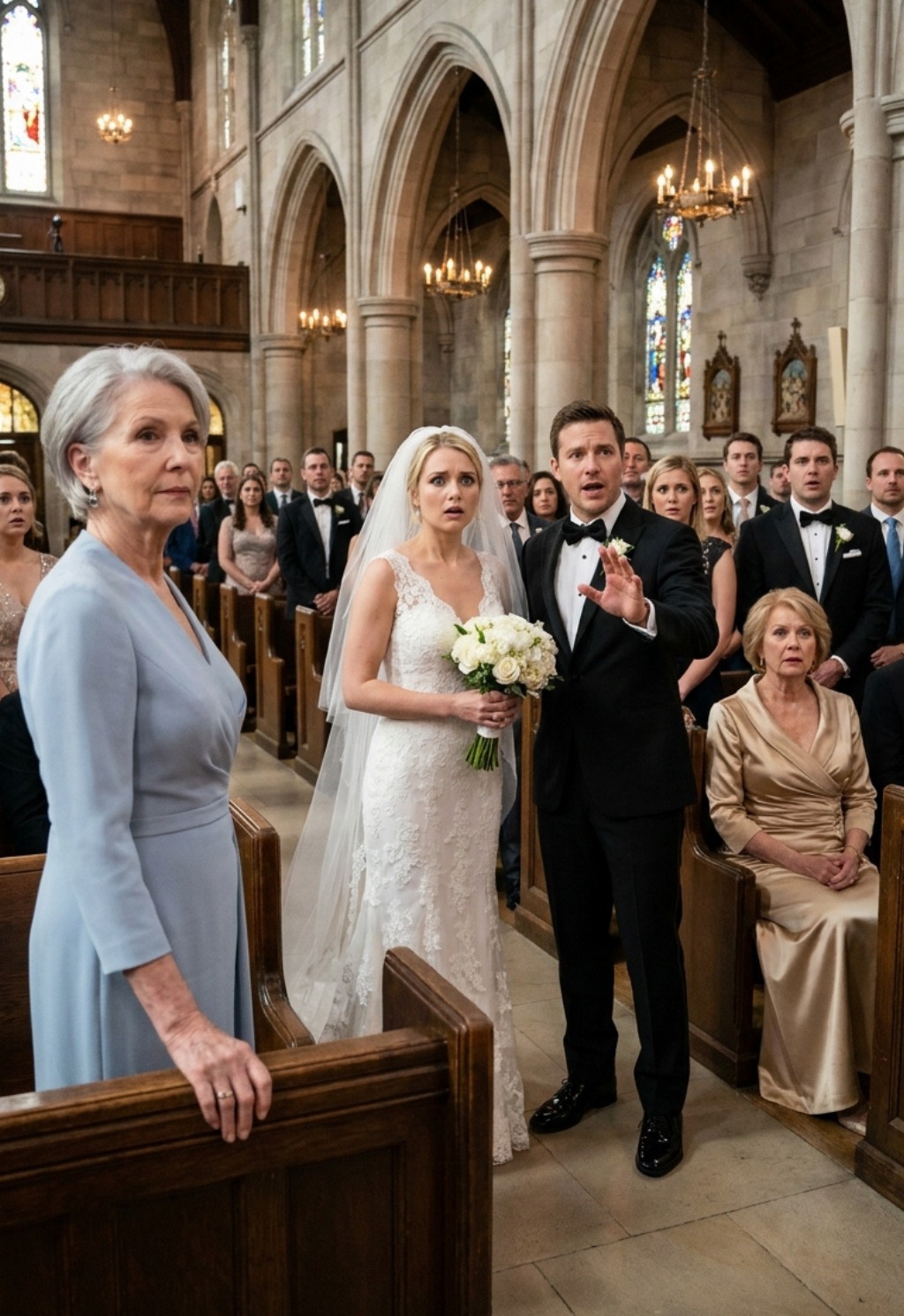
Then the small, ugly miracle happened. Meredith was standing near the side path and whispered to her sister, “Look at that poor thing in her little discount dress. That’s not a mother. That’s a mistake in a dress.”
Brianna heard her and laughed, clapping her hands. Hudson, who was walking toward the altar, heard every single word.
He stopped walking and the string quartet faltered into silence. Hudson tapped the microphone and said, “Before this ceremony begins, I need to say something.”
Brianna stepped forward, but Hudson looked at her as if he had never seen her before. “I heard you and your mother talk about my mother,” he said.
The silence that followed had weight. Meredith surged forward and said they were just joking, but Hudson replied, “You laughed.”
“It was just a comment,” Brianna said, which was the stupidest possible thing she could have uttered. Hudson shook his head and told the crowd that his mother was the best person he knew.
“I’m not marrying you,” Hudson said to Brianna. She began to cry, and Harrison snapped at Hudson, calling him an ungrateful fool.
Harrison rounded on me and blamed me for filling Hudson’s head with resentment. I rose slowly and said, “Actually, you did that yourselves.”
I walked to the microphone and thanked everyone for coming. I turned to Meredith and said, “I chose this dress to look exactly like the woman you’ve spent months underestimating.”
Then I looked at Harrison and mentioned Oak Ridge. “While your family was busy deciding how little respect I was due,” I said, “I was busy buying the future you assumed belonged to you.”
The crowd gasped as I told him that Sheffield Investment Properties had completed its final acquisitions. Harrison turned pale and whispered, “That’s you?”
“It’s my family,” I replied. I told Hudson his real wedding gift was in my car, and it included better opportunities than a dealership job.
I handed the microphone back and let the collapse continue. In the parking lot, Harrison caught up to us and demanded to know what I was doing.
“Humiliation is what your wife did to me,” I said, handing him the legal papers. He read them and the blood drained from his face as he saw the transfer agreements.
Hudson looked at his own folder and asked, “You built this while you were making tuna casseroles at home?” I told him I also make very good lasagna.
Meredith tried to say there was no need for a spectacle, but I told her that a spectacle is inviting three hundred guests to watch her daughter marry a man she considered beneath her. “What this is,” I said, “is information.”
Hudson told them he wasn’t interested in saving people who would have made him apologize for his mother. We went home, and Hudson sat at my kitchen table in his tuxedo pants while I made coffee.
“I hate what they almost made me become,” Hudson said. He moved fast after that, throwing himself into the business because every conversation was finally honest.
Harrison’s empire collapsed within months because he had no liquidity. By spring, Meredith was living in a house a third the size of her old one, and I heard she hated the kitchen.
I bought a lake cottage with a screened porch and a garden. Hudson visits me on Sundays, and he recently brought a woman who is a smart architect.
I don’t rush him because some breaks deserve to heal. I am still a mother who cooks and goes to church, but I am no longer invisible.
Meredith was right about the dress in one way. I had chosen it on purpose, and if I had to do it all over again, I would wear the same one.
THE END.