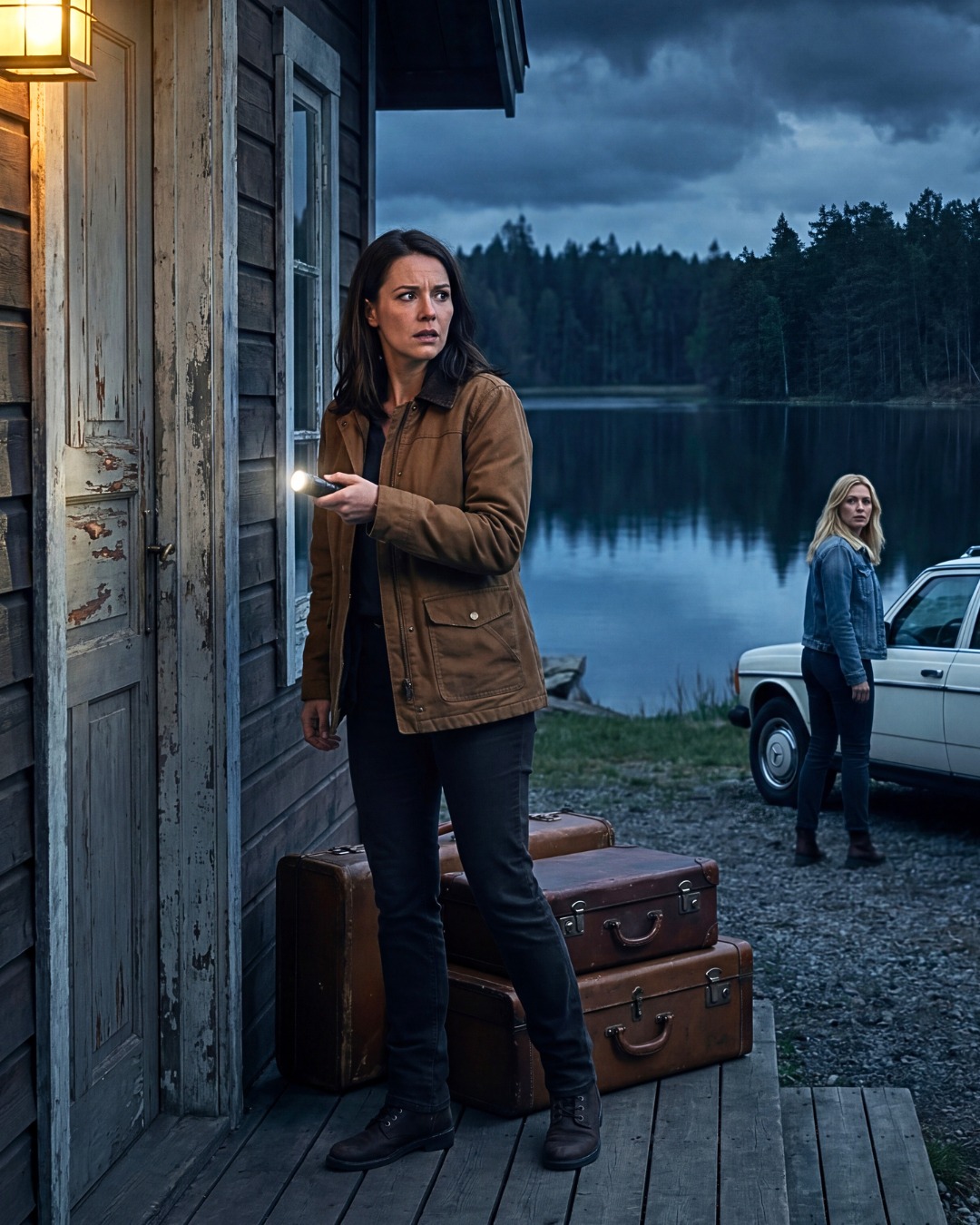
The padlock was rusted shut.
I stood on the porch in the dark with two suitcases and a weak flashlight I had bought at a gas station forty miles back, and the door would not open. For a long moment I simply stood there listening to the lake.
The water moved against the dock my grandfather built when I was seven, the same dock where he taught me to tie a knot properly and told me that patience was not just waiting, but knowing what you were waiting for. I had not understood him then.
At thirty-eight, divorced twelve days earlier and four hours north of the life I had just lost, with damp pine needles gathering at my boots and cold water breathing up from the shore, I still wasn’t sure I did.
The porch light was dead. The flashlight flickered in my hand and made the cabin siding look like old bones under skin. I set the suitcases down and tried the padlock again, though I already knew it wouldn’t turn.
The metal had gone past rust and into identity. Behind me the road had disappeared so completely into darkness it no longer looked like a road at all, only a black idea vanishing into trees.
Somewhere near the shoreline something moved through the brush and then stopped when I stopped. The lake answered itself softly against the dock posts. The cabin did not care that I had arrived broken. It sat exactly as it always had—quiet, stubborn, built to outlast other people’s urgency.
There was a rock by the woodpile.
It took six hits to break the lock.
The first few did almost nothing except send pain up my arm and stir that old humiliating feeling that maybe I was doing it wrong. By the fourth strike the bracket loosened.
By the fifth I was breathing harder than the work deserved, not because breaking a lock is exhausting, but because I had spent the last two weeks not hitting anything, not shouting, not collapsing where anyone could see.
Some part of me had apparently been waiting for something lawful to destroy. On the sixth hit the lock split and dropped to the porch with a dead metallic crack.
I stared at it with the rock still in my hand and felt more tired than victorious.
Then I opened the door.
The smell came first: cedar, dust, pine, and beneath it the warm dry scent of a place closed too long but built from honest wood. My grandfather kept cedar blocks in every drawer and closet. He said they kept moths away, which was true, but I always thought he liked the smell because it belonged to an older, harder life he trusted more than he trusted explanations.
The flashlight moved over the room and everything was where he had left it. The plaid couch with the middle cushion worn lower than the others. The crooked bookshelf he built himself, still lined with paperbacks cracked from years of rereading.
The kitchen table where we played cards while he made hot chocolate too sweet and pretended not to cheat. His coat still hung by the door. His boots still sat under the bench as if he had only stepped outside for firewood and might return before the kettle boiled.
And the paintings. Nine of them, still hanging exactly where they had always hung. All landscapes. All his. The lake in June mist. Birch trees in October. The stone bridge up the road. A winter scene above the fireplace, the frozen lake under a low gray sky.
A deer at the edge of the clearing, listening to something beyond the frame. They were not gallery paintings. Some proportions were wrong. He never could paint clouds quite right. Water reflections were sometimes too careful. But they were honest. They looked the way the land felt to him, and that was better.
I put the suitcases down, sat on the couch, and something inside me gave way.
Not the dramatic kind of breaking. No elegant collapse. More like the sound an old house makes at night when it shifts under a weight it has carried too long. I sat there in the dark cabin with the dying flashlight pointed toward the kitchen floor and cried for hours.
When I finally got up, I found the fuse box in the hall closet, flipped three breakers, and the kitchen light flickered on. The cabin was cold and dusty and mine, and for that first night it was the only thing in the world that still was.
Two weeks earlier, I had sat in a courtroom and watched a judge divide my life.
If I’m honest, I had never really been in possession of it. I had lived inside the marriage, yes. I had painted the walls, remembered the birthdays, hosted the dinners, balanced the calendar, tracked the mortgage, absorbed the moods, defended the man at the center of it with that loyal practical labor women perform without ever being allowed to submit receipts.
But possession is different from participation. Possession leaves evidence. And when the documents were reviewed, there was almost no trace of me.
Ethan was good at that. Good at receiving effort in a way that made it vanish.
When we married, he was selling insurance out of a rented office with a broken air conditioner and one exhausted assistant. I worked double shifts at Mercy General for three years so he could get his broker’s license. I picked up nights, Christmases, weekends, every ugly holiday schedule nobody else wanted. I slept in fragments and learned exactly how far peanut butter, rice, and beans could be stretched. When he finally started making real money, he told me I could quit.
I did, because I believed what came next: that he would take care of us.
That was Ethan’s talent. He did not lie in grand cinematic ways. He lied in sentences that merged seamlessly with hope. We’ll be fine. This is temporary. You’ve done enough. Let me carry it now. By the time I understood that gratitude and authority were not the same thing, the paperwork already reflected his version of our marriage, not mine.
The courtroom was colder than I expected. My lawyer—hired because a friend’s cousin promised he was “solid” and solid had sounded affordable—kept checking his phone under the table while Ethan’s attorney calmly described his client as the sole financial provider for the duration of the marriage. On paper, it was true enough to win. Income records.
Tax returns. Mortgage statements. Retirement contributions. The judge did not ask much because on paper there wasn’t much to ask.
What exhibit proves I painted every room in that house because we couldn’t afford contractors and Ethan called my labor “more personal”? What legal phrase captures the dinners I hosted for his clients, the names I remembered, the preferences I tracked, the atmosphere I created so his business could look effortless? What line item records the savings I quietly handed over when his mother needed a new roof? Where, exactly, do you put the labor of making a man look inevitable?
Nowhere, it turned out.
The judge awarded Ethan the house, both cars, the retirement account, the investment portfolio, and the savings account that still had my name on it. My settlement was eleven thousand dollars and a lawyer’s handshake already halfway turned toward his next case.
When the matter of my grandfather’s cabin came up, Ethan’s attorney barely paused. Direct inheritance before the marriage. Not marital property. Rural structure of negligible value.
Negligible value.
Those three words landed harder than anything else because they were not meant cruelly. Just dismissively. A shack in the woods. Not worth the fight. Ethan rolled his eyes when the judge confirmed it stayed with me. They had won everything that mattered. Neither of them cared enough about an old one-bedroom cabin on a northern lake to steal it too.
That exact texture of dismissal stayed with me.
If they had fought over it, I might have understood greed. But they didn’t. They dismissed it the way Ethan had dismissed so many parts of me for years—not with rage, but with certainty that if something could not immediately improve his life, it had no real value at all.
My friend Rachel let me sleep on her couch after I left. She was kind in all the practical ways that matter. She bought oat milk because I liked it. She moved the coffee table so I wouldn’t hit my shin at night. She pretended not to notice when I stayed in the shower too long because hot water was the only place I could cry without feeling watched. But her apartment was small, and in small apartments kindness has acoustics. I could hear her and her boyfriend whispering in the kitchen at night, wondering how long this would last. They were not cruel. I was simply too much life exploded into too little space.
It was Rachel, sitting in the courthouse parking lot with both hands tight on the steering wheel, who said, “Go north.”
I turned to her.
“Your grandfather’s place,” she said. “Just go. Clear your head. Figure out what comes next.”
So I drove north for four hours.
The first week at the cabin was not beautiful. It was survival in its ugliest form. I scrubbed mold off bathroom tiles at two in the morning because I couldn’t sleep. The water heater required profanity and negotiation before it produced anything warmer than disappointment. The nearest grocery store was thirty minutes away. I ate canned soup four days in a row because I was afraid to spend money I could not replace. On the third day I found mice under the sink. On the fourth I cried because the coffee maker wouldn’t work, then realized I had never plugged it in.
But the cabin had a brutal kind of honesty. Sweep the floor or feel grit under your socks. Split wood or be cold. Fix the latch or live with the draft. Nothing could be translated into someone else’s version of care. If I repaired something, it stayed repaired because I had put my body next to the problem and learned its shape.
On the fifth day I found my grandfather’s toolbox under the sink. Every tool in its place. Every slot labeled in his handwriting. I fixed the leaking faucet first. Then the back door latch. Then the bedroom window that wouldn’t close all the way, which explained a draft I had been blaming on grief. Each repair cost almost nothing and gave back an absurd amount of peace.
As I worked, memories of my grandfather kept surfacing.
Walter Brooks never raised his voice unless something was on fire or someone was being stupid in a way that endangered others. He worked at the paper mill for thirty-two years and never once described himself as successful, though by the standards he respected—steadiness, usefulness, keeping your word—he was one of the most successful men I have ever known. He taught me to bait a hook, sand cedar smooth, read weather off the lake, keep spare batteries in the same place every time, and never use debt for anything that did not grow or shelter.
He was also the only adult in my childhood who saw how easily I confused being useful with being loved.
On the sixth day I started cleaning the paintings. Dust had gathered in the frame grooves, cobwebs in the corners. I moved through the cabin with a damp cloth, talking aloud to myself the way solitude sometimes encourages. When I lifted the winter painting above the fireplace, something shifted behind it. Flat. Heavier than it should have been.
I set the painting carefully on the couch.
An envelope was taped to the back.
My name was written across it in my grandfather’s hand. Not Claire. My full name.
Claire Elizabeth Monroe.
And beneath it, in smaller letters:
“If you are reading this, it is because I am already gone.”
I sat on the floor with that envelope in my lap for a long time before opening it. The cabin was quiet. The lake beyond the windows was quiet. Even the refrigerator seemed to hush. There are moments when your life divides into before and after before you understand why. This was one of them.
Inside was a folded letter, a brass key, and a business card for Daniel Mercer, Attorney at Law, in Pine Falls, twenty miles down the road.
The first line of the letter made every hair on my arms rise.
My dear Claire, if you are reading this in the cabin, then you came back to the only place I could leave something for you that no one else would ever think to look.
I read the letter again and again. My grandfather wrote the way he spoke: spare, exact, without appetite for ornament. He said he had watched me give myself away to people who did not know my value. He said he had seen it first with my mother, then with Ethan, and that the hardest part of loving me had been knowing I would have to learn the hard way what I was worth.
Then the letter changed.
The key opens a safety deposit box at Riverstone Bank on Main Street in Pine Falls. Box 1177. Daniel Mercer knows everything. Do not tell your mother. Do not tell your uncle. Do not tell anyone until you understand the full picture.
And then the line I still read some nights before sleeping:
I was not a rich man, Claire, but I was a patient one. Patience and time can build things that money alone cannot. What is in that box is not a gift. It is a correction.
I barely slept. By dawn I had the key, the letter, and the card in my coat pocket like unstable chemistry.
Pine Falls was small—four blocks of main street, a post office, a diner, a hardware store, and Riverstone Bank in an old stone building. The bank manager who came out to meet me looked at me once and said, not asking, “Walter’s granddaughter.”
I nodded.
“He talked about you every time he came in here,” he said.
That shook me more than it should have.
He led me to the vault. The bank key went into one lock, my brass key into the other. Inside the box was a thick folder, a sealed envelope, and a small leather ledger.
I opened the folder first.
Seven deeds.
Seven parcels of land surrounding the lake.
Dates spanning nearly four decades.
It took me a full minute to understand that I was not looking at random purchases. I was looking at a plan. Forty acres north of the lake. Twenty-two east of the road. Thirty-five including the ridge. Marshland. Shoreline access. A wooded parcel near the old bridge.
The ledger was not a diary. It was a record. Dates, amounts, seller notes, strategies. He had done it piece by piece. Quietly. Cash every time. Saved from the mill, from timber, from side work. He would buy one piece, manage it, cut selectively, replant, and years later use the proceeds to buy another. My grandfather had spent almost forty years assembling control over the lake.
The legal summary Daniel showed me later explained the rest. The Brooks Land Trust. Established in 2005. My grandfather as settlor. Me as sole beneficiary upon his death. Intentionally concealed. No probate notice. No public trail easy enough for greedy relatives to follow.
Then I reached the valuation page.
At the time of his death: assessed value $4.2 million. Estimated current market value: between $7 million and $9 million depending on development use.
I read the number three times.
My grandfather—who drove a truck older than me, wore flannel until the cuffs frayed, and lived in a one-bedroom cabin with a sulking water heater—had built a trust worth up to nine million dollars.
The final entry in the ledger was dated the year before he died.
Claire’s husband does not love her. He loves what she gives him. There is a difference, and she will learn it. When she does, she’ll come to the cabin. And when she comes to the cabin, she’ll find this. That is why I never sold. That is why I never told her. Some things can only be received when you are ready to carry them.
At Daniel Mercer’s office above the hardware store, he walked me through the trust with the patience of a man who understood that speed can be cruelty in disguise. Then he told me the part that changed everything again.
A development company—North Shore Horizons—had been buying up land around the lake for years. Resort plans. Spa. Golf course. Condos. Marina. Conference center. They had already spent tens of millions. But my grandfather’s parcels—the east shore and north ridge—were the missing hinge. Without them, the project could not function as designed.
Then he placed the formal offer on the desk.
$8.7 million.
And then, almost casually, he added, “Their primary investor is Stonebridge Capital. Regional director is Derek Holloway.”
I stared at him.
He understood immediately. “Your ex-husband’s business partner?”
I nodded.
Three days before the meeting, Ethan’s mother called. Carol Monroe had always possessed the kind of warmth that performed intimacy without ever risking sincerity.
“Claire, sweetheart.”
She said Ethan was worried about me. Said there had been “some confusion” about the cabin and property classification and whether I might be willing to sign it over temporarily for tax purposes. Just paperwork, she laughed. It would simplify things. After all, it wasn’t worth much.
I stood at the sink looking out over the shoreline curving east.
My shoreline.
“I’m not staying here temporarily,” I said.
Silence.
Then she adjusted her tone. “Ethan is only trying to make sure everything is clean on paper.”
“The divorce is final,” I said. “The cabin was my grandfather’s. It is not available for tax simplification or any other kind of simplification.”
Pause.
“You sound upset.”
I almost laughed. “I sound informed.”
After I hung up, I looked again at the settlement paperwork.
Inherited rural structure of negligible value.
Negligible value.
Not insulting anymore. Useful.
So I prepared.
I read every filing Daniel sent. Zoning maps. Acquisition records. Environmental restrictions. Financing structures. And the leverage became clear. They needed my land, but I had no intention of selling it outright. My grandfather had not spent thirty-seven years wrapping that lake in quiet protection so I could liquidate it into furniture and regret.
So when the meeting came, I did not offer a sale.
I offered a sixty-year lease.
Renewable by review. Annual payment. Percentage of gross revenue. Environmental protections. Shoreline restrictions. Reversion clauses. Full deed retention under the trust.
Derek laughed when he read the first page.
Then he stopped.
The real money in the room, a man named Charles Whitmore, read the entire proposal without changing expression.
“This is highly unusual,” he said.
“My grandfather was an unusual man,” I replied.
When Ethan walked into the room uninvited, I spoke before he could.
“This man is my ex-husband,” I said to Charles. “He has no standing at this table. If your firm intends to negotiate in good faith, he cannot be present.”
The room went silent. Ethan stood there long enough to realize he had failed in public, then turned and left.
The legal challenge came before the final answer did. Ethan tried to reopen the divorce, arguing the trust should have been disclosed. It was obvious what he wanted: freeze the negotiations, drain me financially, force a concession.
But my grandfather had anticipated even that.
Protocol B.
Tucked into an entry in his ledger was a note: If there is a legal challenge to the trust, Daniel has Protocol B in the gray filing cabinet. I paid for the best. You will not need to pay again.
My grandfather had already funded the defensive package years earlier. Independent legal opinions. Notarized statements. Documentation proving I knew nothing of the trust during the marriage. Ethan’s lawyer withdrew eleven days later.
On the twelfth day, North Shore Horizons called.
They accepted.
Sixty years. Reviewed every decade. Annual payment of $680,000, plus 2.3 percent of gross resort revenue. Environmental protections intact. Deeds retained. Ownership remained mine.
Money did not heal me on contact. Let that be clear. It did not erase humiliation, or fear, or the reflex to calculate grocery totals in my head. But it changed the argument fear could make.
I stayed at the cabin. Fixed the roof. Replaced the water heater. Reinforced the dock. Returned to nursing two days a week at Mercy General, enough to remind myself I could still produce value directly and not merely inherit it.
And one afternoon, after everything had settled enough to breathe, I pulled my grandfather’s old easel from the corner and carried it onto the porch.
I painted the lake.
Or tried to.
The trees came out too round. The ridge looked childish. The sky was the wrong color. The reflections in the water refused to become water. It was a terrible painting. Completely mine.
When it dried enough to move, I signed the lower right corner.
Not his initials.
Mine.
C.M.
Then I hung it beside his nine landscapes. The tenth painting. The worst of them by any objective measure. Also the only one painted after I understood why he painted at all. Not to make masterpieces. To keep faith with the place that had kept faith with him.
People always want the satisfying parts first when they hear this story. The money. The trust. Ethan dismissing what he could not imagine was valuable. The lease. The courtroom irony. Those parts are satisfying, yes. But they are not the center.
The center is smaller.
A rusted padlock in the dark.
A porch step.
A woman with two suitcases and no plan beyond surviving the night.
A rock from the woodpile.
A letter hidden behind a painting because one old man trusted place more than he trusted people.
The center is this: I arrived at the only door still mine and could not open it until I broke something first.
And when I finally went inside, what was waiting for me was not rescue in the childish sense. Not apology. Not vengeance. Not even luck.
It was structure. Proof. Correction.
Land. Water. Cedar. Patience.
And my own name, signed in the corner of a bad painting hanging beside nine good ones.
I was not the woman in the courtroom unable to interrupt the story being written over her. I was not the woman sleeping on Rachel’s couch listening through drywall to whispers about how long I would last. I was not even the woman sitting in that dark cabin on the first night crying because the only thing left that still felt mine had a broken lock.
I was the woman who broke it open.
And after that, slowly, I became the woman who stayed.