Gavin Reed walked into the Crystal Ball like the room had been built to admire him.
That was always the first thing people noticed. He never merely entered a place—he claimed it. He moved with the polished entitlement of a man who had practiced success until it became body language. The marble foyer of the Bellmont Hotel glowed beneath chandeliers large enough to look theatrical, and Gavin loved the way conversations lowered just slightly when he passed.
He loved the glances, the curiosity, the silent assessments: tuxedo tailored within an inch of arrogance, shoes shining like mirrors, watch face bold enough to announce itself from across the room, beautiful woman at his side, expression that said he belonged among power.
He lived for that inventory.
On his arm that night was Chloe Bennett, twenty-six, red-lipped, blonde, overexcited, dressed in the kind of bright red gown that tried very hard to look expensive and only managed to look ambitious. She squeezed his arm and whispered too loudly, “Oh my God, is that the governor?”
Gavin smiled the smile he used on women he wanted dazzled. “Could be.”
“Could be? You know if that’s the governor.”
“I know a lot of people in this room.”
That was only partly true. He recognized faces. He knew enough names to fake closeness. More importantly, he knew how to act like a man who never needed to prove he belonged. Most people, he had learned, accepted confidence as currency if it was dressed well enough.
Inside his tux jacket was the invitation—thick cream paper, silver embossed, the kind of card men kept because it made them feel selected. He had looked at it twice in the car just to touch it. The Crystal Ball. The kind of event a man like Gavin spent years trying to get into and even longer pretending not to care about afterward.
“Stay close,” he murmured to Chloe as they crossed the foyer. “Smile. Don’t drink too fast. If anyone asks what you do, tell them you’re in brand consulting.”
She blinked. “I’m your executive assistant.”
“Tonight you’re in brand consulting.”
She grinned. “Right. Sophisticated.”
“Act expensive,” Gavin said.
Her laugh echoed off the stone. He liked that too.
What Gavin did not know as he stepped into the ballroom was that the invitation in his pocket was not access.
It was bait.
He did not know that every tailored suit, every investor dinner, every fake expansion, every hotel suite, gift, driver, mistress, and polished illusion of his success had all come from one source.
And he did not know the source had finally decided the account was closed.
Forty miles away in Darien, Connecticut, his wife stood in front of a locked room at the end of the second-floor hallway of the house Gavin casually called his. Whenever guests wandered too near, he referred to it as storage. The door was steel-cored beneath painted wood. The lock was digital. Behind it, glowing in the dark, was not storage.
It was truth.
Evelyn Reed stepped inside barefoot, one hand under the weight of her seven-month belly, the other holding a glass of water she had forgotten to drink. Three monitors lit the room. One displayed financial streams. One showed a private internal banking dashboard known only to a handful of people. The third showed a live feed from the Bellmont ballroom, where silk and tuxedos moved like polished pieces across a game board.
The command room had been built in the first year of her marriage. At first she told herself it was temporary. A precaution. A way to keep one life breathing underneath another until love felt safe enough to trust.
Instead, she had upgraded it.
Beside the monitors hung the gown she had not worn in five years—dark midnight silk, sleeveless, altered that week to honor the curve of pregnancy rather than conceal it. Along the bodice, diamonds had been stitched so delicately that in dim light the dress looked severe, but beneath chandeliers it would look like a private sky.
Below it sat an open velvet box.
Inside lay the Hartwell Blue.
The sapphire was large enough to stop a room. Deep blue, alive under light, haloed in antique diamonds. It had belonged to the women in her family for generations. Her father had once touched it with one finger and told her, half joking and half serious, “Wear it when you’re done making yourself smaller.”
Evelyn lifted it from the box.
Her father had been gone six years. Thomas Hartwell did not look like a man who would reshape industries. In Columbus, Ohio, people knew him as the mechanic who worked fair, smelled like winter air and motor oil, and never overcharged single mothers. What most people never knew was that he had designed a fuel-delivery component that changed engine efficiency across an entire market. He patented it. Licensed it. Built wealth so quietly it never had to brag.
By the time he died, what had started in a garage had become a fortune of astonishing scale.
He left Evelyn four-point-three billion dollars and one lesson he never needed to write into a legal document because he had repeated it often enough that it had become part of her bones:
Know who loves you when all you offer is yourself.
She had tried.
Now, fastening the Hartwell Blue around her throat, she looked at herself in the reflection of the black screen. She was still in a maternity robe, hair pinned up loosely, face pale with the private exhaustion of a woman who had cried often enough to become efficient at hiding it. But the sapphire changed the shape of her.
Not because jewelry creates power.
Because recognition does.
The woman in the reflection no longer looked like her husband’s wife. No longer like the soft-spoken woman who apologized when the dog barked too long. No longer like the woman who had slowly learned to shrink inside her own home.
She looked like the heir to something enormous, old, and patient.
Her encrypted phone buzzed.
BENNETT: Leak risk moderate. One board member is talking. We can suppress for twelve hours.
Evelyn typed back: Suppress. No story before I speak.
Another message came.
MARA: Saw Chloe yesterday. She’s bragging. Says Gavin files Monday and “the wife gets nothing.” They think you’re broke.
Then another.
ALICE: Confirmed. He took out a $500,000 home equity loan yesterday using a forged signature. Funds used to buy Stamford condo in Chloe Bennett’s name.
Evelyn closed her eyes for a moment.
It was almost unbelievable how careless cruel men became when they mistook patience for weakness. Gavin had forged her signature against the house she had bought, funded a condo for his mistress, and planned to walk into divorce court as though he were the wronged provider generously discarding a burden.
She could still hear his voice from earlier that day.
Dust the library.
Don’t wait up.
And then the laugh: “You’re getting huge, Ev. Like a whale.”
Seven months pregnant, and he had never once placed a hand on her belly with tenderness.
Her phone buzzed again.
ALICE: Added forgery file. Federal coordination ready.
Evelyn called Benedict Shaw, CEO of the discreet London bank that managed most of her father’s architecture.
“Kill the leak,” she said.
“It will disappear,” he replied.
“Add the forged loan to the packet. Everything.”
“Already done.”
She let the silence hold a second. “How does the room look?”
“Full,” Benedict said. “Hungry. Perfect.”
“Any sign Gavin suspects?”
“None.”
Of course not.
Men like Gavin rarely imagine plans they did not author themselves.
After that she called her friend Naomi Brooks.
“Tell me you’re not backing out,” Naomi said before Evelyn could speak.
“I’m not.”
“Good.”
“But I need you there.”
“I’m already on my way,” Naomi said.
Evelyn laughed softly.
“And Evelyn,” Naomi added, voice gentler now, “you’re allowed to be scared.”
“I am scared.”
“That’s fine. Brave women are scared all the time. Cowards are just louder.”
After she hung up, Evelyn reached for the dress.
Years earlier, after her father’s funeral, after betrayal had already introduced itself once, there had been a diner in Ohio and a phone call that changed the scale of her life. She had been twenty-eight, exhausted, wearing her father’s flannel because it still smelled like him, sitting in a booth that smelled like coffee and pie crust while rain crawled down the windows. Benedict had called from London to explain what her father had left behind: patents, holdings, structures, liquidity, wealth beyond imagination.
Hours later, another call came—from the attorney of the fiancé who had stolen two million dollars from one of her personal accounts and vanished when he realized her father’s garage had not been small at all. The attorney proposed a “private settlement.”
Evelyn hung up without answering.
That night she called Benedict back.
“I want to disappear,” she said.
Not forever. Just long enough to know whether she could be loved without being priced.
So she moved to Connecticut quietly. Through layers of companies, she rented a modest apartment over a bakery in Westport. Through others, she bought a neighborhood restaurant and waitressed under her real first name and no last name. She wore outlet clothes. Drove an old Honda. Let herself become easy to overlook.
She was lonelier than she expected.
But free.
Then one overcast Tuesday in October, Gavin Reed came into the restaurant.
He was handsome in a curated way, polished enough to suggest a man who had spent years studying how others responded to him. He sat in her section. He made an average joke like it was intimate. He remembered her name. Came back. Then came back again. Soon he was waiting near the hostess stand after her shift to ask whether she wanted dinner somewhere that did not smell like fryer oil.
Evelyn nearly said no.
Then, on their third date, an elderly woman dropped her groceries in the parking lot. Cans rolled. An orange disappeared under a car. Gavin moved before Evelyn did—gathered everything, carried the bags, refused the five-dollar bill the woman tried to hand him.
That was the moment she fell.
Years later, when she replayed her mistakes, she always stopped there. Not because kindness is suspicious, but because counterfeit kindness often wears the softest face. Gavin knew exactly how to place generosity where it would be seen and remembered.
The first year was gentle. Flowers. Sunday mornings in bed. Hands at her waist while she washed dishes. “My girl,” spoken like blessing. He made her feel carefully observed, and she mistook that for being cherished.
Eighteen months later, they married.
She told him she had received a modest inheritance. Enough for a down payment, not enough to alter his behavior. Through shell entities, she bought the Greenwich house he thought they were financing together. Through other structures, she created the illusion of shared growth. When he talked dreamily about launching an investment firm, she quietly built him one.
Reed Capital was born on paper as if from his ambition.
In reality, every meaningful dollar came from her.
She did not do that to trap him later. She did it because she loved him. Because she thought helping him feel capable would bring out the best in him.
For a while, she believed that.
But abuse rarely enters loudly. It arrives by erosion.
Year one: You always look beautiful.
Year two: “You’re wearing that? It’s kind of plain.”
Year three: the house became “my house,” the car “my car,” the business “what I’m building.” Over breakfast he told her casually, “You don’t really contribute, Ev. I carry this family.”
Year four: contempt hardened. He came home smelling wrong. Took calls outside. Handed her his jacket and asked what was for dinner.
Year five: he hired Chloe Bennett as his executive assistant.
Three months later Chloe was booking his personal travel, texting him at midnight, appearing at the St. Regis every Tuesday while he told Evelyn he was trapped in meetings. Evelyn knew almost immediately. Corporate cards leave trails. Hotels keep records. Men like Gavin grow lazy when they stop fearing consequences.
She watched a Cartier pendant purchased for Chloe and coded as office hardware. Watched “conference” expenses turn into theme-park tickets. Watched social posts appear and vanish before morning. A champagne flute. A robe. Gavin’s unmistakable wrist beside a resort pool.
Each discovery hurt less than the one before. That frightened her most.
Then she got pregnant.
Against all logic, she hoped this would wake him. Not because babies save marriages—they don’t—but because she believed even a selfish man might go quiet in the presence of something that innocent.
She cooked his favorite dinner. Lit candles. Placed the ultrasound envelope beside his plate.
He opened it. For one heartbeat, surprise softened him.
“A baby,” he said.
“A girl,” Evelyn whispered.
He set the photo down, took a bite of steak, and said, still chewing, “Hope she gets your looks, because my genes would be wasted on someone who’ll probably just grow up to be a housewife.”
That was it.
No hand on her stomach.
No question about names.
No we.
A week later she left an ultrasound appointment alone and saw his silver Mercedes outside a restaurant. Through the window she watched him feeding Chloe dessert, laughing, then reaching across the booth to rub slow circles over Chloe’s stomach with a tenderness he had denied his own wife for seven months.
Chloe was pregnant too.
The rain started while Evelyn stood there watching. In that instant she understood something with cold, surgical clarity: sometimes cruelty is not the absence of tenderness. Sometimes it is the deliberate refusal to give tenderness to you.
Three weeks later Gavin came home drunk, called her a whale, and laughed.
That was when hope died.
Not with a crash.
With a click.
She called Benedict that night.
“When is the Crystal Ball?”
“December fourteenth.”
“Get Gavin an invitation. VIP seating. Front row. I want the audit done, the legal team ready, the media controlled, and federal coordination locked.”
He paused. “Are you certain?”
She looked at the ultrasound on her desk.
“My daughter is not going to be born into a lie.”
So now, on the night of the gala, the lie was strolling across marble with a mistress on his arm while his wife zipped herself into midnight silk and fastened diamonds at her wrists.
At the Bellmont, Gavin had collected a drink and a circle of admirers. He was speaking in expensive nonsense about markets and long-term positioning when the room dimmed.
The master of ceremonies stepped onto the stage.
“Ladies and gentlemen, welcome to the fiftieth annual Crystal Ball. Tonight, for the first time, the chairwoman of the Aurora Foundation joins us in person. Please welcome Madame Evelyn Hartwell.”
Gavin’s champagne glass slipped from his fingers and shattered on the marble.
For half a second he did not understand what he had heard.
Hartwell.
His wife’s maiden name was Hartwell.
But that was impossible, because her father had been a mechanic in Ohio who smelled like peppermint and oil and once fixed Gavin’s tire for free.
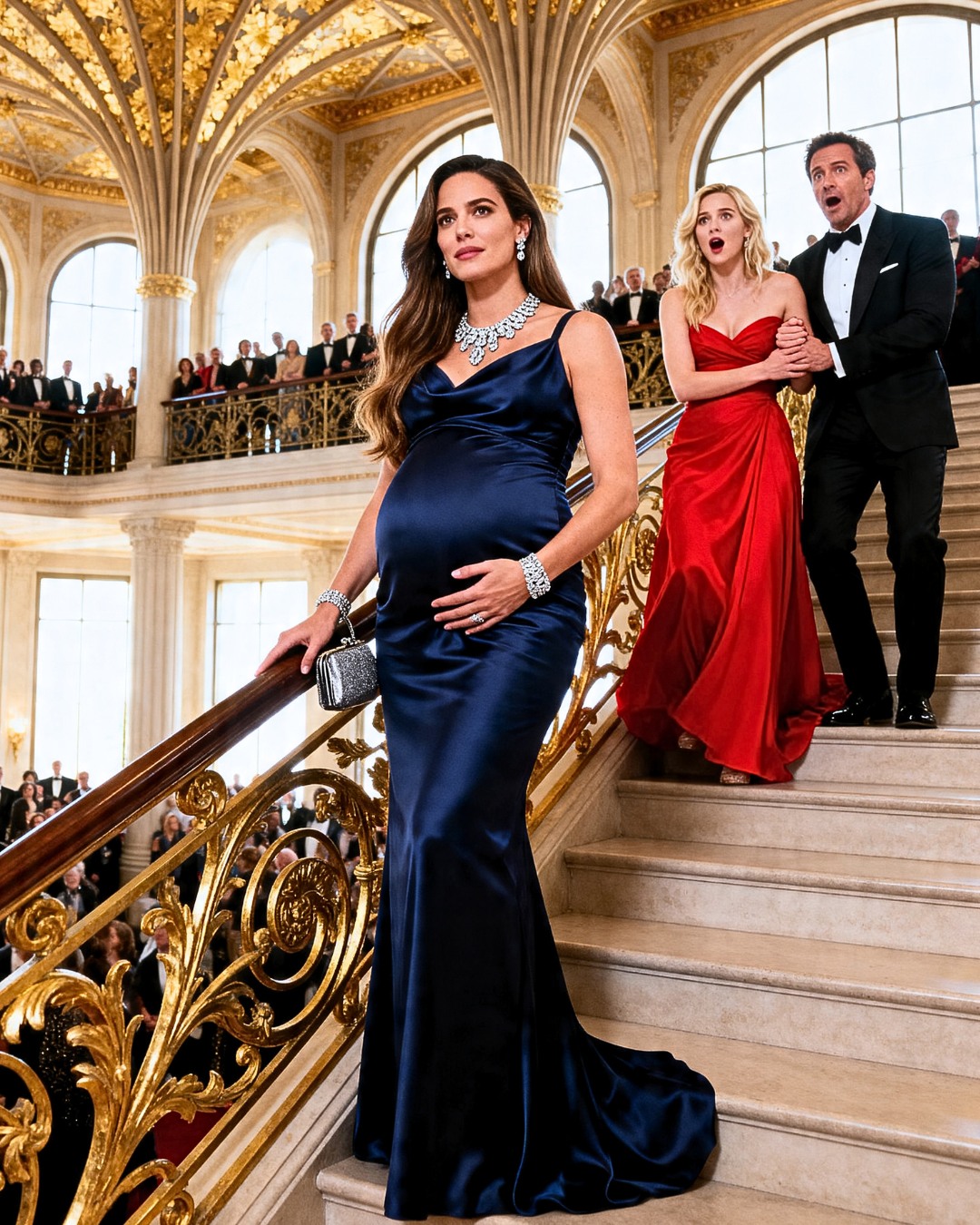
Then the doors at the top of the staircase opened.
Evelyn appeared.
Pregnant. Poised. Descending in midnight silk that moved like shadowed water, diamonds sparking softly, the sapphire at her throat like a captured ocean. She looked neither furious nor theatrical.
She looked inevitable.
For the first time in years, Gavin felt small.
At the bottom of the stairs, security shifted discreetly into place around her. Beside her stood Benedict Shaw. On the other side stood forensic accountant Martin Hale with a leather folio. Just behind them stood FBI Special Agent Dana Mercer.
Chloe whispered, “Why does she look like your wife but… not like your wife?”
A man nearby murmured, without sympathy, “Because that is his wife.”
Evelyn took the microphone.
“Good evening,” she said. “Thank you for your patience. I had some garbage to take out before I arrived.”
A ripple of laughter spread through the ballroom.
Gavin stood abruptly. “Evelyn—”
She looked at him once. That was enough to stop him.
Then she pressed a remote.
The screen behind her came alive.
A flowchart appeared. Aurora Foundation at the top, subsidiaries cascading beneath it, a web of companies and acquisitions. At the bottom sat Reed Capital, threaded through by funding lines dense as roots.
“Five years ago,” Evelyn said, “I conducted what you might call a personal experiment. I inherited a significant fortune after my father’s death. Before that inheritance, I had already learned how quickly some men fall in love with a woman’s money. So I chose privacy. I chose simplicity. I chose to see whether I could be loved without being priced. Eventually, I married.”
Click.
Transfers appeared. Dates. Entities. Routing records.
“My husband, Gavin Reed, has spent the last five years presenting himself as a self-made financier. He has spoken often about hustle, grit, and earning every inch. In truth, every meaningful dollar that capitalized his firm came from me through the entities on this screen. I am his sole real investor, sole meaningful lender, and the source of every substantial success he has claimed as his own.”
The room broke into murmurs.
“That’s insane,” Gavin snapped. “I built that company. The Singapore deal—”
Click.
A contract appeared.
NOVA STRATEGIC
AURORA SUBSIDIARY
“The Singapore deal,” Evelyn said calmly, “was funded by Nova Strategic, which is mine. The lawyers were mine. The analysts were mine. Even the interpreters were mine. One reason your meeting summaries were always so vague, Gavin, is that you were too busy performing sophistication to notice the translators never once spoke Mandarin.”
Laughter detonated across the ballroom.
Then came hotel receipts. Jewelry purchased for Chloe and coded as hardware. Travel expenses labeled as business. A photo of Gavin and Chloe smiling at Disney in matching mouse ears.
The room erupted.
Martin Hale stepped forward. “Forensic summary. Over thirty-two months, Mr. Reed diverted business and nonprofit funds for personal use, concealed transfers through falsified coding, and most recently obtained a home equity loan in the amount of five hundred thousand dollars using a forged signature. Those funds were routed into a condominium in Stamford. Deed holder: Miss Chloe Bennett.”
Chloe went white.
Hale held up a photograph. “For completeness, the pendant currently worn by Miss Bennett was purchased with funds from a nonprofit subsidiary addressing childhood hunger. So, Miss Bennett, what you are wearing tonight cost roughly one hundred and forty-six children their dinners for a month.”
Chloe’s hand flew to her throat. She tore the necklace off so hard the clasp snapped and stones scattered across the floor.
“I didn’t know,” she cried. “He told me they were separated. He told me she was abusive. He told me—”
Evelyn’s voice was almost kind.
“He told you whatever would make you useful. That has always been one of his better skills.”
Then came the final blade.
“One more note,” Hale said. “Gavin Reed was born Gavin Michael Dorsey in Newark, New Jersey. Name legally changed four years ago. Former employment: junior shift manager at a rental car company. Termination record includes unauthorized personal use of company vehicles.”
The laughter died after that.
Because then the side doors opened and FBI agents entered.
Not scandal anymore.
Consequence.
The lead agent approached him. “Gavin Michael Dorsey, you are under arrest for wire fraud, bank fraud, aggravated identity theft, embezzlement, and related financial crimes.”
As they took his arms, he twisted toward Evelyn and shouted, “I loved you! In my own way!”
The room held its breath.
Evelyn stepped closer, unclasped the Hartwell Blue from her throat, and held the sapphire in her hand so it caught the chandelier light.
“You didn’t love me,” she said. “You loved the version of yourself my silence let you perform. The performance is over.”
Then they took him away.
For forty-eight hours, America adored her.
The clip went viral before midnight. By dawn, everyone had seen the moment Gavin dropped the glass. She became a symbol, a meme, a headline, a fantasy. The quiet queen. The billionaire wife who exposed the fraud husband. Women online said they wanted “Evelyn energy.”
Then Chloe uploaded a jailhouse video.
Mascara streaked, orange uniform, trembling voice.
“She ruined my life,” Chloe sobbed. “He told me they were separated. Now I’m pregnant and in jail and everybody hates me because some billionaire wanted revenge.”
The mood turned overnight.
Was Evelyn a victim or manipulator?
Did she go too far?
Had she staged the whole thing?
It is one of the ugliest habits of public spectatorship that women are allowed only two acceptable versions of suffering: silent or dead. If you are too prepared, you are manipulative. Too composed, you cannot have been hurt. Too articulate, you become suspicious.
Evelyn sat in the nursery she had mostly built alone and read the comments until Naomi took the phone from her.
“Enough.”
“Maybe they’re right,” Evelyn whispered.
Naomi crouched in front of her. “About what?”
“I stayed. I kept funding him. I could’ve ended it earlier.”
Naomi’s face hardened. “You stayed because you loved him and hoped he’d become who he pretended to be. That is not a crime. That is what abuse does.”
Later her grandmother, June Hartwell, called from Ohio.
“The world cheers when a woman survives a monster,” June said, “and the second she stands up too straight afterward, they accuse her of liking it. Don’t borrow guilt from people who weren’t in your kitchen.”
Then came the next strike. Gavin’s attorney filed emergency motions: entrapment, concealment, manipulation—and worst of all, an anticipatory custody petition over her unborn daughter.
He did not want the child.
He wanted leverage.
That was when fear made room for something harder.
Motherhood.
Evelyn called an emergency meeting. Benedict flew in. Martin arrived with files. Her attorney, Catherine Webb, spread documents across the dining table. FBI coordination was confirmed. Federal documentation was airtight. No inducement. No entrapment. Just evidence.
“Bring in my grandmother,” Evelyn said.
“As a witness?” Catherine asked.
“As artillery.”
At family court, Gavin appeared by video from detention. Without the clothes and shine, he looked smaller, thinner, strangely unfinished. His lawyer tried to turn Evelyn’s secrecy into instability. Catherine objected. The judge lost patience quickly.
Then June took the stand.
She wore a church hat, carried a cane she did not fully need, and looked at Gavin’s attorney like he was a salesman interrupting breakfast.
“Is it true,” he asked, “that your granddaughter concealed her wealth from her husband?”
June smiled thinly. “After one fiancé stole two million dollars and ran, yes. She became cautious.”
“Would you agree that misleading a spouse about one’s identity is deceptive?”
June leaned forward. “Would you agree that forging your pregnant wife’s signature to buy your mistress a condo is deceptive?”
A murmur moved through the room.
By the time the hearing ended, the judge denied Gavin’s custody petition, dismissed the countersuit, and noted for the record that his credibility was minimal.
That should have been the end.
It was not.
One night, three days later, Evelyn woke at 3:02 a.m. to the unmistakable sound of a door closing downstairs.
Then footsteps.
Her regular phone was dead. She grabbed the encrypted one and texted Naomi: Someone downstairs. Call 911. Stay upstairs.
Then she heard his voice.
“Evelyn.”
Below, the keypad to the secure room beeped once. Wrong code. Again. Wrong code. Then the crash of a shoulder into reinforced wood. Then another.
He appeared in the bedroom doorway damp with sweat, shirt untucked, face hollow with bourbon and rage, a folder ripped from the downstairs evidence wall clenched in his hand.
“You watched me,” he said.
“You need to leave.”
“For five years.” He stepped closer. “Like I was some experiment.”
“You’re violating bail. Police are coming.”
“You made me this way.”
That was the sentence men like Gavin always reached for in the ruins.
Evelyn looked at him and, beneath the fear, felt something else finally replace shame.
“You were cruel before you knew my net worth,” she said. “Money didn’t make you dishonest. It only made the consequences bigger.”
He stepped closer, voice dropping. “I’ll take everything from you. I’ll take the baby if I have to—”
A new voice cut through the room.
“Boy, the only thing you’re taking tonight is a concussion if you move another inch.”
Gavin turned.
June Hartwell stood in the doorway in a floral bathrobe and slippers, holding a cast-iron skillet at shoulder height with the calm of a woman who had already decided she would absolutely use it. Beside her stood Naomi with a fireplace poker in one hand and a phone in the other.
“Are you serious?” Gavin asked.
“At my age,” June said, “if I’m awake at three in the morning holding iron, I promise I’m serious.”
Sirens rose outside.
The fight went out of him all at once.
When officers cuffed him, he twisted toward Evelyn and hissed, “This isn’t over.”
She looked at him for a long moment.
“For me,” she said, “it is.”
After they took him away, the house seemed to exhale. Evelyn sat on the edge of the bed because her knees would no longer hold her. Naomi wrapped a blanket around her. June set the skillet down and sat beside her.
“A woman doesn’t make a man cruel,” June said softly. “A cruel man just waits until he feels safe enough to stop pretending.”
That was when Evelyn cried for real.
Not elegantly. Not quietly. Not the neat tears of women who have learned to stay composed through damage. This was deeper. Fear leaving. Poison draining.
Three months later, on a warm April morning in Columbus, Ohio, Evelyn gave birth to a daughter.
She chose Columbus on purpose. Smaller hospital. Familiar streets. Her father’s memory in the air. June knew half the nurses. Naomi arrived two days early. Benedict appeared by encrypted video looking solemn enough to seem personally involved in the negotiations of labor.
Fourteen hours later, the baby arrived furious, beautiful, and loud.
Seven pounds, four ounces.
A full head of dark hair.
A cry that sounded like constitutional law.
They laid her on Evelyn’s chest, and all the fear, humiliation, calculation, and vigilance of the previous year changed shape. It did not disappear. Trauma never vanishes because you ask it to.
But it was no longer the largest truth in the room.
Her daughter was.
She named her Caroline Naomi Hartwell Reed.
Caroline because she had loved the name in secret.
Naomi for the friend who stayed.
Hartwell because she was done making her own name smaller.
Reed because children do not need lies to survive their fathers’ failures.
Gavin took a plea deal two months later.
Eight years in federal prison.
Chloe cooperated, got probation, and moved back to Virginia with her son. The internet found newer scandals and forgot her.
Evelyn did not forget the child.
When she learned Chloe’s son had been born healthy, she instructed Benedict to establish an anonymous education trust sufficient to cover school, college, and emergency medical care through adulthood.
Naomi stared at her over coffee when she found out.
“After all that?”
“Children don’t choose the moral architecture of the adults who make them,” Evelyn said.
By autumn, her healing had begun to take a different shape.
She launched the Hartwell Foundation not in New York or London, but in Ohio, inside a renovated community center full of folding chairs, coffee urns, and women carrying babies, paperwork, fatigue, and the posture of people who had spent too long being careful.
She stood on the low stage in a simple black dress and her father’s old watch.
“I’m not here as a billionaire,” she said. “I’m here as a woman who stayed too long with someone who taught her to doubt her own pain.”
The room went still.
She told them that abuse is not always loud. Sometimes it comes as jokes. Sometimes as conditional love. Sometimes as a thousand tiny edits to your reality until you begin asking permission to exist inside your own life. She told them the foundation would provide emergency housing, legal help, counseling, relocation grants, childcare, job retraining, and a hotline staffed by people who understood that the first thing many survivors need is not advice.
It is belief.
Women rose to their feet.
Not for spectacle.
For recognition.
Later, after the room had emptied and the chairs were being stacked, Evelyn took Caroline from Naomi’s arms and kissed her daughter’s forehead. Outside, autumn light stretched gold across the lot. June approached with the practical impatience of a woman who respected emotional milestones but not enough to let them interfere with dinner.
“Your daddy would be proud,” she said.
Evelyn looked down at her daughter’s tiny hand wrapped around one finger.
“I hope so.”
June sniffed. “I don’t hope. I know. Now come on. Those cookies in there were stale and I want something decent.”
Evelyn laughed.
There was still sadness in her life. There always would be. Memory remained. Scar tissue remained. Some nights her body still woke before her mind understood why. But now those things lived beside joy instead of strangling it.
And above all else, there was this:
Her daughter, warm against her chest.