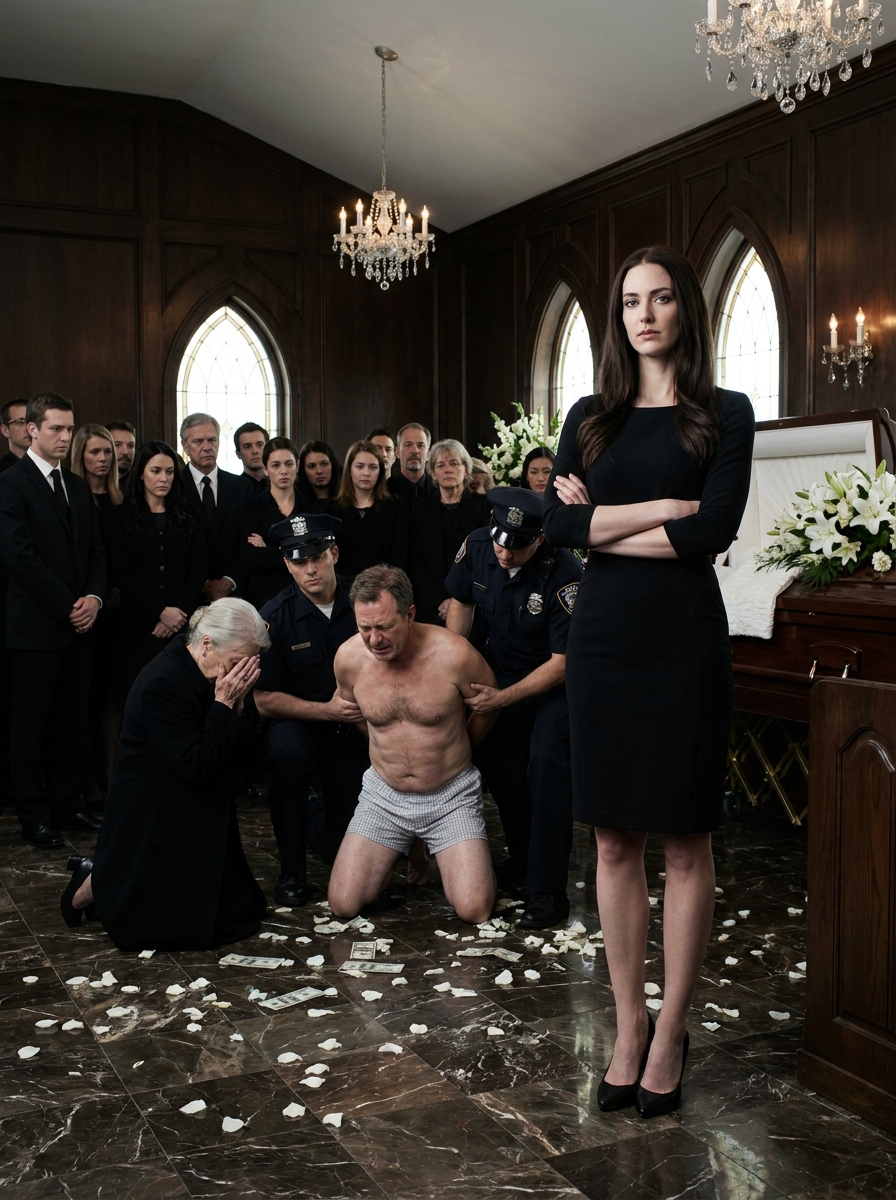
The air inside Peterson and Sons Funeral Home was thick with lilies, polished grief, and the soft, rehearsed murmur of forty people doing their best to look heartbroken. I sat in the third row with my back pressed against the hard velvet pew, feeling less like a daughter and more like a ghost being quietly edited out of the family portrait. To my left, my mother, Eleanor Henderson, wore sorrow the way she wore pearls—deliberate, expensive, perfectly arranged. To my right, my brother Marcus kept adjusting his Tom Ford cufflinks, restless in a way that had nothing to do with mourning.
At the front of the chapel stood my father’s mahogany casket. Richard Henderson had spent forty years building a life in the suburbs of Philadelphia, and before his body was even cold, that life was already being measured, divided, and prepared for sale.
Marcus rose first.
He crossed to the podium with the smooth confidence of a man who had spent his entire life being told the world was waiting for him. His eulogy was filled with fishing trips, father-son wisdom, and tender little memories that sounded polished enough to come from a publicist’s draft. People dabbed at their eyes. Men nodded solemnly. For a few minutes, the room accepted the performance.
Then Marcus didn’t sit down.
He stayed there gripping the podium, his knuckles whitening against the dark wood, and when he spoke again, his tone changed. It dropped into something heavier, more practical, dressed up as responsibility.
“As many of you know,” he said, “Dad’s passing leaves us with some difficult logistical realities. After discussing it with Mom, we’ve decided the best way to honor his memory—and make sure Mom is taken care of—is to sell the house on Maple Street immediately. To cover… family obligations.”
A hush moved through the room like a draft.
I knew exactly what family obligations meant. It was the polite phrase my mother had been hiding behind for months—the phrase that concealed Marcus’s three-hundred-and-forty-thousand-dollar gambling debt, as if changing the language could change the truth.
Then my mother stood.
She didn’t turn toward the casket. She didn’t even pretend to. She looked directly at me, her expression cold, steady, already decided.
“Your father would understand,” she said, and her voice reached every corner of the chapel. “Marcus needs support. Briana is independent. She has her own life in the city. Your sister can find somewhere else to live.”
She said it so simply.
As if removing me from my own home were a matter of rearranging chairs after a luncheon.
The room went still. Forty faces turned toward me—some openly pitying, some blank with that chilling indifference people wear when cruelty is happening to someone else. In our family, love had always been a rationed resource, and Marcus had held the largest share for as long as I could remember.
To understand why my mother felt so comfortable discarding me in public, you have to understand the architecture of the Henderson household.
When I was eighteen, I sat at the dining room table with acceptance letters spread before me—Penn State, Temple, Drexel—proof that I had worked hard enough to imagine a different life. I had a 3.9 GPA, glowing recommendations, and the naive belief that achievement might finally earn me a place.
My mother picked up my Temple letter, glanced at it the way someone studies a dish they already know they won’t order, and set it back down.
“Why would we spend that kind of money on you?” she asked. “You’re a girl. You’ll get married. You’ll be a guest in someone else’s house. Marcus, however, needs an education that reflects his potential.”
My father sat there staring into his coffee, jaw tight, saying nothing.
That silence became the wallpaper of my life.
Sons, in my mother’s world, were foundations. Daughters were temporary.
So I left and built myself without them. I worked two jobs. Took out loans that made my stomach twist. Lived on ramen and determination. I earned my CPA license and hung it on the wall of a tiny studio apartment in Center City Philadelphia, where the radiator clanged through winter like a dying machine. By thirty-eight, I was single, solvent, and entirely self-sufficient. I had even stopped speaking to them for two years—not to punish them, but because I could no longer sit in the same room with people who had treated my future like an optional expense.
Then came the 2:00 a.m. call.
My father had collapsed. By the time I reached Jefferson Memorial, Marcus’s black Mercedes was already under the streetlights. By the time I reached the ICU, Dad was gone.
The last conversation I’d had with him lasted barely ninety seconds. He asked if I was okay. I said yes. We sat in awkward silence until I ended the call. I didn’t know that would be the last time I’d hear his voice. I didn’t know I’d spend the next several days wishing I had asked him why he had stayed quiet for so many years.
The morning after his death, I went to the house on Maple Street expecting grief. What I found was inventory.
Marcus met me at the front door and gave me the kind of one-armed hug people offer when obligation matters more than affection. “Long time, sis,” he said. “You look tired.”
I barely heard him. I was too busy taking in the hallway—the Louis Vuitton duffel, the golf clubs, the Gucci loafers. Marcus had been unemployed for eight months, but the house looked like a showroom for a man who had no income and no intention of explaining himself.
When I opened the door to my childhood bedroom, the pale blue walls were still there, but my bed was gone. In its place sat stacks of designer luggage, unopened electronics, shoeboxes, and a flat-screen television still in its packaging. My room had been converted into his storage unit before my father had even been buried.
So I did what I always do when chaos threatens to swallow me. I organized.
I handled the funeral arrangements because someone had to. I called the funeral home, wrote the obituary, approved the programs, fielded the details. Marcus handled appearances. He wore grief like a tailored suit, stepping into doorways at just the right moment whenever neighbors arrived with casseroles.
Behind closed doors, though, the truth kept leaking out.
On the fourth night, I passed the kitchen and heard Marcus on the phone, his voice tight with panic. “I know, I know. Just give me until after this week. I’ll have the money. The house is as good as sold.”
He saw me, ended the call, and said, “Work stuff.”
He hadn’t worked in eight months.
I didn’t argue. I went downstairs to my father’s office in the basement, needing paper, numbers, order—something solid enough to hold while my thoughts tried to settle. In the second cabinet, inside a folder labeled IMPORTANT DOCUMENTS, I found my birth certificate, old baby photos, and a single sheet of paper on letterhead I didn’t recognize:
Farwell Family Holdings LLC.
It was dated 2009.
My name appeared in the body of the document. At the bottom was my own signature—young, looping, unmistakable. And suddenly I remembered. Dad had called me home that year after college and asked me to sign some “administrative business stuff.” I had trusted him enough not to ask questions.
I slipped the document into my purse just as my mother’s voice drifted down from the top of the basement stairs.
“Briana? What are you doing in your father’s files?”
I told her I was looking for insurance papers.
The next morning, when I mentioned the company name, she dismissed it with a sharp wave of her hand. “That business dissolved years ago. Don’t waste time digging into dead paperwork.”
But something in me refused to let it go. The same instinct that made me good at accounting told me there was a shape here I hadn’t seen yet.
Three days after the funeral came the so-called family meeting.
Marcus had invited fifteen relatives and wore the smug look of a man who believed the final signature was already in reach. He slid a document across the dining room table.
Disclaimer of Interest in Estate Property.
“It’s simple,” my mother said softly. “You sign this and formally give up any claim to the house. Keeps everything clean for the buyer. Marcus needs this resolved quickly.”
I looked at the paper, then at them. “If I have no rights to it, why do you need my signature?”
Marcus’s face tightened. “Because we don’t want some estranged daughter showing up six months from now pretending she deserves a cut. You have twenty-four hours.”
I didn’t sign.
That night, I called Gerald Whitmore.
His office sat on the fourth floor of an old brick building downtown, with brass nameplates, Persian rugs, and the faint scent of old paper and restraint. He looked older than I remembered—wire-rimmed glasses, sharp eyes, the patience of a man who had spent decades watching other people underestimate documents.
“I was hoping you’d call,” he said.
I placed the LLC paper on his desk. “I found this in Dad’s files. I don’t know what it means.”
Whitmore looked down at it, and in the space of a breath I saw recognition turn into something close to relief.
“The house on Maple Street,” he said carefully, “is not part of your father’s estate.”
I stared at him. “What?”
“In 2009, your father transferred the property into Farwell Family Holdings LLC. The house belongs to the company, not to him personally.” He lifted his eyes to mine. “And you, Briana, are the sole member of that LLC. You have been for fifteen years.”
The room went absolutely still.
He explained the rest in the calm, methodical voice of a man laying out a verdict. My father had come to him in 2008, worried about Marcus’s gambling. He loved his son, but he didn’t trust him. He believed that if something happened to him, Marcus would eventually burn through every asset the family had. So he took the most valuable one and placed it beyond reach.
Not for himself.
For me.
The tears came before I could stop them. For years, I had mistaken my father’s silence for indifference. I had believed he watched everything and chose nothing. But Whitmore reached into a drawer and handed me a sealed envelope with my name on it, my father’s handwriting unsteady across the front.
“He wrote this three months ago,” Whitmore said. “Right after the diagnosis.”
I didn’t open it until I got home.
The city lights flickered outside my studio apartment while I sat on my bed and broke the seal with shaking hands. His words were uneven, the handwriting weaker than I remembered. He admitted he knew my mother and Marcus had never treated me fairly. He wrote that he had not been brave enough to say the right things out loud. He wrote that he was sorry for that. But he had tried, in the only language he seemed to trust, to leave me something they could never take.
You’re the only one I trust with what matters.
It didn’t feel like victory. It felt like grief finding a hidden room.
The formal reading of the will took place that Friday.
Marcus arrived in a Tom Ford suit, patting Whitmore on the shoulder as if charm could erase paperwork. My mother sat in black Chanel, receiving condolences from relatives who had already decided they understood how this story would end. As I took my seat, Marcus leaned toward me and whispered, “Brought a pen?”
I said nothing.
Whitmore began with the expected pieces. My father’s vehicle to Marcus. Savings accounts totaling forty-seven thousand dollars to my mother. Personal effects divided in the usual careful language. The room relaxed. Everyone thought they knew the ending.
Then Aunt Dorothy asked, “And the house? What about Maple Street?”
Whitmore removed his glasses and polished them with infuriating calm.
“Regarding the Maple Street property,” he said, “there is a significant legal distinction. The property is not part of Mr. Henderson’s estate. It is owned by Farwell Family Holdings LLC.”
Marcus sat up so fast his chair nearly groaned.
“What the hell is that?”
“A company your father formed in 2009,” Whitmore said. “The transfer was properly recorded. Taxes and compliance fees were paid annually for fifteen years.”
Marcus swallowed once. Hard. “Fine. Then who owns the company? Mom?”
Whitmore turned his head and looked directly at me.
Every face in the room followed.
“The operating agreement names a single member with full control over the company and all its assets,” he said. “That person is Briana Henderson.”
The silence held for three full seconds before Marcus shot to his feet, red climbing violently up his neck.
“She manipulated him! She got to him when he was sick!”
“The paperwork was executed in 2009,” Whitmore replied, calm as winter. “Your father was fifty-three and in excellent health. It was witnessed by his accountant. It is entirely binding.”
Marcus grabbed the document with trembling hands, scanning it like anger might rearrange the words.
“This is fraud. This can’t be real.”
“It belongs to your sister,” Whitmore said.
My mother still hadn’t spoken. When she finally did, her voice was barely more than air. “He never told me. Twenty-five years, and he never told me.”
“He asked me to keep it confidential,” Whitmore answered. “I honored that request.”
Then she turned to me, and for the first time in my life I saw her look at me not as a burden, not as a guest, but as the person holding the keys to her survival.
“Briana,” she said, her voice breaking, “we need that money. Marcus owes dangerous people.”
The room erupted into whispers.
Aunt Dorothy clutched at her chest. Uncle Frank stared at Marcus like he was seeing him clearly for the first time. I looked at my brother and saw panic where entitlement had been.
“How much?” I asked.
No one answered.
So I answered for them.
Three hundred and forty thousand?”
Marcus didn’t deny it.
My mother finally fell apart. Her makeup had begun to run. She clutched her pearl necklace so tightly it looked as though it might break. “I’ve been covering for him for years,” she said. “I gave him everything I had. The house was the last resort. Your father’s been gone barely two weeks, and now you’re taking our home.”
I stood up slowly.
“I’m not taking anything,” I said. “I’m accepting what Dad left me. The difference is, he made sure this part couldn’t be taken.”
Then I looked directly at Marcus.
“He saw this coming. He was right.”
Uncle Frank tightened his grip on Marcus’s arm as my brother leaned forward, fury and helplessness colliding in his face. I turned back to my mother.
“You can stay in the house,” I said. “I’m not throwing you out. We’ll draft a lease for one dollar a month, renewable each year. But Marcus does not live there. That is final.”
She stared at me.
“You can’t—”
“I can.”
My voice didn’t rise. It didn’t need to.
“The house belongs to my LLC. Marcus needs help. Real help. If he enters a legitimate ninety-day treatment program, I’ll support that. But I will not fund his debt.”
I picked up my bag and left.
In the parking lot, I heard the tap of my grandmother’s cane behind me. She reached for both my hands and held them in hers. She told me she had known about the LLC—that my father had asked her three months before he died whether he should protect me. She had told him yes.
“Why didn’t you say anything?” I asked.
“Because I wanted to see whether your mother would do the right thing on her own,” Grandma said quietly. “She didn’t. But you did. You stood your ground without destroying anyone. That matters.”
Marcus found me near my car.
His expensive suit was wrinkled now. The arrogance was gone. What stood in front of me no longer looked like a golden son. It looked like a man finally meeting the cost of his own choices.
“I kept thinking I could win it back,” he said, voice cracking. “One more bet. Then everything would be fixed.”
“But it never was,” I said.
He lowered his eyes.
“Ninety days, Marcus. A real program. If you commit to that, then we talk.”
He nodded.
Then my mother appeared by my car, smaller than I had ever seen her, as if certainty itself had been stripped from her frame.
“Did he leave anything for me?” she asked. “Any message?”
I could have softened it. I could have lied.
But I looked at the woman who had spent twenty years reminding me I was temporary.
“No,” I said. “He didn’t mention you.”
She flinched as if I had struck her.
“Thirty-five years,” she whispered. “I gave him thirty-five years.”
“He didn’t leave me the house because he loved me more,” I said. “He left it to me because he knew what would happen if he didn’t. And he was right.”
For a moment she just stood there, clutching her pearls, unable to argue with the wreckage standing all around her.
Two weeks later, Marcus checked himself into a treatment center in New Jersey. I didn’t visit, but I wrote him a letter: I’m rooting for you. Ten days after that, he wrote back: Thank you.
In December, I moved back into the house on Maple Street.
Not all at once. I kept my apartment in the city for work. But on weekends, I returned and began reclaiming what had been quietly taken from me. The first thing I did was take back my bedroom. I moved Marcus’s designer luggage and unopened television into the garage. Then I painted the walls sage green—the color I had wanted years ago but had never been made to feel entitled to choose.
My mother stayed in the guest room under the one-dollar lease. We spoke very little. It wasn’t peace, exactly. But it was no longer war.
On Sunday evenings, Grandma came for dinner. She told me stories about my grandfather and laughed softly whenever I showed signs of resembling him. I placed fresh yellow roses on the mantel beside Dad’s photograph. They had been his favorite flower, though I only learned that from an old neighbor.
One evening, I sat alone on the porch at sunset with a mug of ginger tea in my hands. I had found my father’s old mug at the back of a cabinet. His letter rested in my pocket, the folds softened from being read too many times.
For most of my life, I believed my father didn’t love me. I thought his silence was proof of absence. I was wrong.
He simply didn’t know how to love aloud.
He came from a world where feelings were weakness and action was the only language that counted. So he loved me the only way he knew how—through fifteen years of paperwork, LLC filings, and a deed protected in the dark until the day it mattered.
I used to think strength looked like noise.
Now I know it can also look like patience. Like building something quietly and trusting it to stand when the light finally reaches it.
My father never said the words I needed.
But he wrote my name onto every page that mattered.
And in the end, that was how he said it.
At last, I understood.