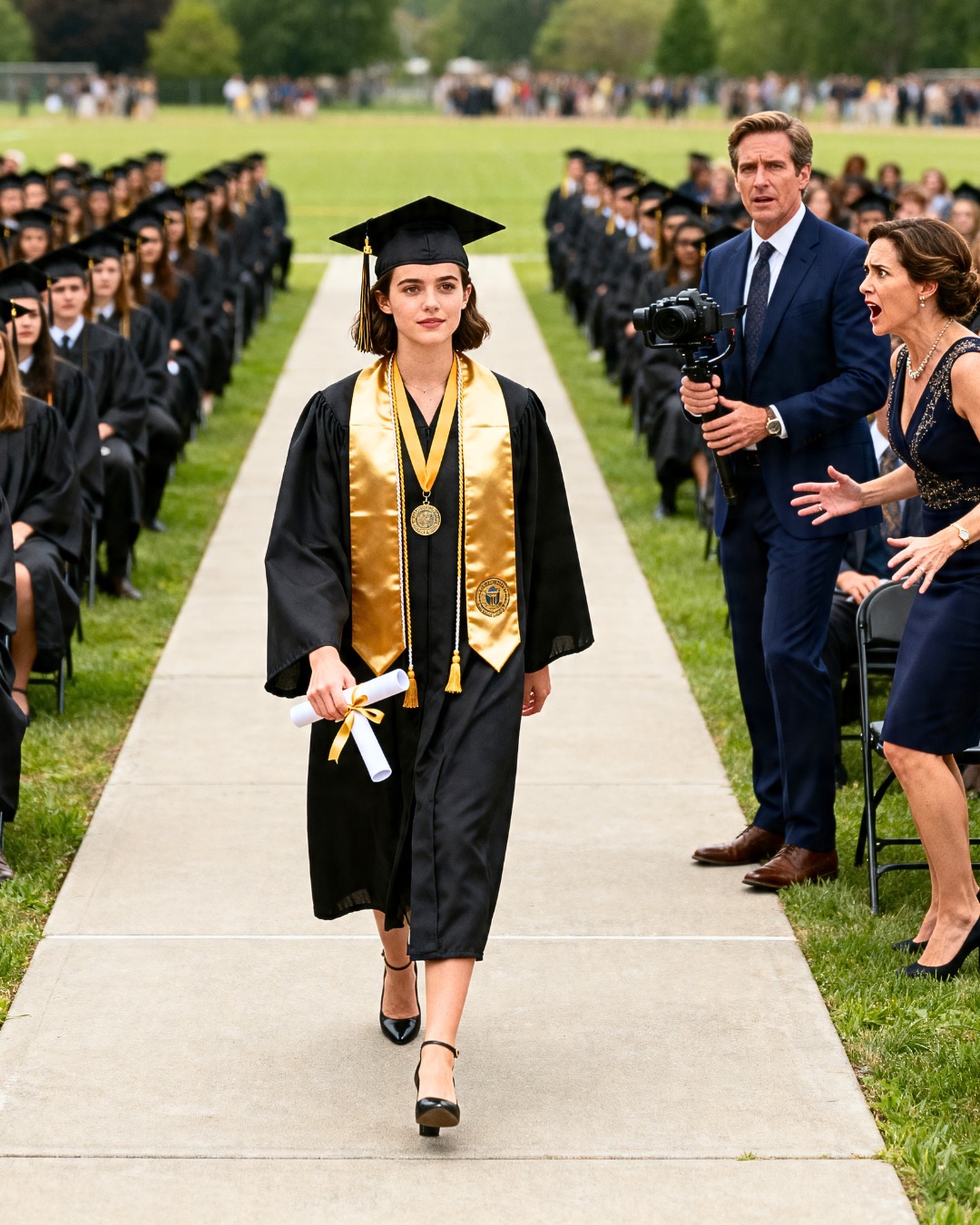
My parents paid for my twin sister’s college but refused to pay for mine because they said I wasn’t worth the investment. Four years later, they sat in the front row at her graduation and heard my name called as valedictorian.
My name is Avery Collins, and two weeks ago I stood on a graduation stage in front of thousands of people while my parents sat proudly in the front row, completely unaware that the valedictorian about to speak was the same daughter they once decided was not worth investing in.
They had not come for me. They had come to celebrate my twin sister.
And when my name echoed through the stadium speakers, the silence on their faces said more than any speech ever could.
But that moment did not begin with applause. It began four years earlier in our family home in Denver, on a warm summer evening when two college acceptance letters changed everything.
The envelopes arrived on the same day.
My sister, Sadie Collins, opened hers first. She had been accepted into Ashford Heights University, an elite private school with a reputation for wealthy families, powerful connections, and tuition costs high enough to make most parents pause.
Mine came next. My hands shook as I opened my letter and saw that I had been accepted into Silver Lake State University, a respected public school with a strong academic program. It was not glamorous, but it was solid. It was the kind of place built for students who worked hard and kept going.
I looked up, waiting for the same excitement that had just filled the room for Sadie.
It never came.
That evening my father called what he liked to call a “family discussion” in the living room. He sat in his usual chair with his back straight and his hands folded, looking less like a father and more like a man reviewing a business proposal. My mother sat beside him. Sadie leaned against the wall, smiling faintly, already carrying herself like someone whose future had been secured.
I sat across from them with my acceptance letter folded in my lap.
“We need to talk about college finances,” my father said.
Then he turned to Sadie.
“We’ll be covering your full tuition at Ashford Heights. Housing, meals, books, everything.”
Sadie let out a breathless laugh and threw her arms around him. My mother immediately started talking about dorm decor, orientation, and flights for move-in weekend.
Then my father looked at me.
“Avery,” he said evenly, “we’ve decided not to fund your education.”
At first the sentence didn’t make sense. It floated in the air without landing.
“I’m sorry,” I said. “What?”
He clasped his hands together. “Your sister has exceptional people skills. Ashford Heights is the kind of environment that will maximize her potential. It’s a strong investment.”
Investment.
The word was so cold I felt it in my chest.
“And me?” I asked quietly.
He barely hesitated.
“You’re intelligent,” he said. “But you don’t stand out the same way. We don’t see the same long-term return.”
I stared at him.
My mother kept her eyes lowered. She did not interrupt. She did not disagree. Sadie had already pulled out her phone and started texting, the corners of her mouth lifted in excitement.
“So I’m just supposed to figure it out on my own?” I asked.
My father gave the smallest shrug.
“You’ve always been independent.”
That was it.
No discussion. No comfort. No promise that they would help in some other way. Just a decision delivered like it had been made long before I entered the room.
That night I sat in my bedroom listening to laughter drift up from downstairs while I stared at the ceiling in the dark. I expected to cry. I expected anger. Instead, I felt something far quieter and much sharper than either of those things.
Clarity.
All at once, years of memories rearranged themselves into a pattern I could no longer pretend not to see.
Birthdays where Sadie got elaborate surprises while mine were simple and practical. Vacations organized around what she liked to do. Family photos where she stood in the middle while I naturally, silently, moved toward the edge.
I had not imagined the imbalance.
I had just learned not to name it.
Around midnight, I pulled out my old laptop—the one Sadie had discarded when she got a newer one—and typed into the search bar: full scholarships for independent students.
The results filled the screen.
Deadlines. Essays. Grants. Fellowships. Part-time job forums. Student housing threads. Impossible odds and tiny openings.
I kept scrolling.
Because if they thought I was not worth investing in, then I would have to become the person who invested in herself.
Downstairs, my parents were still talking about Ashford Heights and all the doors it would open for Sadie. No one came to check on me. No one knocked on my door.
I opened a notebook and started writing numbers. Tuition. Books. Rent. Work hours. Transportation. Food. Every calculation made my stomach tighten, but each line also gave me something I had not felt all evening.
Control.
That was the night I stopped waiting to be chosen.
The next morning felt almost offensively normal. Sunlight poured into the kitchen. My father reviewed meal plan options for Sadie over breakfast. My mother showed her photos of dorm furniture and pastel bedding. Sadie laughed and talked about campus events and the kind of people she hoped to meet.
I sat there quietly eating toast.
Nobody asked how I was going to pay for school.
At first I told myself maybe they needed time. Maybe the conversation would continue later, after emotions settled. Maybe my father would come upstairs that night and say he had been too harsh.
He never did.
Instead, the decision settled over the house as if it had always existed. And once I let myself see the truth, I started noticing how many times my role in the family had already been written for me.
When we turned sixteen, Sadie woke up to a new car in the driveway with a red ribbon across the hood. My parents filmed her reaction while she cried and hugged them. That same evening my father handed me her old tablet.
“It still works,” he said. “You don’t really need anything brand-new.”
I thanked him.
I always thanked them.
On vacations, Sadie chose the destination. Sadie picked the activities. Sadie got her own room because she “needed space.” I slept wherever there was room—on a pullout couch, on a lumpy daybed, once in a narrow little alcove a hotel cheerfully described as “cozy.”
Years earlier I had asked my mother about it.
She smiled and said, “You’re easygoing, Avery. Your sister needs more attention.”
Easygoing became the explanation for every smaller portion I was given. Sadie got the designer prom dress. I got the discounted one. She went to leadership camps. I picked up extra shifts at a local store.
Each moment on its own was small enough to dismiss.
Together, they formed something undeniable.
One afternoon that summer, my mother left her phone on the kitchen counter while she stepped outside. A message thread with my aunt was open. I should not have looked. I knew that. But I did.
“I feel bad for Avery,” my mother had written. “But Mark’s right. Sadie has more presence. We have to be practical.”
Practical.
The same word my father had used.
I set the phone down exactly where I found it and went upstairs. Something in me did not break. It settled into place.
That night I stopped hoping for fairness.
I started planning.
I wrote page after page of numbers until the figures blurred. Silver Lake State was still expensive, even with in-state tuition. My savings would barely cover books. Four years looked impossible. Every option came with risk—debt, burnout, failure.
I imagined future family gatherings where relatives praised Sadie’s achievements and politely asked what I was doing now.
“She’s still figuring things out.”
That thought burned hotter than anger.
Around two in the morning, sitting cross-legged on the floor, I realized something I had never fully admitted to myself before.
No one was coming to rescue me.
And strangely, that truth felt freeing.
I searched scholarship databases until sunrise. Most opportunities seemed designed for students with polished resumes, mentors, and time. Still, I bookmarked everything.
One in particular caught my attention: Silver Lake State’s merit scholarship for independent students. Full tuition. Only a few students chosen each year.
The odds were terrible.
I saved it anyway.
Then I found another program—a national fellowship that selected just twenty students across the country.
I almost laughed out loud.
Twenty.
Still, I bookmarked that one too. Because sometimes belief begins before confidence does.
The rest of that summer unfolded in two completely different worlds under the same roof. Downstairs, my parents helped Sadie order bedding, furniture, and travel outfits for Ashford Heights. Boxes filled the hallway. Excitement followed her through every room.
Upstairs, I researched housing, jobs, and class schedules. I built a future so quietly that no one seemed to notice it was happening.
A week before school started, Sadie posted beach photos with captions about new beginnings and endless possibilities. I packed thrift-store sheets and secondhand notebooks into an old suitcase.
By then, our lives were already splitting apart.
The first day I arrived at Silver Lake State, I had two suitcases, a backpack full of borrowed textbooks, and a bank balance that made me feel sick every time I checked it.
Orientation week was a parade of families carrying boxes into dorm buildings, hugging their kids, taking photos on the lawn, promising visits and care packages and Sunday phone calls.
I dragged my luggage across campus alone.
Dorm housing cost too much, so I rented a tiny room in an aging house five blocks from campus. The walls were thin. The heater clanged. The paint near the window peeled in long curls. Four other students lived there, but we all kept different schedules and moved around each other like strangers in a train station.
My room was barely big enough for a narrow bed and a small desk pressed against the wall.
Still, it was mine.
Affordable meant possible.
My alarm went off at 4:30 every morning. By five, I was at a campus café called Lantern Coffee, tying on an apron while half-awake students shuffled in for drinks and breakfast sandwiches. I learned orders faster than names. Smiling became muscle memory.
Classes filled the rest of the day—economics, statistics, writing, political theory. I sat near the front and took careful notes because I could not afford to miss anything, not even once.
At night I studied until my eyes blurred. On weekends I cleaned residence halls for extra money. Most days I slept four hours. Some days, less.
While other freshmen went to football games or late-night parties, I memorized formulas during lunch breaks and hunted down cheaper used textbooks online. I learned which library corners stayed warm in winter and which vending machine on the third floor sometimes dropped two granola bars instead of one if you hit the buttons in a certain order.
Small victories mattered when everything else was held together by effort.
Thanksgiving came and campus emptied almost overnight. Parking lots cleared. Dorm windows went dark. The whole place grew so quiet it felt abandoned.
I stayed.
Travel home was impossible financially, and even if I had somehow managed it, I was no longer sure I would have been missed.
Still, I called.
My mother answered after several rings, her voice distracted by laughter behind her.
“Oh, Avery, happy Thanksgiving.”
I could picture the scene before she even described it—warm lights, full table, Sadie telling stories from Ashford Heights while my father looked proud.
“Can I talk to Dad?” I asked.
There was a pause.
Then, muffled but unmistakable, I heard his voice in the background.
“Tell her I’m busy.”
The words landed softly, but they landed hard.
My mother came back on the line too quickly.
“He’s in the middle of something.”
“It’s okay,” I said. “I just wanted to say hi.”
She asked whether I was eating enough, whether I needed anything.
I looked down at the instant noodles on my desk and the cheap blanket wrapped around my shoulders.
“No,” I said. “I’m fine.”
After I hung up, I made the mistake of opening social media.
The first photo I saw was Sadie sitting between our parents at the Thanksgiving table, all three of them smiling into the camera.
The caption read: “So grateful for my family.”
I stared at the image and counted the place settings.
Three.
It should not have hurt anymore, but it did.
Still, that was the night something changed for good. The hope that they might eventually become different did not vanish all at once. It simply dimmed. And when it dimmed, disappointment lost some of its power.
Second semester was harder. My classes intensified. My jobs felt heavier. Some mornings I woke up so tired I could not immediately remember what day it was.
One morning, halfway through a café shift, the room tilted. I grabbed the counter as my vision blurred.
My manager rushed over. “Avery, sit down.”
“I’m okay,” I said automatically.
“You almost collapsed.”
She guided me into a chair and handed me water. “You need rest.”
I nodded even though we both knew I would be back at five the next morning. Rest was a luxury, and luxury had never really belonged to me.
Every night before I fell asleep, I repeated the same sentence to myself.
This is temporary.
Temporary exhaustion. Temporary loneliness. Temporary hunger. Temporary instability.
What was not temporary was what I was building.
A few weeks later, after I submitted an economics paper I had written in fragments between shifts, I felt a rare little flicker of pride. Two days after that, the papers were returned.
At the top of mine, in bold red ink, were the words A+ and a note beneath them.
Please stay after class.
My stomach tightened instantly. I packed my things slowly, convinced I had somehow misunderstood the assignment or crossed a line I had not meant to cross.
When the room emptied, I walked to the front of the lecture hall where Professor Nathan Cole stood organizing his papers.
“Avery Collins,” he said. “Sit.”
I lowered myself into the chair across from him.
He slid my essay toward me. “This paper is exceptional.”
I blinked. “I thought maybe I’d done something wrong.”
“You didn’t.”
The silence that followed felt almost suspicious. Praise had always seemed conditional in my life, like something that could be withdrawn the moment someone looked more closely.
“Where did you study before this?” he asked.
“Public high school,” I said. “Nothing special.”
“And your family?”
I hesitated. Then I said, “They’re not involved in my education. Financially or otherwise.”
He did not interrupt. He just waited.
Something in his expression made honesty easier than I expected. I told him about the two jobs. The four hours of sleep. The scholarship searches. The living room conversation. Without planning to, I repeated my father’s exact words.
“Not worth the investment.”
Professor Cole leaned back slightly.
“Do you know why this essay stood out?” he asked.
I shook my head.
“Because it wasn’t written by someone trying to sound brilliant,” he said. “It was written by someone who understands effort.”
Then he opened a drawer and pulled out a thick folder.
“Have you heard of the Sterling Scholars Fellowship?”
I nodded. “I saw it online.”
“And?”
“And it seemed impossible.”
“Most worthwhile things do,” he said.
He placed the folder in front of me.
“I want you to apply.”
I stared at it. “I work two jobs. I barely keep up with classes. That program picks twenty students in the country.”
“Exactly,” he said calmly. “It’s for students with ability and resilience. You have both.”
“People like me don’t win things like that.”
He met my gaze without flinching. “People like you are exactly who should.”
I took the folder home and spread the papers across my desk that night. Essays. Recommendations. Interviews. Deadlines. Requirements that seemed built for students with support systems and free time and confidence.
But I opened a blank document anyway.
The cursor blinked.
Days turned into weeks of class, work, and writing. I drafted essays before sunrise, revised them during lunch breaks, and edited them at night until the words stopped looking like language. My laptop grew hot beneath my hands.
The hardest prompt asked: Describe a moment that changed how you see yourself.
I stared at it for nearly an hour.
I had not founded an organization. I had not traveled internationally. I had not done anything dramatic enough to sound impressive in the polished way scholarship committees seemed to like.
All I had done was survive.
Eventually I realized that survival was the answer.
I wrote about counting grocery money in coins. About learning discipline in silence. About studying in empty classrooms after everyone else had gone home. About the strange loneliness of becoming your own safety net.
When Professor Cole returned the first draft, his notes covered the margins.
“You’re still protecting people who didn’t protect you,” he said. “Tell the truth.”
So I rewrote it.
The recommendations were even harder to ask for. I was not used to depending on anyone. But when I finally explained my situation, two professors agreed immediately. One of them said, “You are one of the most determined students I’ve ever taught.”
I carried that sentence with me for weeks.
Life did not pause to make room for the application. Midterms collided with work schedules. I memorized formulas while steaming milk and practiced interview answers while waiting for the bus. One afternoon, while carrying a tray of drinks, I got so dizzy that I dropped half of them and woke up on the café floor with my manager crouched beside me.
“You fainted,” she said softly.
“I’m fine,” I whispered, mortified.
“No,” she said. “You’re exhausted.”
That night I checked my account balance after rent.
Thirty-six dollars.
I ate instant noodles and stared at interview questions while the radiator rattled beside me.
Somewhere, I knew other applicants were probably preparing from quiet bedrooms in houses where people believed in them. They had polished resumes, guidance counselors, parents who proofread essays and drove them to interviews.
I had determination.
And by then, determination felt stronger than fear.
Weeks later, an email arrived while I was unlocking the café doors before dawn.
Subject: Sterling Scholars Application Update.
My hands shook so badly I nearly dropped my phone.
Congratulations. You have advanced to the finalist round.
I read it three times before it felt real.
That afternoon I rushed to Professor Cole’s office.
“I made it to finals,” I said.
He nodded once, as if he had been expecting exactly that. “Good. Now we prepare.”
The final round involved live interviews. A panel. Questions about leadership, resilience, long-term goals. Just reading the instructions made my chest tighten.
“What if I blow it?” I asked one day during practice.
Professor Cole folded his arms. “Failure isn’t being rejected. Failure is hiding who you are because you think it won’t be enough.”
We practiced relentlessly. He challenged every vague answer, every attempt at modesty, every instinct I had to shrink my own story.
Meanwhile, home remained quiet. Sadie kept posting photos from Ashford Heights—formal dinners, networking events, visits from our parents. My mother commented hearts. My father wrote things like Proud of you.
No one asked how I was doing.
At first that silence hurt. Eventually, it became background noise.
The interview took place in a glass-walled conference room on a cold afternoon. I wore the only blazer I owned, slightly too big in the shoulders but carefully pressed. They asked me about hardship, ambition, work, and what success meant when no one was watching.
For the first time in my life, I stopped trying to sound impressive.
I just told the truth.
When it ended, I walked outside into the cold and felt emptied out. I could not tell whether I had done well or terribly. The waiting that followed was its own form of torture. Every notification made my pulse jump. Every quiet day felt endless.
Then, one Tuesday morning while I was crossing campus, my phone buzzed.
Sterling Scholars Final Decision.
I stopped walking.
Students moved around me, laughing, heading to class, complaining about weather and exams and weekend plans. The whole world felt ordinary except for the screen in my hand.
I stared at it for several seconds before I opened it.
Dear Avery Collins, we are pleased to inform you that you have been selected as a Sterling Scholar for the class of 2025.
I sat down on the nearest bench because my knees suddenly felt unreliable.
Selected.
Full tuition. Annual living stipend. Academic placement opportunities at partner universities across the country.
I laughed once—one broken, stunned little sound—and then I cried.
All the early shifts. The skipped meals. The loneliness. The nights I wondered whether effort mattered when no one saw it. Someone had seen it.
I called Professor Cole immediately.
“I got it,” I said, my voice shaking.
“I know,” he replied. “I got the confirmation this morning.”
I laughed through tears. “You sound less surprised than I am.”
“That’s because I knew what you were capable of before you did.”
Then his tone shifted slightly.
“There’s something else you need to understand about the program,” he said.
I straightened.
Sterling Scholars, he explained, could transfer to one of the fellowship’s partner universities for their final academic year. Many did, depending on academic goals and placement opportunities.
I opened the attachment he mentioned and started reading the list.
Then I saw it.
Ashford Heights University.
My sister’s school.
The same campus my parents had decided I was not worth.
“If you transfer,” Professor Cole continued, “you would enter their honors track. Sterling Scholars in that track are frequently selected to deliver the commencement address.”
I stared at the screen.
“You mean valedictorian consideration?”
“Yes.”
For a long moment I said nothing.
I thought of my father sitting in that chair four years earlier, sliding my future aside like it was a bad investment.
“I’m not doing this to prove anything,” I said quietly.
“I know,” Professor Cole said. “You’d be doing it because you earned it.”
After we hung up, I sat there for a long time.
Then I filled out the transfer paperwork.
I did not tell my parents. Not because I was trying to punish them. Because for once I wanted something in my life that belonged entirely to me.
The move to Ashford Heights happened at the start of the fall semester. The campus looked exactly like the photos Sadie had posted—stone buildings, green lawns, students walking around as if confidence had been built into their bones.
For the first few weeks I kept my head down. I went to class. I studied. I rebuilt my routine. No announcements. No explanations.
Then one afternoon I was in the library reviewing notes when I heard a voice I had known all my life.
“Avery?”
I looked up.
Sadie stood there holding an iced coffee, staring at me like she had seen a ghost.
“How are you here?” she asked.
“I transferred.”
She blinked. “Mom and Dad didn’t say anything.”
“They don’t know.”
Her expression sharpened with confusion. “How are you paying for this?”
“Scholarship.”
She was quiet for a moment. I watched surprise give way to disbelief, then something more complicated. Something that looked a little like guilt.
I started gathering my books.
“I have class,” I said.
As I walked away, my phone began vibrating in my pocket. I did not need to look to know what it was.
Missed calls from my mother. Messages from Sadie. Then one text from my father.
Call me.
For years, silence had belonged to them.
Now it belonged to me.
I waited until the next morning to answer.
“Avery?” my father said the moment I picked up.
“Yes.”
“Your sister says you’re at Ashford Heights.”
“I am.”
“You transferred without telling us.”
I stood in the middle of the courtyard while students moved around me.
“I didn’t think you’d care,” I said.
A pause.
“Of course I care,” he said. “You’re my daughter.”
The sentence felt strange, almost misplaced.
“Am I?” I asked softly.
He did not answer.
“You told me I wasn’t worth investing in,” I said. “I remember it clearly.”
“That was years ago.”
“I know,” I replied. “It still mattered.”
He exhaled slowly. “How are you paying for Ashford Heights?”
“Sterling Scholars.”
Another silence, longer this time.
“That’s extremely competitive.”
“Yes.”
“And you won it?”
The disbelief in his voice would have hurt once. At that moment, it barely touched me.
“Yes.”
Eventually he said, “We should talk in person. Your mother and I will be at graduation for Sadie anyway.”
Even then, he assumed the day belonged entirely to her.
“I’ll see you there,” I said, and ended the call.
The months before graduation passed quickly. Honors meetings. Faculty reviews. Speech planning. And then one afternoon my academic coordinator handed me an envelope.
Inside was the formal confirmation.
Valedictorian.
I read the word again and again.
I signed the paperwork. Reviewed ceremony instructions. Scheduled rehearsal times. Around me, the campus buzzed with graduation parties and family plans. Sadie posted smiling pictures with our parents. They commented proudly, completely unaware of what was waiting for them.
Professor Cole called a few days before the ceremony.
“Do you want your family informed about the speech beforehand?” he asked.
I looked out the window at students crossing the quad below.
“No,” I said. “This isn’t about surprising them. It’s about telling the truth.”
Graduation morning arrived bright and clear. Families filled the walkways carrying bouquets and balloons. Cameras flashed everywhere. The whole campus felt like it was vibrating with celebration.
I entered through the faculty gate in my robe and honors sash, my Sterling medallion cool against my chest.
From my seat near the front, I could see the entire stadium.
And then I saw them.
Front row. Center seats.
My father adjusting his camera. My mother holding white roses. Both of them smiling, waiting to capture Sadie’s moment.
Sadie sat a few rows back with her friends, taking selfies and laughing.
For a second I just watched them. They looked so certain. So comfortable inside the version of the story they believed.
The ceremony began. Names blurred. Speeches came and went. Applause rose and fell.
Then the university president stepped to the podium.
“And now,” he said, “it is my honor to introduce this year’s valedictorian and Sterling Scholar, a student whose resilience and academic excellence embody the spirit of Ashford Heights University.”
My father lifted his camera toward Sadie’s section.
“Please welcome,” the president continued, “Avery Collins.”
Time stopped.
Then I stood.
Applause burst across the stadium as I stepped forward. My mother’s smile fell away. My father lowered the camera and stared. Sadie turned sharply, searching the stage until her eyes found mine.
I walked to the podium.
Three thousand people were clapping.
My parents were not.
They sat frozen as if reality had split open in front of them.
I adjusted the microphone and looked out over the crowd.
“Good morning,” I said. “Four years ago, someone told me I wasn’t worth the investment.”
The stadium went still.
“I was told to expect less from myself because other people expected less from me.”
Nobody moved.
I spoke about working before sunrise and studying after midnight. About learning to believe in myself in the absence of recognition. About the quiet damage of being overlooked and the deeper strength that can grow in its place.
I did not name my parents. I did not need to.
“The most important lesson I learned,” I said, “is that your worth does not begin when someone else notices you. It begins when you decide to see yourself clearly.”
A few people in the crowd were crying. Others nodded slowly.
“To anyone who has ever felt invisible,” I said, “you are not.”
When I finished, there was a brief heartbeat of silence.
Then the entire stadium rose.
The applause came like thunder.
I stepped away from the podium feeling strangely calm. Not triumphant. Not vindicated. Just free.
At the reception afterward, my parents found me in the middle of the crowd.
“Avery,” my father said. “Why didn’t you tell us?”
I looked at him for a long moment and said, “Did you ever ask?”
He opened his mouth, then stopped.
My mother’s eyes were wet. “We didn’t know.”
“You knew enough,” I said.
“That’s not fair,” my father said, but there was no conviction behind it.
“Fair?” I repeated quietly. “You told me I wasn’t worth investing in. You gave everything to Sadie and told me to figure it out myself. So I did.”
Neither of them argued.
My mother reached for my arm. I stepped back.
“I’m not angry,” I said, and I realized as I said it that it was true. “I stopped being angry a long time ago.”
My father’s shoulders sank.
“I was wrong,” he said finally. “I said things I shouldn’t have said.”
“No,” I replied. “You said exactly what you believed.”
That hit him harder than accusation would have.
A few minutes later a representative from the fellowship approached to congratulate me, speaking warmly about leadership opportunities and future placements while my parents stood there watching someone else value me openly.
When he left, my mother said softly, “Come home this summer. Please. We can talk.”
“I’m moving to Boston in two weeks,” I said. “I already accepted a job.”
My father blinked. “Already?”
“I’ve been preparing for a long time.”
He looked at me helplessly. “What do you want from us?”
I thought about that.
For years, I would have had an answer. Recognition. Fairness. An apology large enough to match the damage.
Standing there, I realized I did not need any of it.
“I don’t want anything,” I said. “That’s the point.”
Sadie approached us then, awkward and uncertain.
“Congratulations,” she said.
“Thank you.”
She swallowed. “I should have asked how you were doing.”
“We were kids,” I said. “We didn’t create this. We just grew up inside it.”
Her face softened with relief. “Maybe we can try again. As sisters.”
I gave a small nod. “Maybe.”
A few months later I was standing in a tiny apartment in Boston with a set of keys in my hand. The place was small and noisy and nothing about it was impressive except that it was mine. I started work the following week at a consulting firm, and for the first time in my life, exhaustion felt like progress instead of survival.
My mother wrote to me first. Three pages full of regret, memory, and the line I read more than once:
I see you now. I just wish I had seen you sooner.
I folded the letter and put it away. I did not answer immediately. Healing would happen on my time.
My father called a few weeks later.
“I was wrong,” he said without preamble. “Not just about the money. About you. About everything.”
I sat on the edge of my bed and listened.
“I don’t expect forgiveness,” he said. “I just needed you to hear that.”
I looked around my apartment at the life I had built piece by piece without their permission or support.
“I hear you,” I said.
It was not reconciliation. Not yet. But it was honest, and honesty was more than we had ever had before.
Life moved forward. Sadie and I began meeting occasionally when schedules allowed. The conversations were awkward at first, then easier. Without comparison standing between us, we were finally learning how to be sisters.
One year later, I made a donation to Silver Lake State’s scholarship fund for students without family financial support. It was anonymous. I did not need anyone to know. Someone had opened a door for me. I wanted to hold one open for someone else.
I still think sometimes about that summer evening in the living room, my father explaining with perfect calm why I was not worth the investment.
For a long time, I thought success would erase that memory.
It didn’t.
But it changed what the memory meant.
Because their rejection did not define my value. It forced me to discover it for myself.
If I’ve learned anything, it’s this: you cannot earn love by becoming successful enough. You cannot wait forever for someone else to recognize your worth. And you cannot build your life around approval that may never come.
At some point, you choose yourself.
Two years after graduation, my parents visited me in Boston. The conversations were careful, imperfect, and sometimes uncomfortable, but real. We were not suddenly a flawless family. Maybe we never would be. But at least now we were speaking the truth.
One morning after they left, I locked my apartment door and stepped out into the city noise with coffee in one hand and my work bag over my shoulder, and I realized the feeling I had spent years chasing finally had a name.
Freedom.
Not revenge. Not validation.
Just the quiet certainty that I know exactly who I am.