The beach house in the early morning has a kind of silence that is difficult to describe to anyone who has never stood alone by the Atlantic before sunrise because it is not actually silent at all.
There is always the constant movement of the water which creates a sound so steady that your ears eventually stop treating it as noise and begin treating it as a rhythm inside your own body.
It comes in, pulls back, breaks, and gathers itself again without ever being hurried or apologetic about whether you have managed to sleep through the night.
I could hear gulls arguing somewhere above the dunes while the wind moved through the sea grass in thin, dry whispers that sounded like secrets being shared.
Sometimes, when the tide was exactly right, I could hear shells dragging lightly in the foam like small bones being sorted by an invisible hand along the shoreline.
It was a full and living silence, the kind of silence I had been coming to Sandpiper Point for since my husband died nine years earlier and the kind I returned to whenever the city of Charlotte became too loud with people who wanted something from me.
That morning, I had been awake for twenty minutes before Mateo called me from the security desk of my city apartment.
I had not been woken by any specific sound, but rather by the habit I had developed over the previous year of waking before dawn regardless of my intentions.
It was a particular kind of waking that I did not have in my thirties or forties, not even during the most stressful years of building my real estate consulting firm.
This was different because it felt like the body rising before the mind was ready, as if some animal part of me had heard movement in the dark and decided the safest thing was to be conscious and alert.
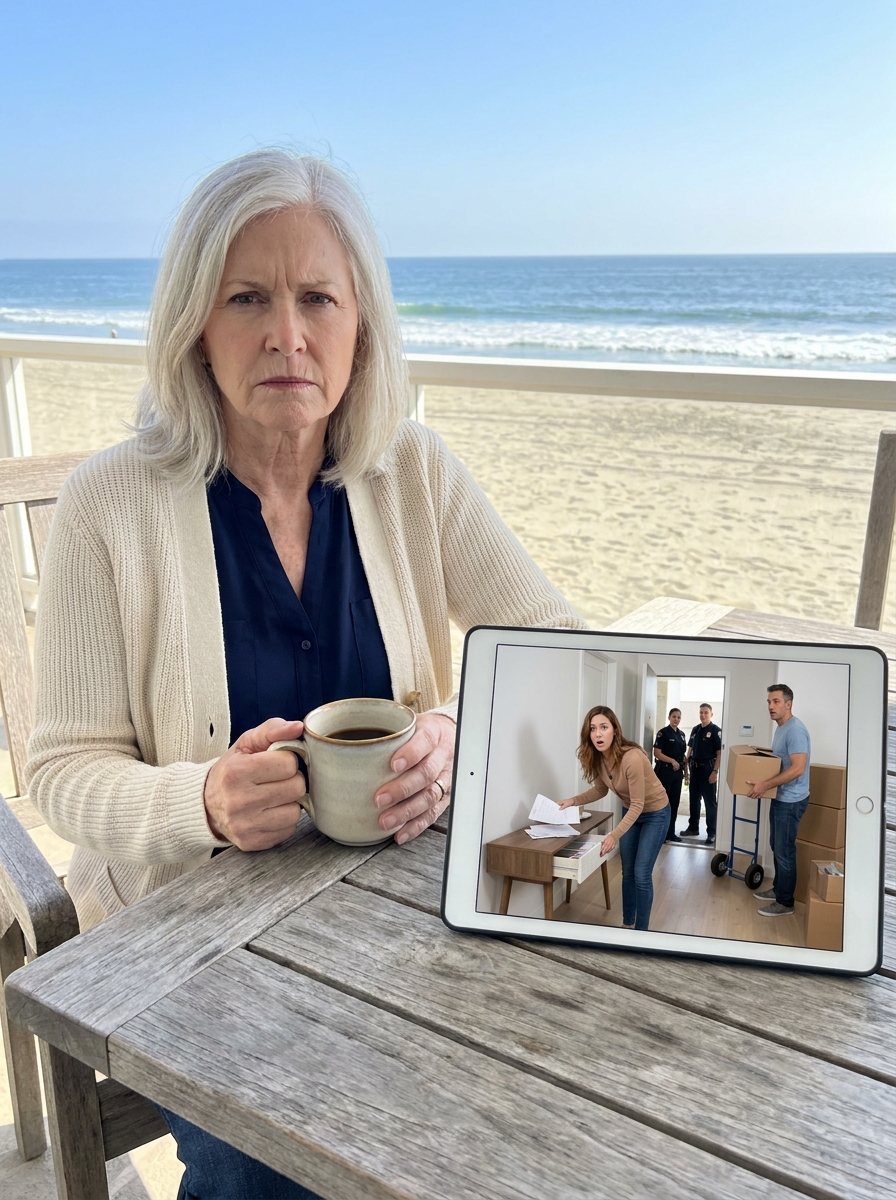
I was standing barefoot on the wooden deck of the house in Sandpiper Point, wearing an old linen robe and holding a mug of coffee that I had prepared entirely by myself.
That small detail mattered more than I realized at the time because the coffee was mine and the beans had been ground by my own hands while the water was poured by me into a mug taken from a cupboard only I had opened.
No one had brought the drink to me or stirred anything into it, and no one had handed it over with a rehearsed smile while watching to see whether I actually drank it.
I had been watching the light change over the gray water, which happens slowly and then suddenly as the horizon becomes a color that the English language does not name properly.
I had been thinking about the tea for several weeks, as it was the place where I finally admitted to myself that something dangerous had started in my family.
My name is Martha Covington, and I was sixty seven years old that morning, though I have never known what people expect that number to mean in terms of my capability.
I was not fragile or confused, nor was I lonely in the dramatic way that younger people like to imagine older women become as if loneliness is an abandoned room rather than a changing weather pattern.
I was healthy and organized and considerably sharper than most people gave me credit for, which was a reality I had learned to treat as a significant professional advantage.
Women of my age are often underestimated in ways that would have enraged me when I was younger, but now I find it incredibly useful to be overlooked by the careless.
People who underestimate you are often very careless in front of you because they assume your silence means you have missed something when you are simply waiting to see what else they will reveal.
I had built a successful real estate consulting practice over twenty five years, helping investors and developers make sense of complicated properties before they made very expensive mistakes.
I did not sell glamour or decorations, but instead I sold accuracy by walking through a building and seeing the lies hidden behind fresh drywall or buried in polite zoning language.
I did well because I did not fall in love with appearances, which is a lesson that is useful in real estate and essential in family life, though many people learn that second part too late.
When I sold the firm, the proceeds were considerably more than most people expected, and I invested the money carefully with people who valued discipline over drama.
None of that success had been built with the help of my son, Julian, whom I loved completely even though I did not trust his financial judgment at all.
Those two truths had coexisted peacefully for decades because Julian was not a bad man, he was simply generous and charming but weak in very specific ways.
He was intelligent enough to explain his mistakes after making them, but he was never disciplined enough to avoid them in the first place because family money always cushioned his consequences.
As an adult, he drifted in the polished way that wealthy men are permitted to drift, holding a position at a boutique investment firm because the founder owed my late husband a favor.
He was my only child, which made me much more patient with his lack of direction than I probably should have been over the years.
Then he married Simone, a woman who entered our lives three years before the morning Mateo called me from the city.
Simone was thirty eight then, eleven years younger than Julian, and she carried herself like a woman who believed that age was a condition that only happened to other people.
She was beautiful in a way that seemed like a calculated strategy, with smooth dark hair and a voice pitched to imply an intimacy that she never actually offered.
She had worked in luxury brand consulting and always knew which restaurants were fashionable before anyone else, ensuring she was always dressed correctly for rooms where belongings mattered.
My instincts disliked her from the beginning, but the dislike arrived as a small tightening behind my ribs rather than a loud warning I could easily explain.
During their rehearsal dinner, I watched her from across the table while a friend of Julian’s gave a toast that was more about his own cleverness than about the couple.
Everyone else looked toward the speaker, but Simone did not, as her eyes moved around the room the way eyes move when they are making a permanent record of assets.
She looked at the antique mirrors and the jewelry on the guests, and then her gaze passed over the silver-framed photograph of my late husband before landing on my own hands.
She was inventorying the estate in her mind, and when our eyes finally met, she flashed a reflexive smile used by people who have been caught looking at things they do not own.
I smiled back and realized that she had been planning her future for much longer than the duration of the wedding weekend.
I said nothing to Julian because saying something at that moment would have meant losing the argument before it even began, as he would have only heard jealousy or possessiveness.
Simone would have also learned that I noticed her behavior, and people like her become much more dangerous when they know exactly what you can see.
So I watched and adjusted quietly, moving certain financial documents out of my study and changing passwords to accounts that Julian had known about for years.
I opened a new safe deposit box at a private bank instead of using the one my family had used for generations, and I began keeping a written log of every odd remark or missing item.
It started with a silver pen from my desk and then a photograph of the beach house that had been moved slightly on the shelf as if someone had been looking at the back of it.
Julian noticed none of these things because he was in love, or at least he was relieved that Simone had given his drifting life a sense of shape and schedule.
“She is really good for me, Mom, and she makes me want to be a better version of myself,” Julian told me once during a lunch where he seemed particularly defensive.
I looked at him and replied, “No one truly makes another person better, Julian, though they may inspire or demand it, the actual work always remains yours to do.”
He rolled his eyes the way he had when he was sixteen and said, “This is exactly why I do not tell you things because you always turn everything into a lecture.”
I changed the subject because I knew that truth is often a seed rather than a hammer, and I simply needed to wait for the right time for it to grow.
Simone became very attentive after the wedding, calling me every Sunday to check in and bringing expensive flowers to my apartment that never quite fit the style of the room.
She sent me articles about the emotional freedom of simplifying possessions and used the phrase “the next stage of life” often enough that I began to hear the outline of a campaign.
“You have so much to manage in this big apartment, Martha, and it must be absolutely exhausting for you at your age,” Simone said one afternoon while sitting in my living room.
I looked at her and replied, “It is not particularly exhausting, as I have always enjoyed the process of managing my own affairs and my own home.”
She smiled and said, “Still, I hope you know that Julian and I would never let you feel alone in any of the challenges that life brings your way.”
I kept my voice warm as I replied, “How very thoughtful of you,” while I watched her eyes pause on the Japanese ceramic vases arranged on my mantel.
The tea began about a year after the wedding when she arrived one afternoon with a thermos, claiming she had found a special herbal blend for sleep in a wellness shop.
“I remember you mentioned you had been waking up very early lately, so I thought this might help you rest more deeply,” she said as she poured a cup for me.
I accepted the drink because refusing such a gesture requires a reason, and women of my generation were trained to preserve social smoothness even when our instincts object.
The tea tasted of chamomile and honey, but there was something faintly bitter beneath the sweetness that I could not quite identify at the time.
That night I slept much too heavily, and the next morning I woke with a fog in my head that felt chemical in quality as if my mind had been wrapped in damp wool.
I stood in the kitchen holding a spoon and found that I could not remember whether I had already fed the cat, even though I had not owned a pet in over a decade.
The moment passed, and I told myself I was just tired, but two weeks later Simone brought the tea again, and the foggy morning returned with even more intensity.
I opened my calendar and stared at a lunch appointment for a full minute before I could remember who the person was or why I had agreed to meet them.
After I hung up from a call with Julian where I had struggled to find the word for “radiator,” I sat down and wrote the date and the symptoms in my private log.
I made an appointment with my physician, Dr. Sarah Miller, who had been my doctor for fifteen years and was known for her low tolerance for vagueness in her patients.
After the bloodwork returned unremarkable, Dr. Sarah looked at me and said, “Martha, you are healthier than half of my fifty year old patients, so tell me when exactly this fog happens.”
I thought about the thermos in Simone’s hand and replied, “It happens in the mornings, usually after I have had visitors the day before.”
She did not push me further but instead instructed me to keep a very detailed log of everything I ate and drank, along with every person who entered my home.
The pattern emerged almost immediately, as the fog only appeared after Simone’s visits and the cups of tea she insisted on pouring for me.
I stopped drinking the tea, but I did not make a scene or an accusation; instead, I became a woman who was temporarily avoiding herbal blends or who was too busy to sip.
I would let the cup cool while we talked, and then I would pour it down the kitchen sink while asking her if she wanted a glass of sparkling water instead.
The fog cleared instantly, and my body returned to itself in a way that was its own testimony to the fact that I was being systematically poisoned.
I called my attorney, Claire Hudson, who was a precise and unsentimental woman I had trusted for nearly twenty years to handle my most sensitive business affairs.
“Claire, I have reason to believe that my daughter in law may be attempting to drug me in my own home,” I said, and there was a long pause of focused attention on the line.
She did not sound shocked or doubtful, but instead she asked me to tell her exactly why I had come to that conclusion and what evidence I had gathered.
I gave her the dates and the symptoms and described Simone’s recent comments about my cognitive decline along with Julian’s sudden concern about my ability to manage my properties.
Claire listened without interrupting and then said, “Document every single thing, change your locks immediately, and whatever you do, do not confront her or warn Julian yet.”
She told me to trust myself, and that sentence meant more to me than she could have known because the world was trying very hard to make me doubt my own mind.
Over the next few months, I moved quietly to update my estate documents and remove Julian as my primary emergency contact, replacing him with Claire’s office for the time being.
I changed every password on my financial accounts and moved my most valuable jewelry to the safe deposit box, leaving only a few pieces and one jewelry box as a test.
I installed cameras in the entry, the hallway, the study, and my bedroom closet, making sure they were visible and legally placed according to the advice Claire had provided.
I spoke with Mateo, the head of security who had a Marine’s posture and noticed everything, and I told him that no one was to enter my apartment without my direct authorization.
“I understand completely, Ms. Covington,” Mateo said, and he entered a note into the building system that made it clear he understood more than I had even said aloud.
Simone noticed the new locks during a visit in February and asked about them with a smile that did not quite reach her eyes as she removed her gloves in my foyer.
“It was a building wide recommendation for security,” I replied, and she noted that Julian had not mentioned it to her, to which I asked why he would be informed about my locks.
In March, Julian began calling me more often, asking me if I had thought more about “simplifying” my life or moving into a facility with more support services.
“If I become incapacitated, Julian, my legal documents will handle that, but until then I plan on enjoying the management of my own life,” I told him firmly.
He sighed and said I was being difficult, but I told him he was simply repeating a language that did not belong to him and that was likely being fed to him by someone else.
By April, Simone escalated her campaign by speaking to my friends and expressing “concern” that I was becoming more scattered and forgetful lately.
My sister, Beatrice, called me from her home in Boston and asked, “What on earth is that woman up to with her fake honey voice and her questions about your transitions?”
I laughed and told her the truth, and Beatrice, who had always been ferociously direct, replied that she had never liked Simone and was glad her instincts were finally being validated.
By May, I had stopped letting Simone bring me anything edible, and I spent more time at the house in Sandpiper Point where I felt safe and where my mind was always clear.
The contrast between the two homes told me everything I needed to know, as I slept well and woke without any chemical fog when I was away from the city.
The night before Mateo called, I had been at the beach for five days, reviewing my quarterly statements and walking along the shore with a sense of strange and heavy calm.
Then my phone rang at 6:37 in the morning, and I answered it immediately to hear Mateo’s voice sounding uncharacteristically shaken on the other end.
“Martha, Simone is in the lobby right now with three men and a large moving truck, and she is claiming to be the new owner of the apartment,” Mateo said.
I felt a cold coil of focus move through my body, and I told him not to let them up and to tell her the elevator was currently under maintenance for the morning.
“She already signed the visitor log and showed me her driver’s license, so she is officially on the record as being here,” Mateo informed me, and I thanked him for his competence.
I called Claire and gave her the facts in under forty seconds, and she replied with a single word “Perfect” that steadied my heart more than any comfort could have.
“Do not go back there, Martha, and do not call either of them, but instead open your camera app and start recording everything that happens,” Claire instructed me.
I sat on the deck and watched the lobby camera as Simone stood there in a camel colored coat, looking like a woman who had dressed for a legal possession rather than a crime.
She produced a leather folder and showed it to the movers, and I could see them looking uncertain as they began to suspect the job was not as simple as they had been told.
The elevator eventually rose, and the hallway camera picked her up as she walked straight to my door with an authority that suggested she had rehearsed this many times.
She tried a key and it failed, and then she tried a second one that also failed, causing her jaw to tighten as she realized I had indeed changed the locks without telling her.
She removed a thin plastic card from her folder, and the head mover stepped back and said, “Ma’am, if you do not have a working key, we are not authorized to enter this residence.”
“I have a right to be here because the owner is incapacitated, and my husband and I are now handling all of her affairs,” Simone said, her voice caught clearly by the microphone.
The mover shook his head and said he was not going to force a door for an “estate move” where the owner was still alive, and he walked away toward the elevator.
Simone offered the other two movers three thousand dollars in cash to stay, and they hesitated before agreeing to help her work the plastic card into the lock mechanism.
The door finally swung open, and I felt a peculiar sense of violation watching strangers cross my threshold and flick on the lights of my private living room.
“Take the sofa, the walnut table, and those vases, as we want anything that is of significant value,” Simone commanded the men as she moved through the rooms.
She did not search like a thief but rather followed a floor plan she had already memorized, going directly to my bedroom closet and reaching for the jewelry box I had left there.
She opened it and I saw her face change to an expression of pure disappointment because she had clearly expected to find my most expensive pieces waiting for her.
She took several items anyway and placed them in a pouch, and then she made a phone call that I recorded with the audio turned as high as it would go.
“I am inside the apartment now, and we are taking the items while the old woman is away at the beach house,” she said into the phone with a cold and practical tone.
She laughed and added, “The woman is much too stupid to protect herself, and the tea and the sugar sedatives would have worked better if she were ever actually home.”
I stopped breathing for a moment, not because I was shocked, but because I was hearing her admit to the very things I had been documenting in secret for months.
“Miles, listen to me, the petition for guardianship is ready and once these assets are in motion, she will look too erratic to defend herself in court,” Simone continued.
I realized then that she was talking to a man named Jasper, a lawyer I would later learn was a disreputable figure who specialized in predatory guardianship cases for the wealthy.
Then the sound of sirens began to echo through the camera audio, and I watched Simone go rigid and run to the window with a movement that lacked all of her usual grace.
She told the movers to leave everything and go, but the elevator doors opened to reveal four uniformed police officers stepping into the corridor with Mateo right behind them.
“Rebecca Tiarra? We have a report of an unauthorized entry and a broken lock,” the officer said as he stepped into the doorway of my home.
Simone tried to claim it was a misunderstanding and that she had legal authority, but the officer asked for a court order that she simply did not have in her leather folder.
I watched as she was instructed to step into the hallway and put the folder down, and her face hardened as she realized her carefully constructed world was collapsing.
I sat on the deck of the beach house for a long time after the feed went dark, feeling a mix of relief and a deep grief for the son who had allowed this woman into our lives.
Claire called me and said that the recording was already being preserved in the cloud and that Simone was being detained while the movers were being questioned by detectives.
Julian called me at noon, and his voice sounded like someone who was standing at the edge of a fact that was too large for him to fully process or understand.
“Mom, Claire called me and said Simone was arrested at your place, but that doesn’t make any sense because she said you asked us for help,” Julian said.
I told him the truth about the break-in and the forged documents, and I could hear his breathing change as the shame began to settle into his voice.
“I believed her when she said you were becoming forgetful and that we needed to keep track of your decline to protect you,” Julian whispered, and I felt a pang of pity for him.
I told him that there was much more he was going to hear from the police and from Claire, and that he needed to go downtown and answer every question with total honesty.
“I love you, Julian, and what happened today is not the end of us unless you make choices that make it so,” I said, and I heard him catch his breath before hanging up.
I cried then, not for long but just enough for my body to acknowledge that being ready for a crisis is not the same thing as being invulnerable to the pain of it.
By the evening, the legal structure of the case was forming, and Simone was charged with burglary, grand larceny, and criminal possession of forged instruments along with conspiracy.
Jasper was picked up the next morning after Claire provided his name and the recorded audio of the phone call Simone had made from my bedroom.
Julian spent hours with the police and later told me that he had heard the recording of Simone talking about the tea and the sedatives she had used on me.
“Mom, I gave her examples of your forgetfulness because I thought I was being a responsible son, and I hate that I let her use me like that,” Julian told me.
I told him that love without truth becomes its own kind of drug, and that he should have spoken to me directly instead of watching his wife build a case against my mind.
“You made me less safe in my own home, Julian,” I said, and that sentence seemed to break him more than any accusation of greed ever could have.
The case moved slowly, but with the recording and the forged documents, the “family misunderstanding” defense that Simone’s lawyers tried to use did not survive for long.
Simone eventually accepted a plea agreement that included a term of incarceration, and at the hearing, I stood up to give a victim impact statement that I had written in the dark.
I told the judge that the deeper violation was not the property but the attempt to steal my reality and my credibility by using my age as a weapon against me.
“I am here because I trusted myself and because I had resources that many other women in my position do not have,” I said as I looked directly at the back of Simone’s head.
I wanted the record to show that I was right, and when Simone finally looked at me, I saw only hatred in her eyes, which was fine because I did not need her remorse.
After the sentencing, I invited Julian to Sandpiper Point with the condition that we would not discuss money but would instead discuss the hard work of restoring trust.
We walked the beach in silence, and he eventually told me that he had wanted the narrative of my decline to be true because it relieved him of the guilt of wanting help.
I did not rescue him from that realization because sometimes shame has work to do in a person’s soul if they are ever going to truly change their behavior.
I renovated the city apartment, not to erase what happened but to make the space mine again, and I moved the bronze sculpture to a place of honor in the living room.
I found the missing pearl bracelet behind a baseboard months later, and I wore it as a reminder that I was indeed better with hard things than anyone expected.
My granddaughter, Lily, came to visit and told me that she understood why I preferred the beach to people who were “weird about money,” and we laughed together.
I still wake before dawn at the beach house, making my own coffee and standing on the deck while the light turns the gray water into a blue that has no name.
I am still sharp, I am still here, and I am still the only person who decides what happens inside the walls of my home and the boundaries of my life.
I want other women to know that they are allowed to notice when something is wrong and they are allowed to protect themselves without waiting for permission.
The morning Mateo called, Simone thought she was dealing with a victim who was too old to fight back, but she was simply dealing with a woman who was ready.
THE END.