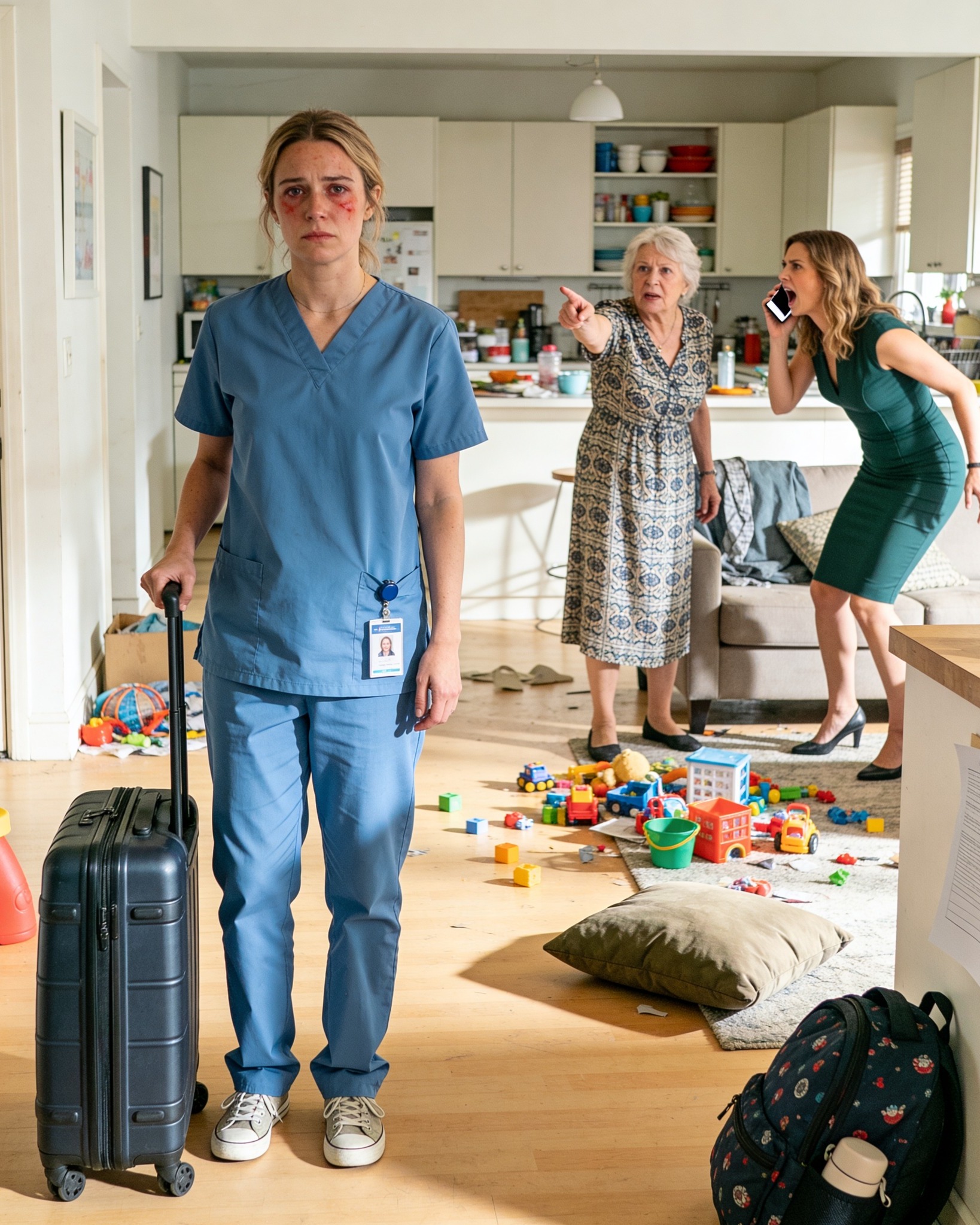
“If you really want to keep living under this roof, then start paying rent like any adult.”
My mother said it in front of everyone, just as I had arrived home from a double shift at the civil hospital in Guadalajara. My hair was still tied back with a loose hair tie, my sneakers were stained with rain, and my eyes were burning because I had slept no more than three hours. On the table there were unwashed dishes, an open school backpack, cereal spilled on the floor, and two children fighting over a tablet.
My sister Claudia was sitting on the couch, perfectly made up, checking messages from clients because she sold houses in Zapopan. She didn’t even look up when my mother pointed at me as if I were the family’s problem.
“It was about time, Mom,” Claudia said. “Mariana is 28 years old. She can’t live here for free her whole life.”
Free.
The word hit me harder than any shout.
Because for the last three years, I had paid in another way. I had taken care of my nephews, Emiliano and Santiago, every time Claudia had an appointment, a lunch, a showing, or simply wanted to rest. I had prepared lunchboxes, washed uniforms, taken the boys to the pediatrician, picked up medicines, helped with homework, bought groceries, and paid bills whenever “they would pay me back later.”
I was a daughter when they needed me to obey, a sister when they needed favors, an aunt when they needed a babysitter… but I was never a tired woman with the right to say no.
I took a deep breath. My mother kept talking.
“Everyone contributes here. You also have to learn responsibility.”
I looked at the kitchen, the sticky floor, the scattered toys, the clothes piled on a chair. I had picked all of that up the night before, before leaving for the hospital. And still, when I came back, it seemed as if my effort had never existed.
Claudia laughed.
“Don’t make that face, Mariana. Taking care of your nephews isn’t a job either. It’s family.”
Something inside me broke in silence.
I didn’t argue. I didn’t explain. I didn’t make that endless list of everything I had given. I just walked to my room, opened the closet, and pulled out the blue suitcase I had kept hidden for weeks. I filled it with my clothes, my documents, my work shoes, and a photo of my father.
My mother appeared in the doorway.
“What do you think you’re doing?”
I closed the suitcase.
“I’m going to pay you with the only thing I still have left: my absence.”
Claudia stood up, furious.
“You won’t last even two days on your own.”
I took my keys and left without looking back.
A week later, Claudia texted me first. Then she called me screaming. And what I heard when I answered left me frozen, because I couldn’t believe what was about to happen…
PART 1
“If you really want to keep living under this roof, then start paying rent like any adult.”
My mother said it in front of everyone, just as I had arrived home from a double shift at the civil hospital in Guadalajara. My hair was still tied back with a loose band, my sneakers were stained with rain, and my eyes were burning because I had slept no more than three hours. On the table there were dirty dishes, an open school backpack, cereal spilled on the floor, and two children fighting over a tablet.
My sister Claudia was sitting on the couch, perfectly made up, checking messages from clients because she sold houses in Zapopan. She did not even look up when my mother pointed at me as if I were the problem in the family.
“It was about time, Mom,” Claudia said. “Mariana is 28. She can’t live here for free her whole life.”
Free.
The word hit me harder than any scream.
Because for the last three years, I had paid in another way. I had taken care of my nephews, Emiliano and Santiago, every time Claudia had an appointment, a lunch, a showing, or simply felt like resting. I had prepared lunchboxes, washed uniforms, taken the children to the pediatrician, picked up medicine, helped with homework, bought groceries, and paid bills when they said they would “pay me back later.”
I was a daughter when they needed me to obey, a sister when they needed favors, an aunt when they needed a babysitter… but I was never a tired woman with the right to say no.
I took a deep breath. My mother kept talking.
“Everyone contributes here. You also need to learn responsibility.”
I looked at the kitchen, the sticky floor, the toys scattered everywhere, the clothes piled on a chair. I had picked all of that up the night before before leaving for the hospital. And still, when I came back, it looked as if my effort had never existed.
Claudia laughed.
“Don’t make that face, Mariana. Taking care of your nephews isn’t a job either. It’s family.”
Something inside me broke silently.
I did not argue. I did not explain. I did not make that endless list of everything I had given. I simply walked to my room, opened the closet, and pulled out the blue suitcase I had been hiding for weeks. I filled it with my clothes, my documents, my work shoes, and a photo of my father.
My mother appeared in the doorway.
“What do you think you’re doing?”
I closed the suitcase.
“I’m going to pay you with the only thing I still have left: my absence.”
Claudia stood up, furious.
“You won’t last two days on your own.”
I took my keys and left without looking back.
A week later, Claudia texted me first. Then she called me, screaming. And what I heard when I answered left me frozen, because I could not believe what was about to happen…
PART 2
The first night, I slept in a simple room near Calzada Independencia. The mattress was hard, the window did not close properly, and the fan sounded as if it were about to fall from the ceiling. But for the first time in years, no one woke me up in the middle of the night to tell me Santiago had a fever. No one asked me to wash a uniform. No one left Emiliano crying in front of my door while Claudia “stepped out for a bit.”
I slept ten hours straight.
When I woke up, I stared at the ceiling and cried silently. It was not sadness. It was rest leaving my body.
On the fourth day, I found a small apartment above a stationery shop in the Santa Tere neighborhood. It had a narrow kitchen, a window overlooking a street full of stalls, and a bathroom barely big enough for one person. For anyone else, it would have been little. For me, it was freedom.
I bought a white mug, a new sheet, and a basil plant. I kept my phone turned off most of the time. I needed silence.
On the seventh day, I turned it on.
I had 46 messages from my mother, 22 missed calls from Claudia, and several voice messages where I could barely understand anything between children crying and people shouting.
My mother wrote: “Enough of your tantrum,” “Your sister can’t do this alone,” “The children miss you,” “Don’t be cruel to your own blood.”
Claudia wrote worse things: “Because of you I lost a sale,” “Santiago refused to go into school,” “Mom’s blood pressure went up,” “You’re selfish.”
I answered with one single sentence: I didn’t leave to punish you. I left to save myself.
The phone rang immediately.
I answered.
Claudia’s face appeared on the screen, her hair messy, sweaty, her eyes red. Behind her, Emiliano was crying because he could not find his uniform, Santiago was shouting that he was hungry, and my mother was trying to clean up spilled juice with a napkin.
“Look what you caused!” Claudia shouted. “The house is impossible! Mom missed work! I lost two clients because no one could pick up the kids!”
I stayed silent for a few seconds.
“No, Claudia. I didn’t cause that. It already existed before. The difference is that now I’m no longer there to cover it up.”
My mother took the phone, her voice breaking.
“Mariana, family helps each other.”
“A family doesn’t turn a daughter into a servant and then charge her rent,” I answered.
No one said anything.
That silence was the first confession.
After hanging up, I logged into my accounts. I removed my card from the supermarket app, changed the internet password, canceled the automatic electricity payment, and blocked the food delivery app where Claudia ordered “emergency” dinners with my money.
Then I called the school.
“I need you to remove my name as an authorized contact for Emiliano and Santiago,” I said. “I can no longer be responsible.”
That afternoon, Claudia sent a message that left a knot in my stomach: “You have no idea what you just uncovered.”
And then I understood that the chaos in the house was not the real problem… the real problem was the lie that was about to come out.
PART 3
Two days later, my younger brother, Andrés, called me. He almost never got involved in family fights, so when I saw his name on the screen, I knew something serious had happened.
“Mariana,” he said quietly, “I found a folder in Mom’s closet.”
He told me he was looking for some of Santiago’s papers when he saw an old box behind some blankets. Inside there were supermarket receipts, pharmacy receipts, tuition payments, internet bills, and even tickets for school shoes. Almost all of them had been paid with my card.
But that was not the worst part.
There was also a notebook where my mother wrote down the household expenses. In one column were Claudia, Andrés, and herself. In another, my name. But next to my name, it did not say “Mariana.” It said: permanent support.
Permanent support.
As if I were not a person. As if I were a source of money, time, and energy that never ran out.
That night, Claudia came to my apartment without warning. She knocked on the door for several minutes. When I opened it, I found her crying, without makeup, holding a paper bag in her hands.
“I found the receipts,” she said. “And I found the notebook.”
I did not invite her to sit down. She came in anyway, but this time not with arrogance, only with shame.
She placed the bag on my table. Inside there was money, not much, but enough to understand that something in her had broken.
“It’s not everything we owe you,” she murmured. “But it’s the first thing I can give you.”
I did not answer.
Claudia covered her face.
“I knew you did a lot, Mariana. But I chose to play dumb. Because while you took care of my children, I could work, go out, sleep, live. It suited me to say you were exaggerating.”
Her words hurt me more than I expected.
“And Mom?” I asked.
Claudia lowered her eyes.
“Mom said you were the strongest. That you could handle everything.”
I felt anger, sadness, and exhaustion all at once.
“Being strong doesn’t mean you’re allowed to break me.”
A week later, I went to the house. Not to come back. Not to take care of children. I went to close a door without hatred.
My mother was in the kitchen, her eyes swollen. The house was still messy, but something had changed. Andrés was washing dishes. Claudia was folding clothes. Emiliano was picking up toys. Santiago was putting his shoes by the door. For the first time, no one expected me to walk in and fix everything.
My mother cried when she saw me.
“Forgive me,” she said. “I treated your love as if it were an obligation.”
I took a deep breath.
“What hurt me most wasn’t that you asked me to pay rent,” I told her. “It was realizing that I was already paying with my life.”
She lowered her head. Claudia cried too. I accepted their apologies, but I did not return.
I hugged my nephews, kissed Andrés on the cheek, and left that house with a strange peace, new and clean.
That night, from my small balcony above the stationery shop, I understood something I would never forget: leaving did not destroy my family. It only took away their comfort of using me without seeing me.
And it gave me back the one thing no one should ever have taken from me: my own life.