By the time Victoria Beaumont’s smile finally began to falter, I had already learned one of the most difficult truths of my adult life. People like Victoria only appeared powerful as long as the people around them were still willing to play along with the charade.
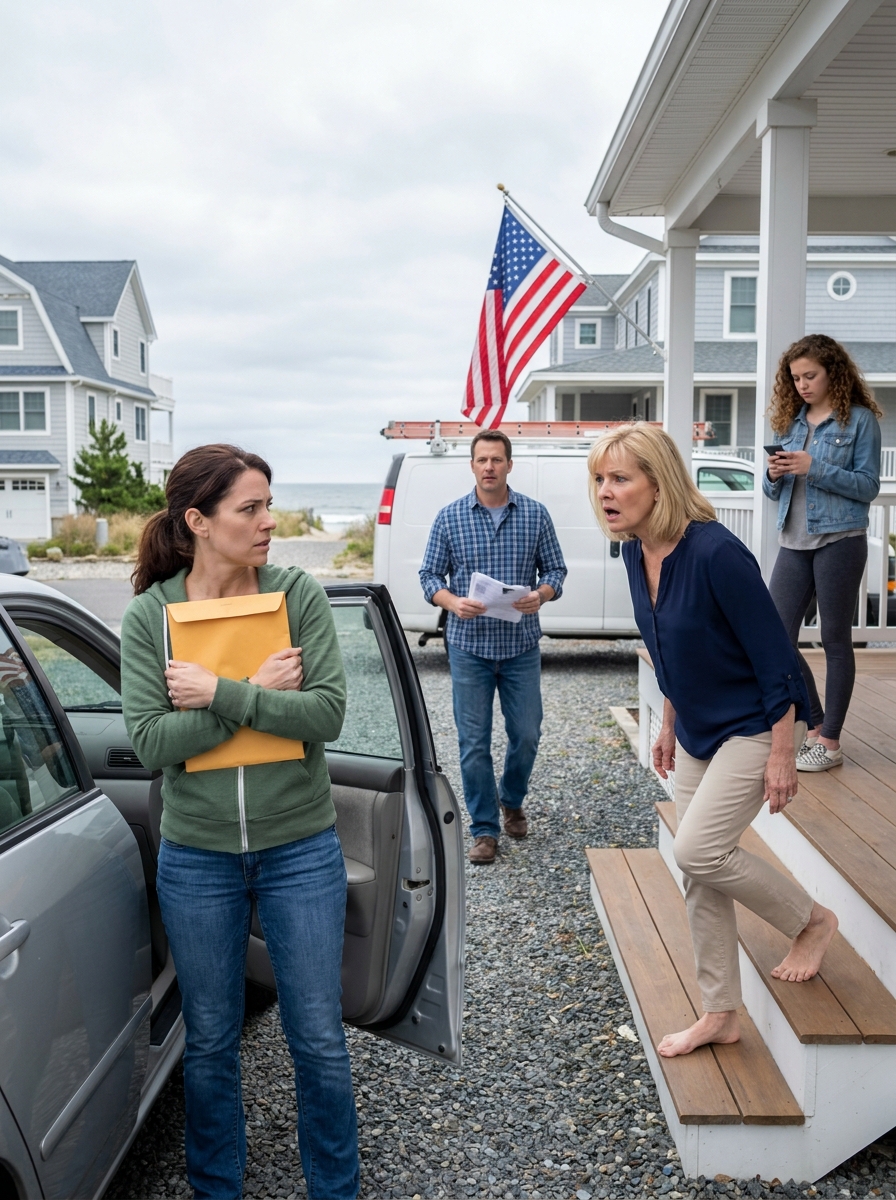
She had been smiling when I pulled into the gravel driveway of the beach house just after sunrise, while a soft blue light stretched over the dunes of Cape Crescent. The porch boards still looked like weathered silver under the heavy salt air that rolled in from the Pacific.
The hydrangea bushes my mother used to care for had grown a little wild around the front walk, and their pale blooms were heavy with the morning dew. A police cruiser was parked to one side, and Victoria stood in the middle of the porch in a cream cashmere sweater with her hair perfectly coiffed.
Her gold hoops caught the early light as she rested one hand possessively on the railing, acting as if she had personally built the house from driftwood. She had always loved that specific pose, using it at charity events and during every Christmas dinner we had shared over the years.
It was the same look she wore at hospital fundraisers where she air kissed strangers and claimed our family had always been committed to local history. Standing there that morning beside a brand new brass lock gleaming on the front door, she looked like an actress who had finally landed the lead role.
Then a second truck turned into the driveway behind me, kicking up bits of gravel and sea salt. The man who stepped out was thickset with a sun reddened face, wearing work boots and a navy jacket with the name Miller’s Security stitched over the pocket.
He had a clipboard tucked under one arm as he squinted toward the porch and lifted a hand in polite recognition toward Victoria. I watched the exact moment she realized who he was, and her face did not simply change but seemed to collapse from the edges inward.
The smugness drained away first, followed by her color and her cool certainty. In their place came something much rawer and uglier, which was a mixture of deep calculation and genuine fear.
Attorney Lydia Thorne got out of her own car at almost the same moment, looking smooth and composed in a charcoal wool coat. Her silver hair was pinned back in a neat twist that had survived the two hour drive from Philadelphia without losing a single strand.
She closed her door with quiet precision and did not even glance at me as she walked toward the porch. “Good morning,” Lydia said with a voice that was as sharp as a winter frost.
Victoria straightened her back and tightened her grip on the railing. “Who exactly are you, and why are you on my property?” Victoria asked with a trembling voice.
“I am Lydia Thorne, and I serve as legal counsel for Audrey Sinclair,” the lawyer replied as she took another step up the walk. “Unless there has been a very unusual change in trust law overnight, you are currently standing on property held in trust for my client.”
The two police officers who had been speaking near the cruiser turned toward us with sudden interest. One was an older man with a face lined by years of sun and wind, while the younger one looked cautious about the escalating situation.
Victoria gave a bright and brittle laugh that sounded like breaking glass. “This is absolutely ridiculous because this house belongs entirely to my husband, Harrison Beaumont.”
Lydia opened her leather folder and pulled out a stack of documents. “No, Victoria, it most certainly does not belong to him.”
She did not raise her voice, yet something in her tone made every other sound on the property fall away into silence. The gulls overhead and the distant crash of the surf seemed to fade as she held the papers out.
I stood beside my car with my mother’s envelope in my hands and felt a sliver of steadiness returning to me for the first time. The older officer stepped forward and looked at Victoria with a confused expression.
“Ma’am, you told dispatch that your stepdaughter had threatened to force entry onto your private property,” the officer said. “She has indeed done that,” Victoria snapped as she pointed a finger at me as though outrage could still save her reputation.
“She is unstable and vindictive, and she has been harassing my family for years,” Victoria added with a sneer. “That is an interesting claim,” Lydia said as she lifted a specific document from her folder.
“Here is the recorded deed placing this property into the Miriam Sinclair Trust twelve years ago, and here is the trustee designation naming Audrey Sinclair as the sole beneficiary.” Lydia held up a third page, which was the legal notice sent to Harrison Beaumont’s counsel acknowledging his right to limited seasonal occupancy only.
Victoria’s expression turned blank in the way faces do when the mind is racing too fast to choose which lie to tell next. My father’s name seemed to hang in the salt air like something dead and forgotten.
The older officer took the papers from Lydia and read the first page carefully before glancing up at me. “Are you Audrey Sinclair, and was your mother Miriam Sinclair?” he asked.
I nodded my head and met his gaze with a level stare. “Yes, that is correct.”
He looked at the documents again and then turned his attention back to Victoria. “Then why were we told that this was a domestic dispute involving a residence owned by Mr. Beaumont?” he asked.
Lydia gave him a look that was almost gentle in its profound disappointment. “That, officer, is an excellent question that I would like to hear the answer to as well.”
The locksmith cleared his throat and shifted his weight from one foot to the other. “For what it is worth, I was told by the woman on the porch that her husband owned the property outright,” Miller said.
“I would not have changed these locks if I had known that the ownership was disputed,” he added while looking at his clipboard. Victoria whirled on him with her eyes flashing.
“You do not need to say another word to these people,” she hissed. “I am just saying what happened,” Miller replied as he lifted both hands in a defensive gesture.
Cassandra, whom I had not noticed at first, pushed open the side gate and emerged from around the back of the house. She was wearing oversized sunglasses and a matching cream tracksuit, looking like she had dressed for a resort brunch instead of a family ambush.
She froze when she saw Lydia and the officers holding the legal papers. “Mom, what is going on out here?” Cassandra asked with a tight voice.
Victoria ignored her daughter and kept her eyes fixed on the police. “Ma’am, if these documents are valid, then having the locks changed without the owner’s authorization could create a major problem,” the younger officer said.
“A problem?” Victoria echoed as her voice began to climb in pitch. “I am her father’s wife, and I have hosted every holiday in this house for years.”
“I have paid for improvements to this home and I have every right to be here,” she shouted. “Actually, your right to host holidays was extended as a courtesy by Audrey’s mother during her lifetime,” Lydia interrupted.
“That courtesy was later tolerated by Audrey out of deference to her father, but those are not the same as legal rights,” Lydia added. Victoria’s head turned sharply toward me with a look of naked fury.
“You knew about this the entire time?” Victoria asked through gritted teeth. The question was so ridiculous that it almost made me want to laugh out loud.
“Yes, Victoria, I knew,” I replied. “Then why didn’t you ever say anything to us?” she demanded.
I thought about how my mother had asked me not to turn the house into a weapon. I thought about how I was twenty three and drowning in grief after she died, while my father looked smaller and weaker without her.
For years I told myself that love and restraint were the same thing, believing there might be a version of family worth salvaging. “Because I was trying very hard not to become someone like you,” I said as the silence followed my words.
The sound of the rope clinking against the old aluminum flagpole was the only thing I could hear. Cassandra let out an incredulous sound and shook her head behind her sunglasses.
“Oh my God, you are being so dramatic right now,” Cassandra said. I turned to her and remembered the message she had sent me the night before.
“Last night you texted me that I was never really a part of this family,” I reminded her. She folded her arms over her chest and stood her ground.
“You weren’t because you chose to leave and stay away,” she argued. “I moved to Philadelphia for my career, and that is not the same thing as joining a witness protection program,” I replied.
“You stopped showing up to the things that mattered,” she snapped. “I stopped showing up to dinners where your mother turned every conversation about my actual mother into a correction exercise,” I said.
Cassandra’s jaw hardened as she looked at me. “Mom has done everything for this family, and you know it,” she said.
The words hit me with a strange force because they were so old and familiar. Cassandra had been repeating some version of them since she was sixteen when Victoria first started using the phrase “after all I’ve done.”
It was always framed as generosity or sacrifice, but the subtext was always about possession. The older officer handed the papers back to Lydia and looked at Victoria.
“Based on this, Ms. Sinclair has a legal right to be here, and we are not going to remove her from the premises,” he said. Victoria stepped down one porch stair with her face pale from controlled rage.
“Harrison will fix this as soon as I call him,” she promised. Lydia’s expression did not change as she looked at her watch.
“Perhaps he will try, but he will need to do so through legal counsel who can explain the difference between marital assumptions and recorded ownership,” Lydia said. She reached into her folder again and produced a final document.
“In the meantime, I have an emergency order signed this morning granting my client exclusive access pending a hearing,” Lydia announced. “So here is what will happen next because the locksmith will restore access and Ms. Sinclair will enter her property.”
“And you, Victoria, will leave immediately,” Lydia finished. Cassandra made a choking sound of disbelief.
“You cannot be serious about this,” she said. “I am consistently serious about my work,” Lydia replied with a slight smile.
Victoria planted herself on the porch and refused to move. “I am not leaving my home,” she declared.
The older officer looked tired of the drama. “Ma’am, please do not make this any worse than it already needs to be,” he warned.
For a second I thought she might truly refuse, but then she turned toward the front door and fumbled in her tote bag for her keys. She yanked the wrong key so hard that the new brass lock rattled in the door frame.
“That key is not going to work,” Miller said as he took a step forward. “I know exactly how keys work,” she snapped back at him.
Her fingers shook as she tried another key and then another before thrusting the whole ring toward him. “Open it right now,” she commanded.
He took the keys and selected the right one to open the lock before glancing at Lydia. “Do you want the old cylinders reinstalled?” he asked.
“I do,” Lydia confirmed as Miller set down his toolbox. I climbed the porch steps slowly while my pulse hammered in my ears.
Victoria stood off to the side and breathed through her nose with her eyes bright with hatred. Up close I could smell her expensive perfume, but underneath it I caught the faint scent of the house itself.
It was the smell of old wood and sea salt and lemon oil mixed with the dust warmed by the morning sun. I stepped across the threshold and almost stumbled because the entry rug was gone.
In its place lay a pale sisal runner that looked like it had been selected from a catalog for women who do not actually like the coast. The hallway table where my mother kept a bowl full of shells was gone too.
There was a narrow mirrored console instead, topped with coral shaped candlesticks and a framed photo of Victoria and my father. They were both smiling into a life that had cost someone else everything they owned.
The violence of that small replacement hit me much harder than I expected. People often think theft looks like a disappearance, but sometimes it looks like a cold substitution.
I walked farther into the living room and saw that the walls had been painted a colder gray. The slipcovered sofa that my mother loved had been replaced by a white sectional that no one would ever sit on with sandy legs.
The bookshelves still stood, but the cluttered paperbacks my mother read each summer were gone. In their place were decorative boxes and large objects that no one had ever touched.
“I told her not to paint over the cream color,” Cassandra muttered from behind me. I turned in surprise to see that she had followed us inside and pushed her sunglasses up into her hair.
“It made the whole place look much colder,” she added. It was the first honest thing I had heard her say all morning.