When I married Daniel Hayes and moved into his family’s sprawling home just outside Charleston, South Carolina, I told myself the strange rules were temporary. Adjustment takes time, I thought. Every family has its quirks.
But this house didn’t feel like it had quirks. It felt like it had boundaries—carefully placed, heavily guarded ones.
Daniel’s mother, Evelyn Hayes, was all charm in public. Neighbors adored her. Church friends praised her generosity. But inside the house, she controlled everything—from the tone of conversations to which rooms felt safe to enter.
His father, Thomas Hayes, rarely raised his voice. He didn’t need to. One look from him could make people stop mid-sentence.
And then there was the rule I heard more than any other:
“Stay out of Christopher’s room.”
Christopher was Daniel’s older brother. I’d been given the explanation before I even unpacked my bags.
Years ago, they said, he’d been in a devastating car accident. He couldn’t walk anymore. He needed constant care. He stayed in the upstairs east bedroom—private, quiet, undisturbed.
Meals were brought to him. Medication was handled by Evelyn. A nurse came occasionally, but the family insisted they could manage the rest.
Every time I offered to help, Evelyn shut it down immediately.
“He hates being seen like this,” she’d say. “You’ll only upset him.”
Daniel echoed her, gentler but just as firm.
“Just respect it. Please.”
So I did.
At first.
But the longer I lived there, the less the story made sense.
I heard footsteps in the hallway outside Christopher’s room late at night—when no one was supposed to be upstairs.
I heard arguments through the door. Evelyn’s voice, sharp. Thomas’s, low and dangerous. Once, even Daniel’s—strained, defensive.
If I walked too close to that side of the house, Evelyn would appear almost instantly, as if she had been watching.
One afternoon, I heard something heavy crash inside the room. I stopped, hand hovering near the door.
Before I could knock, Thomas’s voice came from behind me.
“You were told not to go in there.”
I stepped away.
New brides learn quickly how to explain things away. It’s easier than admitting something feels wrong.
Then came the Thursday that changed everything.
Evelyn and Thomas drove to Savannah for an appointment. Daniel was out of town for work. The morning nurse had called in sick.
Before leaving, Evelyn told me she had already prepared Christopher’s lunch.
“Dinner can wait,” she added.
But around mid-afternoon, while I was downstairs, I heard it.
A voice.
Weak. Strained.
“Hello…?”
I froze.
“Can anyone hear me?”
It came again—desperate this time.
“Please… I need water.”
My heart started pounding.
I filled a glass. Made a quick sandwich. And before I could talk myself out of it, I walked upstairs… and opened the door I had been forbidden to touch.
It wasn’t locked.
The first thing I noticed was the air.
Stale. Heavy. Like the room hadn’t been allowed to breathe.
The curtains were half-closed despite the sunlight outside. A TV flickered silently on the wall.
And then I saw him.
Christopher Hayes.
Thin. Too thin. His face hollow, his skin pale with something deeper than illness.
But that wasn’t what made my stomach drop.
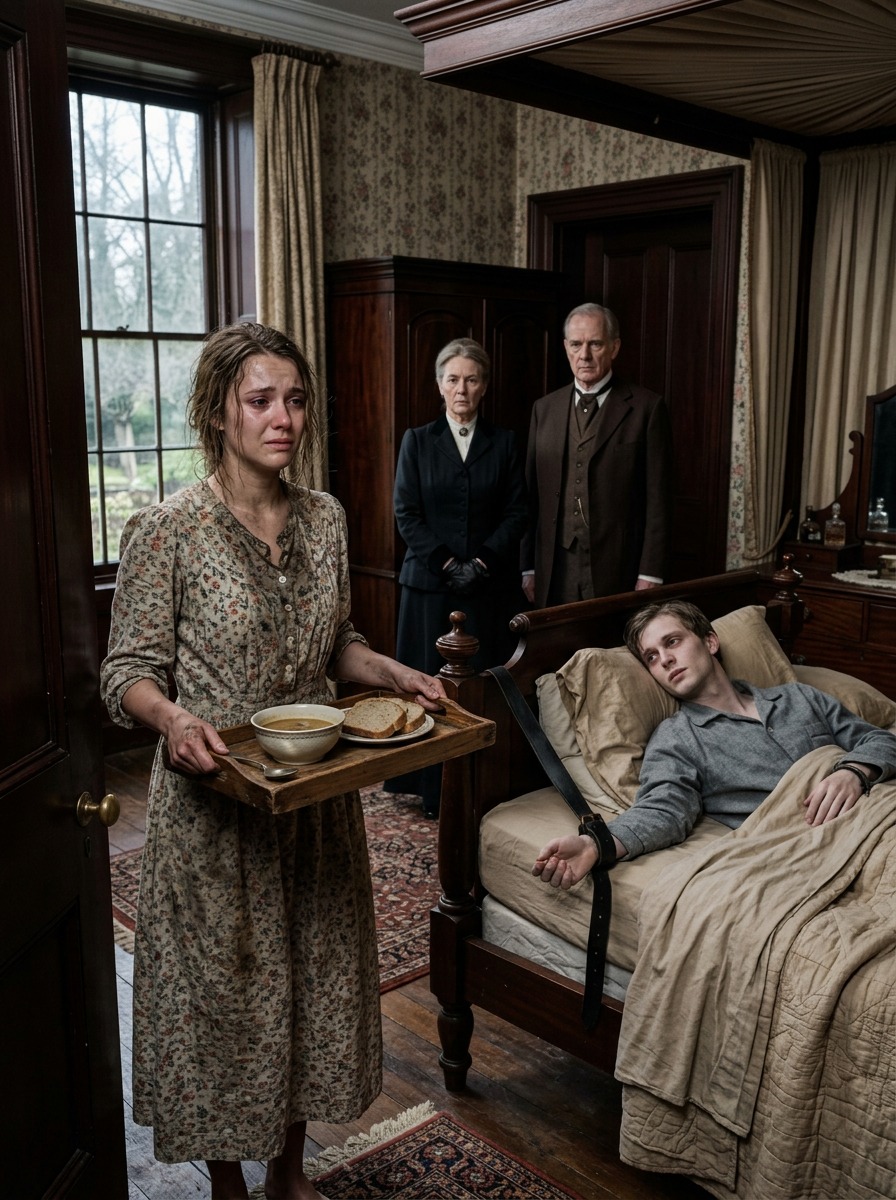
It was the strap.
A leather restraint, fixed to the bed rail.
Not fastened at that moment—but worn, bent, clearly used.
I set the tray down too quickly, spilling water.
“What is that?” I asked.
Christopher followed my gaze and gave a bitter, tired smile.
“That,” he said quietly, “is why you weren’t supposed to come in.”
I stepped closer, searching for a reasonable explanation.
“For seizures? Falls?”
He shook his head.
“They use it when I refuse the pills.”
The room seemed to shrink.
“What pills?”
“Whatever keeps me quiet.”
I picked up one of the bottles. The labels were partially covered with handwritten instructions. Another bottle had no label at all.
“Why would they do that?” I whispered.
He looked straight at me.
“Because they need me manageable.”
A pause.
“And because they need my money.”
The words didn’t make sense at first.
Then they did.
He explained slowly.
After the accident, while he was still recovering, he signed temporary control of his finances over to his father.
Settlement money. Disability payments. Investments.
“Temporary,” he said. “Until I got better.”
But “temporary” never ended.
I thought about the renovations. The expensive upgrades. Evelyn complaining about how much his care “cost.”
“Does Daniel know?” I asked.
Christopher didn’t answer right away.
Then:
“He knows enough not to ask.”
That hurt more than I expected.
I found the notebook next.
Pages filled with dates, transfers, withdrawals. Names of doctors, lawyers, agencies.
Notes like:
“Called—no response.”
“Denied visit.”
And one unfinished sentence:
“If anyone ever reads this, I never agreed to—”
A car door slammed outside.
Christopher stiffened.
“They’re back.”
My chest tightened.
“Why are you scared?” I asked.
He looked at me—really looked.
“Because now they know you’ve seen.”
Footsteps filled the house.
Voices. Evelyn first. Then Daniel.
I stood there, notebook in hand, heart racing.
Then Christopher said something that made any chance of pretending disappear.
“Please,” he said. “Don’t walk out of here and act like this is normal.”
I didn’t.
I called for help.
And everything unraveled after that.
The investigation moved quickly.
Medical evaluations showed overmedication. Signs of neglect. Restraint use without proper authorization.
Financial records told the rest.
Christopher was removed from the house and placed under protective care.
Evelyn and Thomas were charged.
Daniel left the house within days.
And me?
I left him not long after.
People later asked why.
He hadn’t tied the restraints. Hadn’t forged the documents.
But he had lived there.
He had heard things. Seen enough.
And chosen not to look.
Silence isn’t neutral when it protects harm.
Christopher now lives in a place designed for him—not to contain him.
With real care. Real oversight. Real choices.
We speak sometimes.
Not often.
But honestly.
And when I think back to that room, what stays with me isn’t just what I saw.
It’s how carefully everyone downstairs worked to make something terrible look… ordinary.
Like it was just another rule in the house.
Like it was something you weren’t supposed to question.
Until someone finally did.