The day my husband’s sons gave me thirty days to disappear from my own life, the funeral lilies were still breathing their sweet and rotten perfume through the hallways of our home. Douglas’s photograph sat on his mahogany desk as if he might walk back in at any moment and ask why everyone looked so incredibly serious.
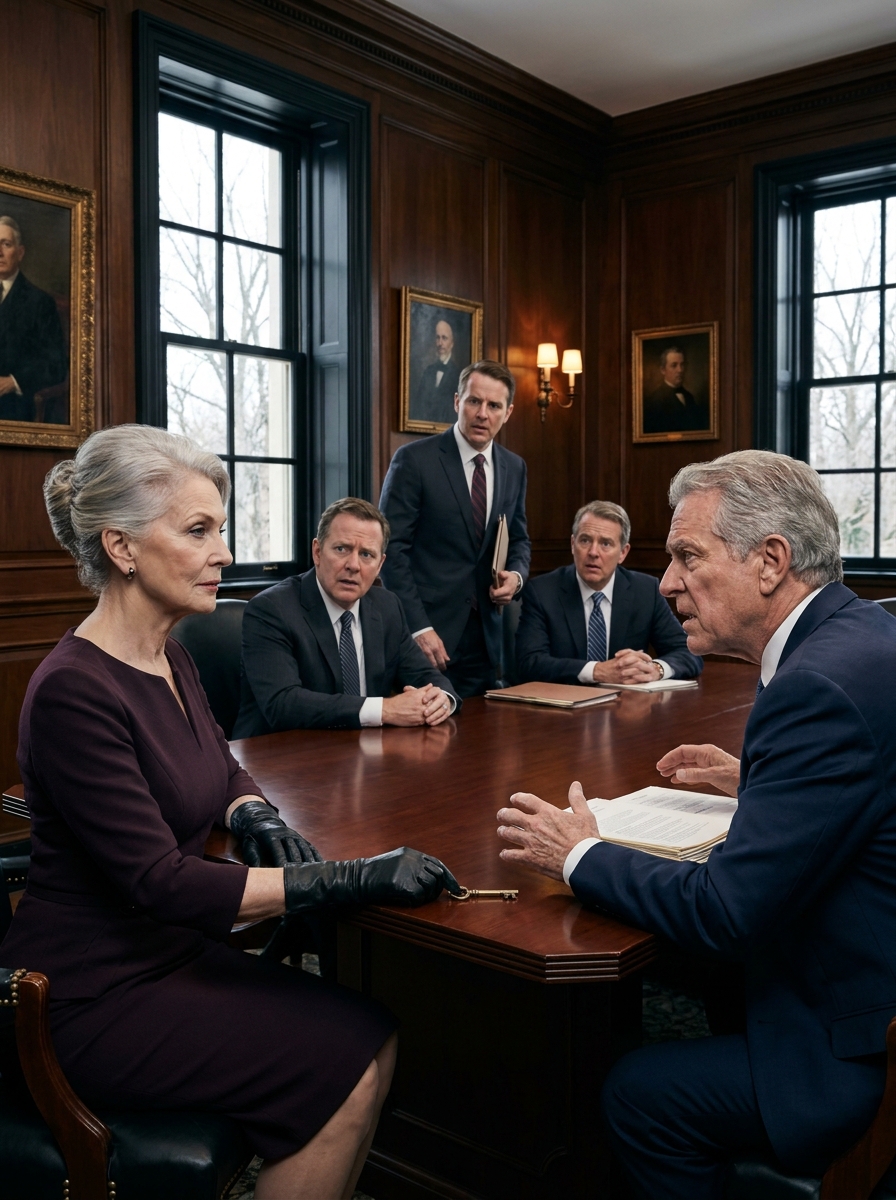
I remember the surprising weight of the old brass key in my palm before I truly understood what its presence meant for my future. Jeffrey stood on the Persian rug that Douglas and I had chosen together during a rainy weekend in Charleston, his polished shoes pressing into the deep red vines of the wool.
Todd remained near the tall bookcase with his hands folded in front of him, wearing the practiced softness of a man who had learned that cruelty sounded much better when it was delivered gently. I remember the gray afternoon light reflecting off the windows and the steady ticking of the old regulator clock that Douglas had meticulously wound every Sunday morning.
The desk was covered in papers where my husband had once planned our summer vacations and signed checks for family members who never quite learned the meaning of gratitude. “You can stay for thirty days, Diana,” Jeffrey said with a voice that suggested he was simply explaining a routine parking regulation.
“After that period of time, this house officially belongs to us,” he continued while he adjusted the sleeves of his tailored navy suit. He spoke as if twenty two years of marriage could be boxed up and removed from the premises before the next mortgage cycle began.
It felt as though he was suggesting I had been nothing more than a long term guest in a life I had helped build from the ground up. I was sitting in the leather chair that Douglas had loved because it groaned when he leaned back and still smelled faintly of his old pipe tobacco.
My knees were pressed tightly together beneath the desk while I held a small framed wedding photograph of the two of us on a bright April afternoon. My veil was caught in the wind in that picture, and his face was turned toward me with such open adoration that even the strangers in the background seemed to be smiling at our happiness.
In my other hand, though I did not yet know why I was clinging to it, I held the brass key I had found tucked away in his center drawer. Jeffrey likely thought I was clutching the frame because I was in a state of shock after losing my husband so recently.
Todd probably assumed I was trembling because I was frightened of what would happen to me now that I was alone. Perhaps I was indeed afraid, but I have learned that fear is not always a sign of weakness in a woman.
Sometimes fear is simply the first sound a sleeping part of your soul makes when it finally decides to wake up and defend itself. I looked up at these two men who had stood beside me three days earlier at their father’s grave, accepting condolences with solemn faces and damp eyes.
I looked at the sons I had cooked for, hosted, forgiven, and quietly excused for more than two decades of my life. These were the men Douglas had loved even when they had disappointed him deeply, and even when loving them had cost him his inner peace.
“Then I suppose you should be very careful what you inherit,” I said in a voice that was very soft but perfectly steady. Jeffrey’s mouth stopped moving for a moment, and Todd blinked as if he had not expected me to find my voice so quickly.
For one perfect second, neither of them smiled or offered another platitude about the necessity of practical matters. Then Jeffrey recovered his composure because he was a man who always found a way to regain his footing in a conflict.
He had inherited his father’s tall posture and squared shoulders, but he had unfortunately failed to inherit any of Douglas’s conscience. At forty five years old, he looked like the sort of man who had never once been refused a table at the most expensive restaurants in Phoenix.
“Diana, this is not the appropriate time for you to make cryptic remarks about the situation,” he said while he dipped his chin in a condescending manner. “No,” I replied while I looked him directly in the eye, “I imagine it isn’t the time for many things that are currently happening.”
Todd shifted his weight beside his brother, looking older in the face despite being three years younger than Jeffrey. He had the anxious air of a man who was forever waiting for someone else to make a decision so he could complain about the outcome later.
Where Jeffrey was sharp like a blade, Todd was damp and seeping like a slow leak in a basement. “We are not trying to hurt you, Diana,” Todd said with a disciplinary tone that almost made me laugh out loud in the silence of the office.
The house still held the heavy sound of mourners, and there were still casseroles in the refrigerator with masking tape labels on the lids. Sympathy cards stood in long rows along the mantel, and the gardening gloves Douglas used were still resting on the mudroom bench.
His robe still hung behind the bedroom door, and his pill organizer sat on the bathroom counter as a ghost of our daily routine. And yet these two men were standing in his private office, telling me they were not trying to cause me any pain.
“Then what exactly are you trying to do here?” I asked while I leaned back in the creaking leather chair. Jeffrey sighed as if he were dealing with an inconvenient child who refused to understand the reality of the world.
“We are trying to handle the practical matters of the estate because Dad was very clear about his wishes in the will,” he explained. “There are assets and business obligations that must be settled, and we thought it was best to discuss this as a family before attorneys make it ugly.”
“As a family,” I repeated the words slowly, feeling the bitterness of the term as it sat on my tongue. Todd nodded eagerly because he was always desperate for any sign of agreement during an uncomfortable conversation.
“Exactly, we need to handle this as a family,” he said while he moved closer to the desk to look at the folders Jeffrey had brought. Family was a word they used like a rope that was soft when held loosely but became brutal once it was pulled tight around someone’s neck.
Jeffrey placed a manila folder on the desk and opened it with movements that were precise and almost ceremonial in nature. He drew out a stack of documents and tapped them against the wood until the edges were perfectly aligned with one another.
“The will is quite straightforward,” Jeffrey stated as he pointed toward the legal language on the first page. “The primary residence in Phoenix goes jointly to Todd and me, and the vacation home in Sedona also goes to us.”
He glanced at me as if he were expecting me to gasp or offer some kind of loud protest against the distribution of the property. I remained silent because I was waiting to hear the rest of the plan they had devised in the dark.
“This house is valued at approximately eight hundred and fifty thousand dollars, and the Sedona property is around seven hundred and fifty thousand,” he continued. “The business interests are harder to value precisely, but preliminary estimates put them near four hundred thousand dollars.”
Each number entered the room like an unwelcome intruder that was trying to steal the memories I held of those places. I remembered Douglas laughing in the kitchen the first morning we moved into this house, telling me that the old plumbing had a lot of personality.
I saw him in Sedona, barefoot on the wooden deck with coffee in his hand as he watched the mountains turn a deep red at dawn. “And what about me?” I asked while I felt the metal of the brass key digging into the skin of my palm.
Jeffrey’s eyes cooled by a significant degree as he prepared to deliver the news he knew I would find insulting. “Naturally, our father made sure that you were provided for in your own way,” he said with a stiff professional tone.
Todd leaned in and added, “There is a life insurance policy for two hundred thousand dollars, Diana.” “That should give you a very comfortable cushion while you decide what your next steps will be,” Todd finished with a sympathetic look that felt entirely hollow.
A comfortable cushion was the reward for twenty two years of marriage and for leaving my own career to tend to Douglas’s life and family. I was sixty three years old, and I was being offered a small sum of money and thirty days to vacate my own home.
“There are also the outstanding medical bills to consider,” Jeffrey added while he removed another sheet of paper from the folder. “Insurance covered a large portion of the treatment, but there is still approximately one hundred and eighty thousand dollars owed to the specialists.”
“Since you were his wife and participated in the medical decisions, those expenses may fall to you personally,” he said with a calculated pause. The room seemed to tighten around me as I realized the two hundred thousand dollars would effectively be reduced to twenty.
“So I am left with almost nothing after twenty two years,” I said while I looked at the wedding photo again. “We know it is not an ideal situation, but we are just following the legal documents,” Todd said while he looked down at the carpet.
An ideal situation was not a term I would use for being handed a eviction notice and a mountain of debt after burying a husband. “Douglas told me that I would always be protected,” I said while I felt the first sparks of a cold anger beginning to burn in my chest.
Jeffrey’s expression did not change, but I saw something dark move behind his eyes when I mentioned his father’s promises. “Dad said many things while he was ill and perhaps not entirely himself,” he replied with a poisonous implication that made my blood run cold.
Douglas had been hollowed out by cancer, but his mind had remained as sharp as a diamond until the very final hours of his life. He had known the names of every nurse on the floor and had whispered a promise to me at three in the morning to trust him.
Now his sons were trying to use his illness as a weapon to dismantle the life he had intended for me to have. “Your father was perfectly clear minded,” I stated firmly as I stood up from the leather chair.
“None of us wants to debate his condition because that would be a painful process for everyone involved,” Jeffrey said while he folded his hands. He meant it would be painful for them if I forced the truth of their father’s lucidity into the legal record of the estate.
Todd moved closer to the desk and said, “We want this to be dignified because Dad always believed the family assets should stay with the bloodline.” The word bloodline acted as an invisible wall that they had spent two decades building between me and the rest of the family.
“You can stay for thirty days,” Jeffrey repeated as he stood up and prepared to leave the office. “That gives you enough time to find a small apartment and decide which personal belongings you actually want to keep.”
“How incredibly generous of you both,” I said with a tone that was dripping with a sarcasm they chose to ignore. They left a few minutes later, taking the original documents but leaving a set of copies on the desk for me to review.
I stayed in the office until I heard their car disappear down the driveway and the silence of the house returned. Only then did I open my hand and look at the brass key that was worn smooth by many years of use.
I searched every drawer and cabinet in the office, but the key did not fit any of the locks I could find. I moved through the hallway, the bedroom, and even the garage, trying the key on every old chest and locker in the house.
By midnight, I was sitting on the floor of a closet surrounded by old shoe boxes and laughing because I felt like a fool. Then I cried for everything I had lost and for the terrible possibility that Douglas had truly left me unprotected.