—If you keep yelling like that, Mateo, I’m going to sign the paperwork to have you committed today.
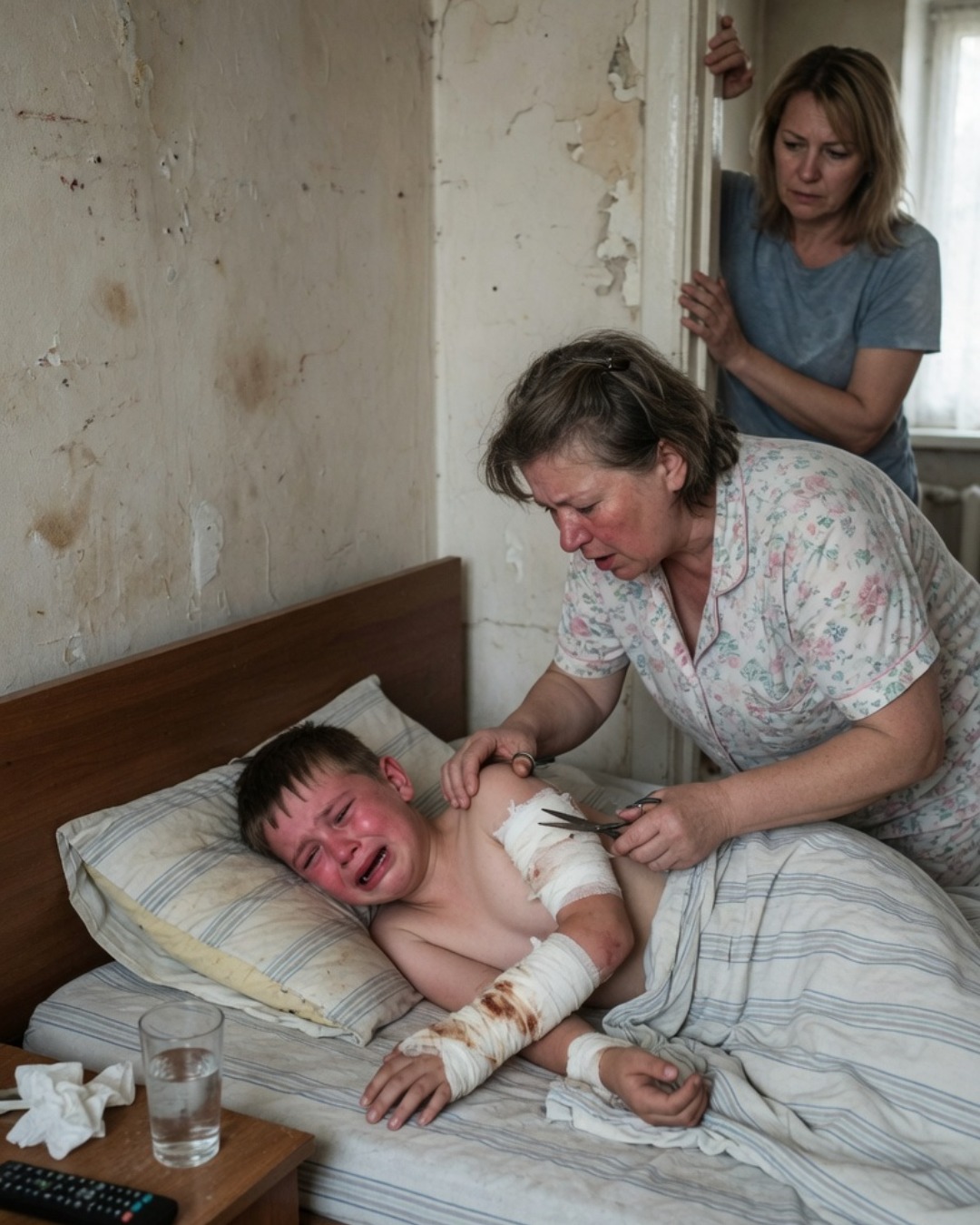
That’s what Carlos said, his voice breaking, standing in the doorway of his son’s room, while the ten-year-old boy banged the cast on his arm against the wall as if he wanted to tear his life away along with that white thing.
It was almost two in the morning in a large house in Coyoacán, and the dry sound of plaster against the wall echoed through the hallways like an alarm. Knock. Knock. Knock. Mateo’s face was drenched in sweat, his eyes were wide and bulging, and his lips were chapped from crying so much.
“Take it away! Dad, please! They’re getting in! They’re biting me!”

Carlos ran towards him, not with tenderness, but with the furious weariness of a man who hadn’t slept for nights. He grabbed him by the shoulders and threw him onto the bed.
—Stop! You’re going to break your arm again!
Mateo was trying to push a feather under the edge of the plaster cast. He scratched desperately, as if there were fire underneath. The skin around the bandage was irritated and stained, but Carlos didn’t want to look too closely. He no longer knew what to believe.
Lorena, his wife, appeared leaning against the doorframe. She wore an elegant robe, her hair was perfect, her face cold.
“I told you, Carlos,” she murmured. “This isn’t pain. It’s manipulation. Ever since you married me, Mateo can’t stand sharing you.”
“Lies!” shouted the boy. “You know what you did!”
Lorena opened her eyes with feigned sadness.
—See? Now he’s accusing me. That’s paranoia. He needs psychiatric help before he really hurts himself.
Carlos was breathing heavily. He looked at his son, then at Lorena. Since the accident at school, everything had become unbearable. The doctor had said the cast should only be a little uncomfortable, nothing more. But Mateo wasn’t eating, wasn’t sleeping, he was trembling, sweating, and talking about “little legs” moving under his skin.
Rosa, the nanny who had worked in the house for years, watched from the hallway, her heart heavy. She had noticed something different. A strange smell in the room. It wasn’t sweat. It wasn’t old plaster. It was a sweet, heavy aroma, mixed with something sick.
As she went to change the sheet, she saw a small red ant crossing the pillow. It wasn’t going toward the floor. It walked straight to the opening in the cast and disappeared there.
“Mr. Carlos…” Rosa said, pale. “There’s something inside.”
Carlos let out a bitter laugh.
—She must be hiding candy. Clean it up well and don’t give her any more ideas.
Mateo looked at her with tears in his eyes.
—Nana… I’m not crazy.
That same night, Carlos took a belt and tied his son’s good wrist to the bed to stop him from hitting himself.
And Lorena smiled slightly, as if everything was going exactly as she had planned.
PART 2
The next morning, Mateo no longer had the strength to scream. That was what frightened Rosa the most.
She found him staring at the ceiling, his lips parched and his forehead burning. His casted arm rested on the sheet, but his fingers were swollen and trembling. The boy looked smaller than ever.
—Nana… —she whispered—. Go get the big bread knife.
Rosa leaned forward, thinking she hadn’t heard correctly.
—What did you say, my child?
Mateo looked at her with a clarity that froze her blood.
—Cut off my arm. I don’t want it anymore. I promise I won’t scream.
Rosa had to cover her mouth to keep from crying. No child would ask for something like that as a tantrum. No child would rather lose an arm than continue wearing a cast, unless something terrible was happening underneath.
He went out into the hallway and confronted Carlos.
—Sir, he has a fever. He smells bad. This isn’t psychological. Take him to the emergency room.
Carlos had the phone in his hand. On the table were admission papers for a private psychiatric clinic in Santa Fe. Lorena was next to him, stroking his shoulder.
“Rosa, you don’t understand,” said Carlos, devastated. “Last night he almost broke his arm against the wall. He says imaginary things are biting him.”
“They’re not imaginary,” Rosa insisted. “I saw an ant go into the plaster.”
Lorena let out a tired sigh.
“For God’s sake, Rosa. An ant doesn’t cause a crisis like this. Besides, if they take him to any hospital and see those wounds, they’re going to accuse Carlos of negligence. Do you want him to be arrested?”
Carlos lowered his gaze. That phrase paralyzed him.
Lorena knew exactly where to hit. She had repeated to him for days that Mateo could destroy her reputation, her job, her life. She told him that the boy was jealous, that he was self-harming to blame her, that he needed to be locked up and sedated.
But Rosa began to remember details that didn’t fit.
Three days earlier, when Carlos had traveled to Monterrey for work, Lorena asked him not to go into Mateo’s room because “the boy needed discipline.” That same afternoon, Rosa found a thick syringe in the kitchen, the kind used for injecting marinades into meat, only half-washed. She also noticed a nearly empty jar of honey and sugar scattered on the counter.
At that moment he didn’t think anything. Now everything seemed like a sign to him.
In the afternoon, Mateo worsened. He began to convulse in pain. He no longer begged, he no longer insulted, he no longer defended himself. He only clenched his teeth while silent tears ran down his temples.
Rosa understood that if she waited for permission, the child could die.
When the storm hit the city, she went down to the garage. She searched through Carlos’s tools until she found a pair of heavy industrial pliers. She went back upstairs with them hidden under her shawl, entered Mateo’s room, and locked the door.
Carlos heard the insurance.
—Rosa? What are you doing?
Lorena shouted from behind:
—She’s gone crazy! She’s going to hurt him!
Rosa took a deep breath. Mateo looked at her without fear, only with hope.
“Hang on, my love,” he whispered. “I’m going to get rid of what’s killing you.”
He placed the tweezers on the edge of the plaster.
Crack.
The first cut sounded as if the whole house had split apart.
And then, through the opening, came a smell so sweet and rotten that Rosa realized the truth was much worse than she had imagined.
PART 3
Carlos kicked the door down just as the plaster cast finished opening.
He stormed in, furious, ready to separate Rosa from her son, but he froze in the middle of the room. The smell hit him first. Then he saw Mateo’s arm.
It wasn’t just a simple irritation. Beneath the plaster was a sticky, dark mixture, laced with traces of honey, inflamed skin, and tiny red ants scurrying between the inner bandage. A few white larvae writhed in the most damaged area. Mateo hadn’t made this up. He wasn’t crazy. They were slowly devouring him beneath a white prison they all called “treatment.”
Carlos put a hand to his mouth and fell to his knees.
—No… no, son… forgive me…
Rosa, crying with rage, kicked the open piece of plaster towards him.
“Look at him closely, sir! That’s what was driving him crazy! And you were going to send him to a mental hospital!”
Carlos couldn’t answer. He picked up Mateo as best he could and ran to the bathroom. Under the stream of warm water, he carefully cleaned his arm while repeating over and over:
—Forgive me, champ. Forgive me. Dad was an idiot.
Mateo barely sobbed. He was too exhausted to speak.
Lorena tried to back away into the hallway. She wanted to disappear without making a sound, but Rosa saw her.
—Check the medicine drawer—said the nanny in a trembling voice—. The bottom one.
Carlos returned with a towel and opened the drawer. There was the culinary syringe. Crystallized residue of honey and sugar remained on the tip.
The silence that followed was terrible.
Lorena raised her hands.
—Carlos, it’s not what it looks like. It was a home remedy. My grandmother said that honey helped to—
Carlos grabbed her arm.
—Did you inject honey into my son’s cast?
—I just wanted her to stop playing the victim.
—She’s ten years old!
Carlos’s voice boomed throughout the house. For the first time, Lorena had no prepared response. The mask of a patient and elegant woman completely slipped away. Her gaze turned hard, resentful.
—Ever since I arrived, that boy has hated me. He’s always looking at me like I’m an intruder. He’s always reminding you of his dead mother.
Carlos let go of it as if it were burning him.
—You weren’t jealous. You wanted to destroy him.
That night, an ambulance took Mateo to the hospital. Doctors confirmed he had a serious infection and that, had they waited one more day, the damage could have been irreversible. He needed surgery, a deep cleaning, and weeks of recovery.
Lorena was arrested after Carlos handed over the syringe, the plaster cast, and Rosa’s statement. She tried to claim it was all an exaggeration, that Mateo was disturbed, that Rosa had staged the scene. But the hospital, the evidence, and the boy himself told a different story.
Months later, Mateo returned home. His arm was scarred, but also strong. Carlos sold that house full of bad memories and moved with him to a smaller one in Querétaro. Rosa went with them, no longer as an employee, but as family.
One afternoon, Mateo hugged his nanny with his recovered arm.
“You did believe me,” he told her.
Rosa stroked her hair.
—Sometimes, my child, saving someone begins with listening to what everyone else prefers to ignore.
Carlos watched them from the doorway, tears welling in his eyes. He knew the guilt would never completely disappear. But he also knew that justice had begun the day a humble woman dared to break a cast… and with it, an entire lie.