Lila Carter learned early that some rooms could make loneliness louder. It was not always the empty apartment that hurt. Sometimes it was a school hallway full of paper crowns, camera flashes, and parents calling children by nicknames.
She was nine years old, small for her age, careful with her words, and always aware of what she did not have. Her mother had died when Lila was younger, and her grandmother had become the only steady person left.
Their apartment sat three bus stops from Carver Primary School. It smelled faintly of mint ointment, laundry soap, and the tea her grandmother drank when her chest felt tight. Lila knew where the medicine bottles were kept.
On graduation morning, her grandmother tried to sit up twice. Each time, her breath gave out before her feet touched the floor. Lila pretended not to see the way the old woman’s hands trembled against the blanket.
“You’ll be fine,” her grandmother whispered, though her eyes said she hated the words. “You walk across that stage like your mama is watching.”

Lila nodded because children often protect adults by pretending comfort is enough. Then she went into the bathroom, locked the door, and practiced asking a question no child should have to ask.
At 7:43 a.m., she wrote it on the back of an old Carver Primary lunch notice. Please pretend to be my dad just today. I will not ask for anything else. She folded the paper twice and put it in her dress pocket.
The yellow dress had once belonged to a neighbor’s daughter. The hem had been let down unevenly, and one sleeve had a tiny repair near the shoulder. Lila loved it anyway because her grandmother had pressed it flat the night before.
Outside Carver Primary School, the morning had the bright, nervous feel of a celebration. Shiny SUVs pulled up along the curb. Parents carried flowers, balloons, gift bags, and phones already recording.
Lila stood on the cracked pavement, twisting the frayed edge of her dress. The air smelled like warm asphalt and cut grass. From inside, folding chairs scraped across the auditorium floor with a sound that made her stomach tighten.
Every other child seemed to arrive inside a circle of arms. One girl’s father lifted her off the ground. A grandmother adjusted a boy’s collar. A mother cried before the ceremony even began.
Lila’s empty place felt visible before she entered the building. She imagined classmates glancing beside her and seeing nobody. Worse, she imagined them learning not to glance at all.
Across the street, a polished silver SUV pulled quietly to the curb. A tall man stepped out wearing a charcoal-gray suit, his expression closed and tired. He checked his phone, then stared at the school like he had not decided whether to enter.
His name was Elliot Vance, though Lila did not know that yet. He had come to Carver Primary for a school board meeting scheduled before the ceremony. He was not there for a child.
He was a man who had spent years learning how to look composed. People saw the suit, the car, the careful voice, and assumed his life had clean edges. They did not see the grief he carried privately.
That morning, Elliot had almost canceled the meeting. The date sat too close to an old wound. Years earlier, he had lost the possibility of becoming a father, and he rarely spoke of it because pity made him feel smaller.
When Lila approached him, he first thought she was lost. Then he saw her hands twisting together, the faded dress, and the effort it took for her to stand still.
“Hey there,” he said gently. “You okay?”
The question nearly undid her. Kindness is dangerous when a child has been holding herself together with both hands. It can feel like permission to fall apart.
“I need to ask you something really weird,” Lila said quickly. “Please don’t leave before I finish.”
Elliot put his phone away. That small gesture mattered. Adults were always looking past her, around her, through her. He looked directly at her and said, “Okay. I’m listening.”
She told him about fourth-grade graduation. She told him her mother had died and her grandmother was too sick to leave the apartment. She told him every other child would have someone cheering.
Then she looked down at the sidewalk and asked, “Could you maybe pretend to be my dad? Just for today?”
There are sentences that reveal a whole life without explaining it. Lila’s sentence did that. It showed the empty chair, the rehearsed courage, and the shame she had been carrying like a secret.
Elliot crouched until their eyes were level. “What’s your name?”
“Lila. Lila Carter.”
“I’m Elliot Vance.”
She did not recognize the name, and that helped. To her, he was not important, wealthy, or connected. He was simply an adult who had not walked away.
Elliot asked only one question before agreeing. “Would it help if I sat where you can see me?”
Lila nodded so fast the ribbon in her hair slipped slightly. “You just have to clap,” she said.
That sentence stayed with him. You just have to clap. It was the smallest job in the world, and somehow the heaviest one he had been offered in years.
By 11:51 a.m., the auditorium was full. The air carried the waxy smell of balloons, the faint perfume of parents dressed for photographs, and the dusty warmth of stage curtains. Children whispered in rows of little chairs.
Lila sat near the end of the second row. Elliot sat beside her, too tall for the small chair, holding the program carefully. He had slipped her folded note inside it without telling her.
Mrs. Hanley, Lila’s teacher, noticed him almost immediately. She had watched Lila all year. She had seen homework turned in with careful handwriting, shoes worn thin, and a child who never asked for extra attention.
Mrs. Hanley also knew about the grandmother’s illness. The school had a file with emergency contact forms and attendance notes. Paperwork can prove hardship, but it rarely comforts a child in the moment hardship becomes public.
The ceremony began with music from a small speaker near the stage. Names were called. Families cheered. Phones rose like a field of glass rectangles catching the overhead lights.
Lila clapped for every classmate. She smiled when others looked back at their families. But each cheer sharpened something inside her. Happiness for someone else can still hurt when it reminds you what you are missing.
Then Mrs. Hanley stepped to the microphone with a pale blue folder. She announced the Courage Award, explaining that some students carry more than any child should have to carry.
“This year’s Courage Award goes to Lila Carter,” she said.
For a moment, Lila did not understand that the name belonged to her. Elliot leaned down and whispered, “That’s you.”
She walked to the stage on trembling legs. The rail felt cool under her palm. Her yellow dress moved around her knees, and the certificate Mrs. Hanley handed her felt too official for her small hands.
Mrs. Hanley bent toward the microphone. “Is there anyone here today you’d like to thank, sweetheart?”
The auditorium quieted. It was the kind of silence that notices itself. Balloons brushed softly against chair backs. A candy wrapper stopped crinkling halfway through a child’s hand.
Lila looked out at the room. She saw parents with flowers, grandparents with tissues, teachers smiling too hard, and Elliot Vance sitting in the second row with her program in his hands.
“I want to thank…” Her voice wavered. “The man who came today so I wouldn’t be alone.”
Every head turned.
Elliot stood up.
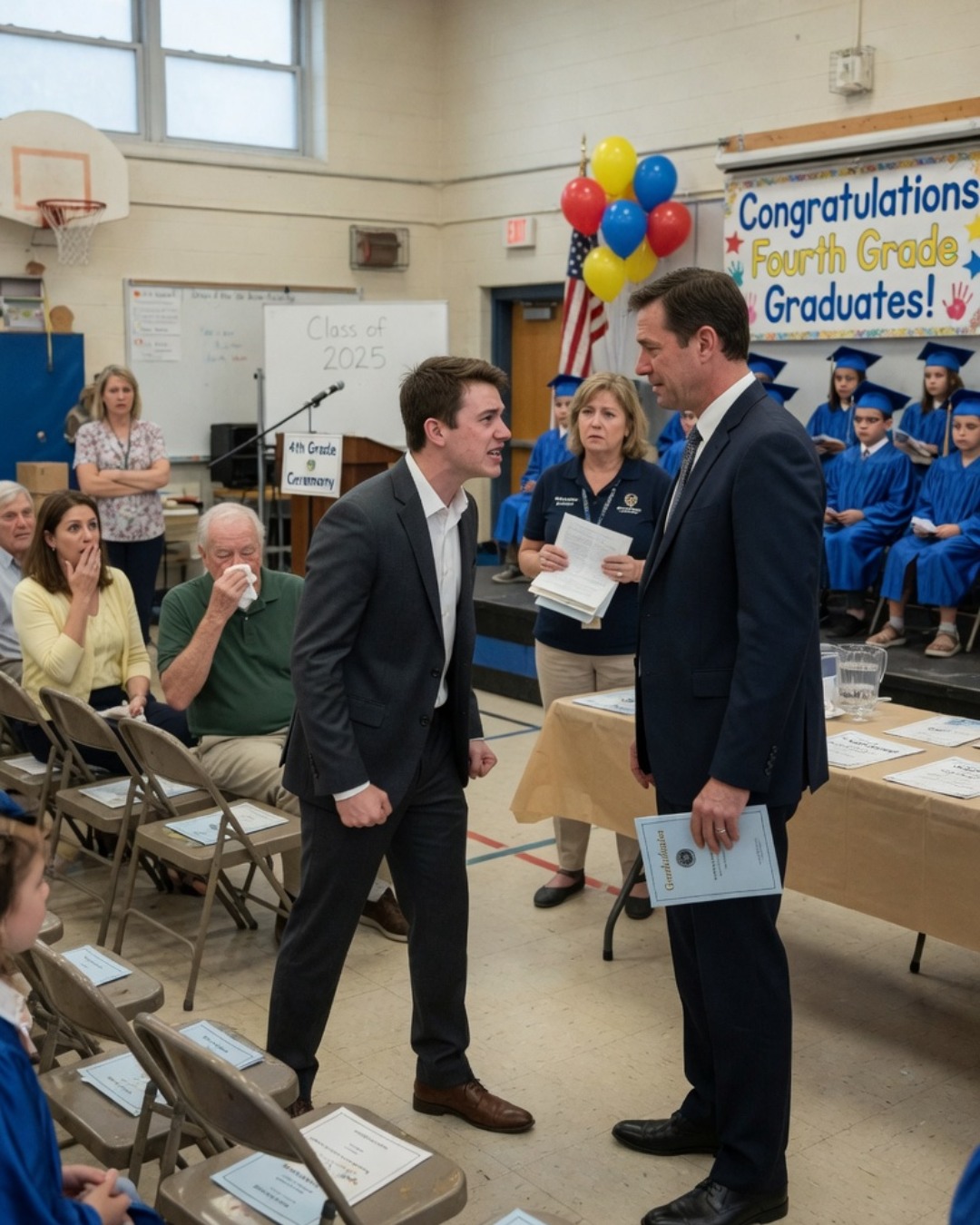
The chair legs scraped the floor, loud and bare. At first, people looked curious. Then they saw his face. Tears had gathered in his eyes, and he did not try to hide them.
“I’m not her father,” he said.
The words moved through the auditorium like a cold draft. Lila’s expression fell, and Mrs. Hanley reached toward her instinctively. But Elliot lifted one hand gently, asking for one more second.
“I met Lila outside this morning,” he continued. “She asked me to sit here because she thought an empty chair would hurt less if someone kind filled it.”
A mother in the front row lowered her phone. The principal, standing beside the stage curtain, went rigid. Even the children sensed that the room had changed.
Then Elliot unfolded the program. Inside was the old lunch notice Lila had written on at 7:43 a.m. He did not read all of it at first. He only looked at it and swallowed hard.
“This is what she gave me,” he said.
Mrs. Hanley’s eyes filled. The principal looked down. No one seemed to know where to put their hands. Applause would have been wrong. Silence was worse.
The whole room froze. Phones hung half-lowered. A grandmother’s tissue stayed pressed to her cheek. One child onstage stopped swinging his feet. The paper stars on the wall trembled faintly in the air conditioning.
Nobody moved.
Elliot turned back to Lila. “You told me I only had to clap,” he said, his voice breaking. “But that is not enough.”
Lila stared at him, confused and frightened by the attention. She had asked for pretend. She had not asked for an auditorium to learn how lonely she was.
Elliot understood that. He lowered the note and spoke more softly. “I’m sorry,” he said to her, not to the crowd. “I should have asked before I said this out loud.”
That apology mattered more than anything else he said. Adults often turned children’s pain into lessons for other adults. Elliot stopped himself before he did the same.
Lila’s shoulders loosened by a fraction. Mrs. Hanley placed a steady hand behind her back.
Then Elliot looked at the principal. “This school has a Courage Award,” he said. “Today it needs a Kindness Chair too. A real one. A place no child sits beside emptiness during a ceremony like this.”
The principal nodded before he seemed to realize he was nodding. “Yes,” he said quietly. “Yes, of course.”
Elliot was not finished. “And if her grandmother permits it,” he added, “I would like to make sure Lila has transportation, school supplies, and someone in this building assigned to call before big events. Not after. Before.”
The room finally exhaled. Not in applause yet. In recognition. People understood that this was no longer about one girl’s ceremony. It was about all the children they had failed to notice because their loneliness was polite.
Mrs. Hanley bent beside Lila. “Is that okay, sweetheart?”
Lila looked from Mrs. Hanley to Elliot. “Will Grandma know?”
“Yes,” Elliot said immediately. “Nothing without your grandma.”
That was the second trust signal. He did not try to replace anyone. He did not turn generosity into ownership. He honored the woman who had been loving Lila from a sickbed.
Only then did Lila nod.
The applause started softly. One teacher first. Then a few parents. Then the whole auditorium rose, not in the wild cheer of a ceremony, but in something slower and heavier. People clapped like they were apologizing.
Lila cried then. Not loudly. Just one hand over her mouth, certificate pressed against her chest, as if joy had arrived too suddenly and needed somewhere to go.
Elliot walked to the stage steps but stopped at the bottom. He did not rush her. He waited until she came down herself. When she reached him, he crouched again so they were eye to eye.
“You were very brave,” he said.
Lila wiped her cheek with the back of her hand. “You clapped really loud.”
He laughed through tears, and half the auditorium cried harder because of it.
After the ceremony, Mrs. Hanley helped call Lila’s grandmother. The old woman cried on speakerphone when Lila described the award, then scolded Elliot gently for making everyone emotional before thanking him in a voice made thin by illness.
Elliot did not make promises he could not keep. Instead, he made practical arrangements. He gave Mrs. Hanley his office number. He asked the principal to document the support plan in writing.
By the following week, Carver Primary had created a family-support list for ceremonies, field days, performances, and parent breakfasts. Staff volunteers and approved community members could sit with children whose families could not attend.
Lila’s grandmother signed every permission form herself. Elliot respected that. He visited with groceries once, then twice, always asking before coming, always leaving when Lila’s grandmother looked tired.
Over time, he became neither pretend father nor replacement family. He became something gentler and more honest: a steady adult who had been invited into their life carefully, with boundaries and gratitude on both sides.
At the next school event, Lila did not have to ask a stranger. Mrs. Hanley checked the list beforehand. Elliot arrived early with a small bouquet and sat beside her grandmother, who had managed to come with a wheelchair and a blue blanket over her knees.
Lila looked out from the stage and saw them both.
Every other child had somebody. That day, so did she.
Years later, people at Carver Primary still talked about the graduation when Elliot Vance stood up in a crowded auditorium and told the truth. They remembered the tears, the silence, and the note folded inside the program.
But Lila remembered something smaller. She remembered that she had asked for one day and received a beginning. She remembered that the man who came so she would not be alone never made her feel ashamed for needing him.
And whenever a child at Carver Primary sat beside a volunteer at a ceremony, teachers called it Lila’s Chair. Not because loneliness disappeared. Because one empty seat had taught an entire room to look harder.