Diane Harrison was not the kind of woman people expected to move fast.
At sixty-four, she wore practical shoes, kept tissues in every coat pocket, and still wrote grocery lists on the backs of envelopes because her mother had done it that way.
She lived alone in a small house with a sloping driveway, a humming refrigerator, and a kitchen table polished so often that the grain of the oak felt almost soft under her fingers.

To the outside world, she looked like a retiree who read crime novels for entertainment and met old colleagues twice a month for lunch.
That was exactly why Glenda underestimated her.
Before Diane retired, she had spent thirty-six years as a forensic architect.
Her work had not been glamorous in the way people imagine architecture to be glamorous.
She did not design shining towers for magazine covers.
She walked into structures after something failed.
She studied parking decks with crushed concrete layered like broken cake.
She measured hairline fractures in balconies while developers stood behind her insisting they had followed every regulation.
She read inspection reports, maintenance logs, permit histories, and photographs of damage with the patience of someone who understood that catastrophe rarely begins at the moment everyone notices it.
Something always fails first.
A bolt weakens.
A beam shifts.
A record is altered.
A person lies.
That was why, when her sister called and said, “Mom’s dead. The estate is mine,” Diane did not argue.
She listened.
The call came on a Tuesday morning while steam was still rising from her mug.
The kitchen smelled of coffee, lemon oil, and winter dampness from the coat she had hung by the door.
Outside, gray slush gathered at the edge of the driveway, and the sky had the flat color of wet cement.
The phone display said Glenda.
Diane answered with the mug halfway to her lips.
“She’s gone,” Glenda said.
There was no hello.
There was no break in her voice.
There was only that flat, practiced delivery, the kind people use when they are reading from a page and trying not to sound like it.
“Diane, that was it,” Glenda continued. “Mom passed at 4:00 a.m. The facility said it was heart failure.”
For half a second, Diane felt the room sharpen.
The refrigerator hum grew louder.
The steam from the mug touched her cheek.
Her fingers tightened around the counter.
“Heart—” she started.
Glenda spoke over her.
“Look, I’ve already handled the legalities. Since I have power of attorney and the updated will Mom signed last month, I’ll be taking over the Richmond Hill property and the investment portfolio.”
Diane stared at the window above the sink.
The old maple beyond it was bare, its branches black against the pale morning.
Glenda had said taking over.
Not settling.
Not protecting.
Taking over.
“There’s a blue envelope in the mail for you,” Glenda added. “It’s a small payout. Consider it a gift from me. Don’t call me. I’m busy with the estate sale.”
Then the line clicked dead.
Diane stood there with the phone against her ear while the dial tone flattened into silence.
Her mother, Helen Harrison, had been eighty-five.
Age had made her slower, but it had not made her vague.
Helen still did the Sunday New York Times crossword in pen.
She still corrected Diane’s Latin pronunciation with the same crisp impatience she had used when Diane was sixteen.
She still refused to be spoken to like a child.
Two months earlier, Glenda had moved Helen into The Willows, a polished eldercare facility with gleaming floors, expensive brochures, and staff trained to use words like transition and wellness instead of fear and decline.
Glenda said Helen had aggressive late-stage cognitive decline.
The phrase had bothered Diane immediately.
It sounded too prepared.
It sounded like a label selected because it could explain anything.
The last time Diane had spoken to her mother by phone, Helen had corrected her Latin and complained that the tea at The Willows tasted like pennies.
“Diane,” Helen had whispered, “the tea makes me heavy.”
Diane had asked what she meant.
The line had gone muffled, and then Glenda’s voice had appeared in the background, bright and firm.
“Mom’s tired. We’ll call later.”
They had not called later.
The power of attorney had come through during what Glenda called a confused spell.
Diane had challenged it and asked for records.
Glenda accused her of judging from a distance.
“You’re not here,” she said. “You don’t see her day to day. Let me handle this.”
Diane had let her handle too much.
She had given Glenda the doctor’s numbers.
She had given her the spare key to Richmond Hill.
She had given her copies of insurance paperwork and the name of Helen’s attorney.
She had even agreed, at first, that one sister being the point person would make things simpler.
Trust is a door you open from the inside.
Greed only needs you to leave it unlocked once.
After Glenda hung up, Diane walked to the mail basket in the hall.
The blue envelope was there.
It was powder blue, thick, and printed with her name in the elegant calligraphy Glenda liked to use on charity invitations.
Diane held it between two fingers.
It felt too clean.
It felt like a performance.
She did not open it.
She placed it in the junk drawer beside dried-out pens, takeout menus, and rubber bands, then shut the drawer with a quiet push.
Glenda’s story was a wall of crumbling brick.
Heart failure at 4:00 a.m.
No warning call.
No nurse asking family to come.
No doctor explaining what had changed.
No grief in Glenda’s voice.
Only legalities, property, portfolio, payout, estate sale.
By 2:17 p.m., Diane was on the road to The Willows.
The facility smelled like lemon disinfectant, reheated soup, and lilies that had been standing in water too long.
The lobby held a grand piano nobody touched.
Framed photographs showed seniors painting watercolors and laughing over board games with the eerie brightness of stock images.
The receptionist looked up when Diane gave her last name.
For one quick second, the young woman’s fingers stopped moving over the keyboard.
Then she smiled.
It was a staff smile, thin and trained.
“I’m Helen Harrison’s daughter,” Diane said. “I’m here for her belongings.”
The receptionist swallowed.
“Mrs. Harrison, I believe your sister requested privacy around the transition.”
Diane had heard many people lie in conference rooms after buildings failed.
Most did not think of themselves as lying.
They thought they were protecting their jobs, their companies, their signatures.
Diane rested one hand on the counter.
“My mother is dead,” she said evenly. “I am her daughter. I need her belongings. Every item.”
The receptionist glanced down the hallway toward Resident Wing B.
That glance mattered.
Diane followed it with her eyes and said nothing.
A nurse named Paula brought out a cardboard box from room 214.
Inside were two sweaters, a crossword book, reading glasses, a chipped ceramic mug, and a packet of papers tucked under a folded nightgown.
Paula noticed the packet at the same moment Diane did.
“I’m not sure that was supposed to be in there,” Paula said.
Diane looked at her.
Paula’s face changed.
It was not defiance.
It was fear asking for permission.
“Then it’s fortunate mistakes happen,” Diane said.
The packet was a copy of a medication log.
Three entries caught her immediately.
Tea service.
9:30 p.m.
Sedative initials.
Three nights in a row.
The dosage code did not match anything Helen had ever been prescribed.
Diane photographed every page in the parking lot with her phone against the steering wheel.
Her hands were steady.
That frightened her more than shaking would have.
Inside Helen’s crossword book, folded into the crease of a half-finished puzzle, Diane found a note.
The handwriting was Helen’s.
Square.
Stubborn.
A little uneven.
Diane. Tea makes me heavy. Glenda says sign and sleep. Don’t believe the blue envelope.
Diane read it once.
Then again.
The air in the car turned small and hot.
For one ugly moment, she imagined walking back into The Willows and demanding every camera file, every nurse note, every visitor log, and every answer immediately.
Instead, she folded the note into a clean envelope.
Cold rage is useful if you do not spend it all at once.
At 7:12 p.m., Diane drove to Richmond Hill.
The house had belonged to Helen for forty-eight years.
White columns framed the porch.
Black shutters bracketed the upstairs windows.
The porch swing still moved in the wind with a small complaining creak.
Diane had learned to ride a bicycle in that driveway.
Glenda had broken a window there with a tennis ball and blamed a neighbor boy.
Their father had died in the back bedroom after a summer of oxygen tanks and hushed conversations.
Helen had kept the house because, she said, “Land remembers who loved it.”
That was why Richmond Hill mattered.
It was not just property.
It was proof of a family having existed before greed started rearranging the furniture.
Glenda’s silver SUV sat in the drive.
Diane parked down the street and walked back through the cold.
She let herself in through the mudroom with the key Helen had hidden behind the loose brick since 1978.
The kitchen smelled faintly of furniture polish and stale tea.
A folder lay open on the dining table.
Diane did not touch it yet.
First, she went to the mantel clock.
Six weeks earlier, after Helen told her things moved when Glenda visited, Diane had driven to Richmond Hill and installed a tiny camera inside the clock’s decorative housing.
It had been a precaution.
Diane had told herself she was being excessive.
Now she removed the memory card with fingers that did not tremble.
On her laptop, the footage began with empty-room silence.
Then Glenda entered.
The timestamp read Monday, 10:46 p.m.
Helen sat at the dining table in her blue cardigan.
Her shoulders sagged as if gravity had grown heavier around her.
Glenda placed a cup of tea near her hand and laid papers in front of her.
“Just sign here, Mom,” Glenda said.
Helen blinked slowly.
“What is it?”
“It’s what we talked about.”
“I want Diane.”
Glenda’s face hardened so quickly Diane felt the shift through the screen.
“Diane already agreed.”
Helen’s hand hovered above the page.
“No,” she whispered. “Diane would come.”
Glenda leaned closer.
“Diane is the problem.”
Then she pushed the tea nearer.
Diane watched her mother lift the cup with both hands.
She watched Glenda guide the pen.
She watched Helen’s signature appear on the deed transfer with the uneven drag of a person fighting sleep.
When the footage ended, Diane sat perfectly still.
The room around her seemed to tilt.
The folder on the table contained copies of the updated will, the Richmond Hill deed transfer, and the power of attorney.
There was also an estate-sale schedule marked Friday afternoon.
Glenda had planned to begin selling the house hours after the funeral.
At the bottom of the folder was a cream envelope.
Diane opened it.
Inside was a funeral invitation.
The paper was thick and expensive.
The font was Glenda’s favorite.
DIANE HARRISON
A Celebration of Life
Friday, 11:00 a.m.
Hawthorne & Sons Funeral Chapel
For several seconds, Diane could not make the words fit together.
Then she understood the shape of it.
If Diane was framed as unreachable, unstable, or dead in the eyes of the social circle Glenda needed, then any challenge Diane made could be dismissed as confusion, cruelty, or fraud.
If Glenda could present herself as the grieving daughter, the grieving sister, and the only responsible heir, people would sign, release, transfer, and step aside.
A lie does not have to fool everyone.
It only has to fool the people who stamp paper.
By midnight, Diane had what she needed.
She sealed the chipped mug and remaining tea residue in a freezer bag.
She copied the camera footage onto two drives.
She photographed the POA, the updated will, the Richmond Hill deed transfer, the estate-sale schedule, and the funeral invitation.
She placed Helen’s handwritten note in a protective sleeve.
Then she called three people.
The first was an attorney she had once worked with on a construction negligence case.
The second was a retired county investigator who owed her a favor from a school roof collapse.
The third was Paula from The Willows.
Paula did not speak for almost ten seconds.
Then she said, “I wondered if you’d call.”
By Friday morning, Diane had slept less than six hours in three days.
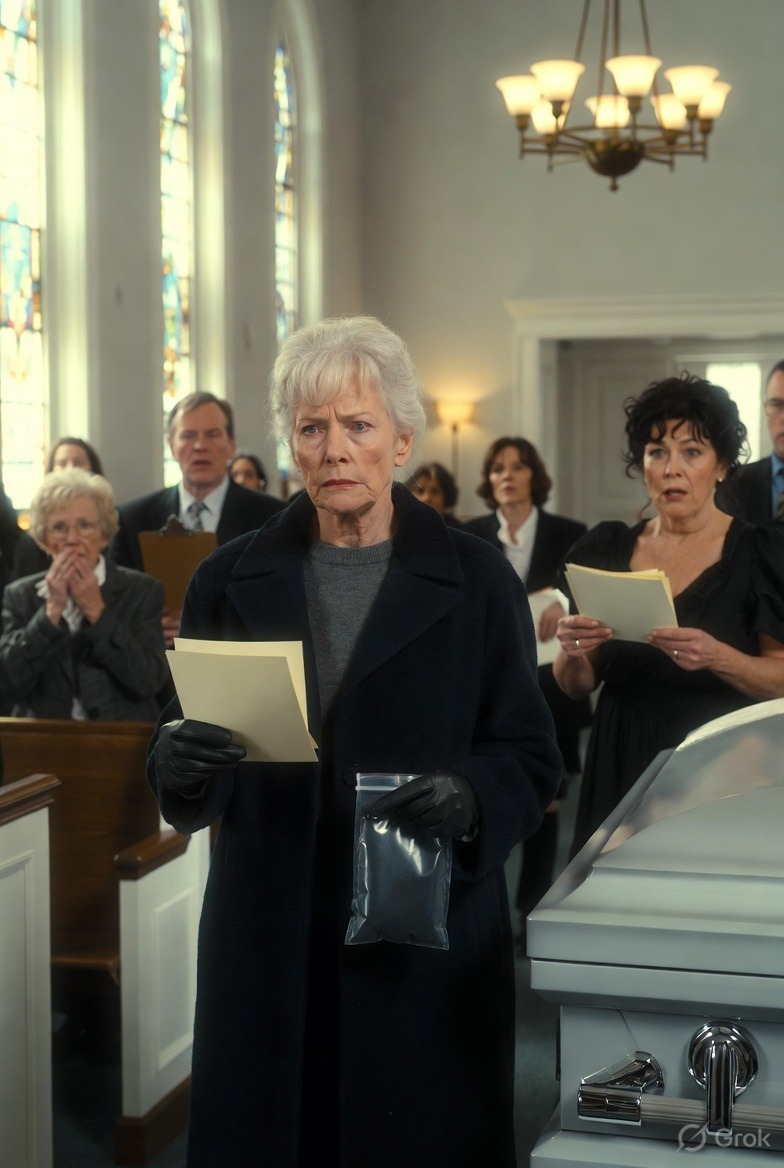
She dressed in a dark wool coat and gray sweater.
She put the vial of tea, the flash drive, the funeral invitation, and copies of the documents into her bag.
At 10:52 a.m., she parked behind Hawthorne & Sons Funeral Chapel.
The building looked gentle from the outside.
Red brick.
White trim.
A sign with gold lettering.
Inside, organ music trembled through the walls.
Diane waited until 11:00 a.m.
She wanted Glenda comfortable.
She wanted every necessary witness seated.
She wanted the structure loaded before the first crack sounded.
The chapel was full.
Cousins occupied the front pews.
Two women from Glenda’s garden club sat together with tissues folded in their laps.
A banker from Richmond Hill Savings stood near the back with a clipboard.
An estate company representative waited by the rear doors, probably counting furniture in his head.
At the front stood a closed white casket surrounded by lilies.
Beside it stood Glenda in black silk.
She looked composed.
She looked almost serene.
That was the part Diane would remember later.
Not guilt.
Not grief.
Serenity.
The whole room performed silence.
Programs lay flat against knees.
Hands folded and refolded.
One cousin stared at the carpet as if the pattern had suddenly become fascinating.
The banker checked his watch, then pretended he had not.
A garden club woman dabbed at dry eyes.
Everyone had been handed a story in which Diane’s absence made Glenda noble, and everyone had accepted it because it was easier than asking why a living woman had no voice at her own funeral.
Nobody moved.
Then Diane opened the chapel doors.
The hinges made a small sound.
It was not dramatic.
It was enough.
Heads turned.
The organist missed a note.
Someone whispered, “Diane?”
Glenda saw her.
For the first time all morning, her smile disappeared.
Diane walked down the aisle without hurrying.
Every step sounded clean against the polished floor.
Glenda’s eyes moved from Diane’s face to her bag, then to the casket, then back again.
“You shouldn’t be here,” Glenda said.
Diane stopped beside the front pew.
“That is an interesting thing to say at my funeral.”
The sentence seemed to pass through the chapel like a draft.
The funeral director stepped forward, pale and confused, holding a folder.
“Mrs. Harrison,” he said carefully, looking between the sisters, “your sister signed the release documents yesterday. She said the family requested a sealed-casket service.”
Diane looked at Glenda.
“My sister has been signing a lot of things lately.”
She placed the cream invitation on the casket lid.
Then the copy of Helen’s note.
Then the flash drive.
Then the sealed vial of tea.
Glenda whispered, “Diane, don’t.”
That whisper did more damage than a confession would have.
People heard fear in it.
Not sorrow.
Fear.
Diane flipped open the casket.
It was empty.
Not symbolically empty.
Not ceremonially arranged.
Empty.
White satin.
No body.
No urn.
No explanation.
A sound moved through the chapel, not quite a gasp and not quite speech.
The funeral director took one step back.
The banker lowered his clipboard.
The estate company representative went still.
Cousin Marjorie began to cry, and for once the tears were real.
Diane turned to the room.
“My mother was declared dead at 4:00 a.m. Tuesday,” she said. “I was told it was heart failure. Before anyone here helps my sister sell Richmond Hill, transfer funds, or sign one more document, you should know what I found.”
Glenda said, “She’s lying.”
Diane opened the laptop she had carried in a black document bag.
Her attorney had insisted on being present before anything public happened.
He stood from the back pew at that moment, quiet and grave.
So did the retired investigator.
Paula from The Willows rose more slowly, hands clasped at her waist.
Glenda looked at them and understood, finally, that Diane had not come alone.
The video played.
Helen’s frail voice filled the chapel.
“I want Diane.”
Then Glenda’s voice answered from the laptop speakers.
“Diane already agreed.”
People watched Glenda push the tea closer.
They watched Helen’s hand drag across the paper.
They watched the signature happen.
No one spoke.
There are silences that protect.
There are silences that accuse.
This one accused.
When the clip ended, Paula stepped into the aisle.
Her voice shook, but she kept speaking.
She said the medication log had been altered after Helen’s death.
She said Helen had been unusually sedated on nights Glenda visited.
She said she had reported concerns to a supervisor and been told the family had authorized comfort care.
The attorney took over from there.
He named the documents.
Power of attorney.
Updated will.
Deed transfer.
Pre-need authorization.
Estate-sale contract.
He did not raise his voice.
He did not need to.
One by one, the pieces that Glenda had arranged into a throne rearranged themselves into evidence.
The county investigator asked Glenda to step aside with him.
Glenda did not move.
For a moment, Diane saw the sister she had known as a child, cornered after breaking a window and furious that anyone had noticed the glass.
“You always thought you were smarter than me,” Glenda said.
Diane felt no satisfaction.
That surprised her.
She had imagined, in flashes, that exposing Glenda would feel like justice arriving with heat.
Instead, it felt cold.
Necessary.
Heavy.
“I thought you loved Mom,” Diane said.
Glenda laughed once.
It was a broken, ugly sound.
“Mom loved you. That was always the problem.”
The words landed harder than Diane expected.
Not because they were true.
Because they were small.
All of this had been small at its root.
Jealousy.
Money.
Old resentment polished into paperwork.
Helen Harrison’s life had been reduced, in Glenda’s mind, to property and proof that someone had been chosen first.
The investigator led Glenda from the chapel.
No one clapped.
No one shouted.
The room remained bright with stained-glass daylight and full of people who had to sit inside their own willingness to believe the easiest story.
The funeral did not continue.
Hawthorne & Sons closed the casket.
The estate company representative left without his clipboard.
The banker asked Diane’s attorney where to send the hold notice.
The garden club women avoided Diane’s eyes.
Cousin Marjorie hugged her and whispered, “I’m sorry.”
Diane did not say it was all right.
It was not all right.
In the weeks that followed, the blue envelope was opened in front of counsel.
Inside was a check for an amount so insulting Diane almost laughed.
There was also a letter from Glenda written in the voice of a benefactor, calling the payout generous and asking Diane to respect Helen’s final wishes.
Helen’s real final wishes were recovered from an older trust document in the Richmond Hill study.
The trust left the house jointly to both daughters, with a clause requiring independent medical review before any change could be made if Helen entered long-term care.
Glenda had known about that clause.
That was why she needed Diane erased.
Not dead in every legal sense yet, perhaps, but socially erased, practically erased, buried beneath ceremony before Diane could object.
The toxicology report on the tea residue supported what the medication log suggested.
The sedative had no place in Helen’s nightly tea.
The signatures on the deed transfer and updated will were challenged.
The court froze the estate.
The Willows opened an internal investigation, and Paula eventually left the facility for another job.
Diane visited Richmond Hill every Thursday while the case unfolded.
At first she went to collect documents.
Then she went because the house was the last place that still smelled faintly of Helen’s lavender soap and dusting powder.
She found more notes in small places.
A grocery list tucked into a cookbook.
A crossword answer written on the back of a receipt.
A birthday card Diane had sent years earlier, saved between pages of a gardening book.
Land remembers who loved it.
So do houses.
Glenda’s case did not resolve quickly.
Cases built from paperwork rarely do.
There were hearings, continuances, expert statements, and arguments over capacity.
Diane gave testimony in a steady voice.
She explained how structural failures work.
She said a collapse can look sudden to people who arrive at the end, but the evidence always shows a history.
The judge listened.
So did Glenda.
For once, Glenda had no room to interrupt.
In the end, the forged and coerced documents were invalidated.
Richmond Hill was placed under the terms of Helen’s earlier trust.
Glenda lost control of the estate, faced charges tied to fraud and elder abuse, and became the subject of a civil action Diane had never wanted but refused to withdraw.
People asked Diane later how she had stayed so calm.
They wanted a simple answer.
They wanted courage to feel like a personality trait.
It was not that.
It was training.
It was grief with a task.
It was love sharpened by evidence.
It was a daughter hearing “Mom’s dead” and recognizing that the sentence had been built too neatly to be true.
Near the end of that first year, Diane stood alone in the Richmond Hill dining room.
The mantel clock had been repaired.
The hidden camera was gone.
Helen’s crossword book lay on the table, open to the last puzzle she had started.
Diane filled in one answer with a pen.
Then she sat for a long while in the quiet.
My sister called: “Mom’s dead. The estate is mine.”
That was the line that started it.
But it was not the line that ended it.
The ending was not the courtroom.
It was not Glenda being led out of the chapel.
It was not even the moment Diane flipped open the empty casket and made a room full of people understand what they had agreed not to question.
The ending was smaller.
It was Diane locking the front door of Richmond Hill at dusk, not because she was guarding money, but because she was guarding memory.
It was the blue envelope filed away as evidence instead of accepted as mercy.
It was Helen’s note preserved beneath glass.
Diane had spent her life asking which crack came first.
In this case, the first crack was not the forged signature.
It was not the drugged tea.
It was not even the empty casket.
It was the moment Glenda mistook silence for consent.
She had confused Diane’s restraint with weakness.
That was her fatal design flaw.
And like every failed structure Diane had ever studied, once the first true crack was exposed, the whole thing came down.