
Part 1
The dust cloud rising from the westbound stage caught Harrison Lambert’s attention as he stepped out of the general store, a sack of flour balanced on his shoulder. His heart lurched with an emotion he had not allowed himself to feel in the 6 weeks since he had sent that letter back east. The coach rattled into Fort Stanton, New Mexico, with its usual fanfare, and Harrison found himself rooted to the wooden boardwalk, watching as the driver pulled the horses to a halt outside the modest hotel that served as the town’s main gathering place for travelers and locals alike.
It was September 1878, and the late afternoon sun cast long shadows across the dusty street, painting everything in shades of gold and amber that made the moment feel suspended in time. Harrison had not told anyone about the correspondence, about the advertisement he had answered in a Boston newspaper that his cousin had sent him months earlier. At 32, he had resigned himself to a solitary existence on his cattle ranch 5 miles outside of town, assuming that no respectable woman would want to travel all the way to the New Mexico Territory to marry a man she had never met.
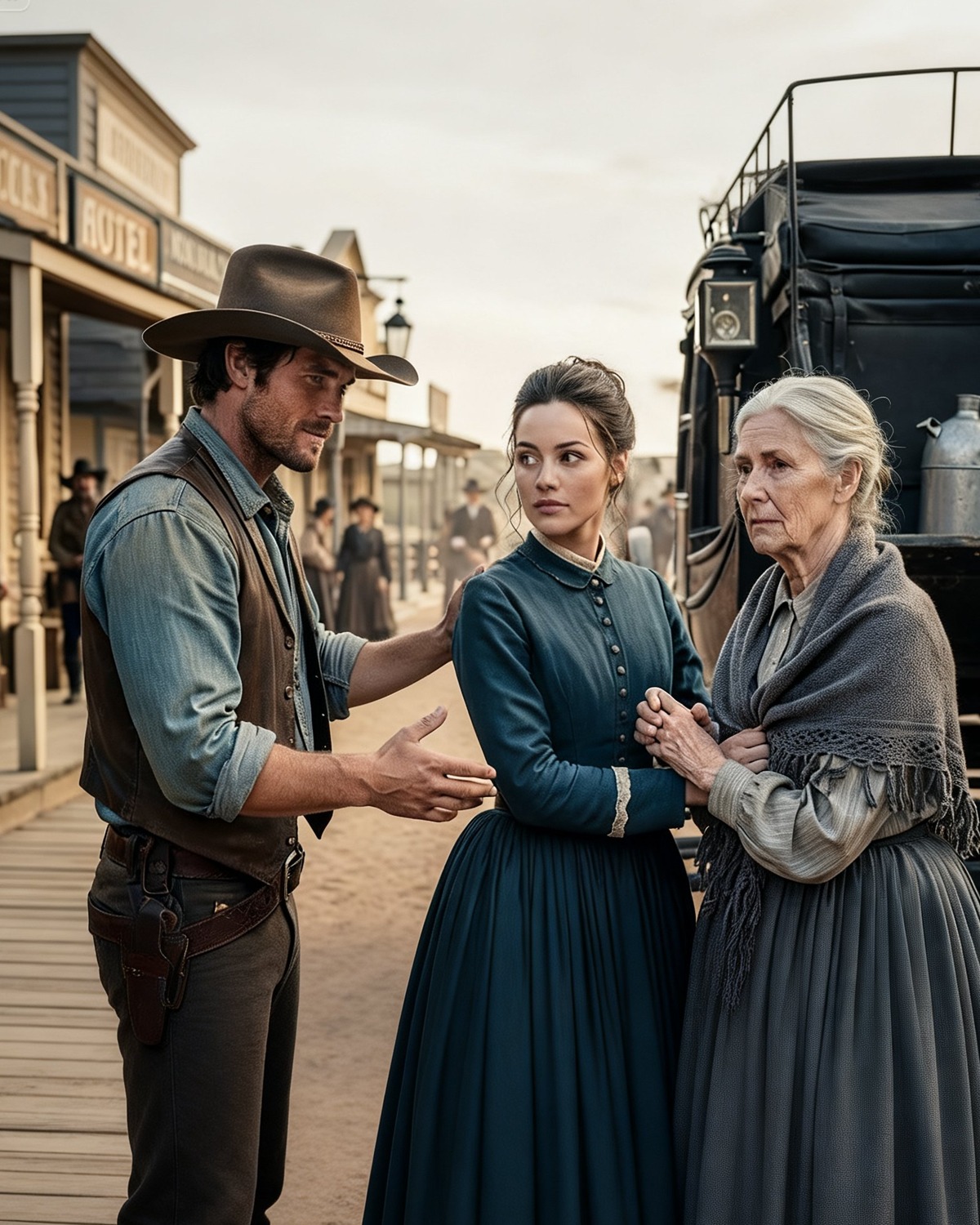
Yet here he stood, watching the stage door open. His breath caught in his throat as a gloved hand appeared, followed by a woman in a traveling dress of deep blue that had seen better days but still maintained an air of dignity.
Rebecca Sullivan stepped down from the coach with careful precision, her movements graceful despite the obvious exhaustion that marked her features. She was not what Harrison had expected, though he could not have said exactly what he had anticipated. Her dark hair was pulled back in a practical bun, and her face, while not conventionally beautiful in the manner of magazine illustrations, held an intelligence and warmth that made his chest tighten. She appeared to be in her mid-20s, with fine lines around her eyes that suggested she smiled often, though at this moment her expression was guarded and uncertain.
Harrison’s attention was immediately drawn to the second figure emerging from the coach. An elderly woman, thin and frail, with silver hair and a face mapped with wrinkles that spoke of both hardship and laughter, took Rebecca’s offered hand. The older woman moved slowly, wincing with each step, and Harrison could see the protective way Rebecca positioned herself, ready to catch her companion if she stumbled.
“Mama, careful now,” Rebecca said softly, her voice carrying across the street despite its gentleness. “We are here. We made it.”
Something shifted inside Harrison’s chest.
The letters had never mentioned a mother. Rebecca had written about herself, about her teaching position in Boston that had ended when the school closed, about her desire for a new life and her hope that they might build something together based on mutual respect and kindness. She had been honest about her circumstances, or so he had thought, but this was an unexpected complication that would have given many men pause.
He watched as Rebecca helped her mother onto the boardwalk while the driver tossed down two worn carpetbags and a small trunk that had seen better days. The older woman was breathing heavily, and even from a distance Harrison could see the slight bluish tint to her lips that suggested a weak heart or troubled lungs.
This was not a temporary visit. This was permanent.
The station manager, a rotund man named Clyde who prided himself on knowing everyone’s business, was already approaching the women. Harrison could not hear the exchange, but he saw Rebecca’s shoulders stiffen and her chin lift in defensive pride. She was explaining something, likely asking about lodging, and Clyde was shaking his head apologetically in a way that suggested the hotel was full or that he had reservations about their ability to pay.
Harrison made his decision in the span of a heartbeat.
He set the flour sack down by the general store’s door and crossed the street with long, purposeful strides. His boots kicked up small puffs of dust with each step, and he was aware of curious eyes following his progress. Fort Stanton was small enough that any unusual occurrence drew attention, and the arrival of two eastern women would be the talk of the town for weeks.
“Excuse me,” Harrison said as he approached, removing his hat in a gesture his mother had drilled into him before she passed. “Miss Sullivan.”
Rebecca turned. Up close, he could see that her eyes were a striking hazel, green and gold mingled in a way that reminded him of the cottonwoods along the creek in autumn. She studied him with an assessing gaze that held both hope and weariness.
“Yes,” she said. “I am Rebecca Sullivan. Are you Mr. Lambert?”
“Harrison Lambert. Yes, madam.” He nodded, then turned his attention to the elderly woman leaning heavily on her daughter’s arm. “And you must be Mrs. Sullivan. I am pleased to meet you both.”
The older woman’s faded blue eyes, still sharp despite her frailty, fixed on him. “Martha Sullivan,” she said, her voice thin but steady. “I apologize for the surprise, Mr. Lambert. Rebecca wrote to tell you, but I suppose the letter did not arrive before we had to leave Boston.”
Harrison processed this quietly. Whatever had prompted their departure had been urgent enough that they could not wait for his response. That spoke of desperation, and desperation made people vulnerable in ways he instinctively wanted to protect against.
“No letter arrived,” he confirmed, keeping his voice neutral and kind. “But that does not change anything important. My home has room for both of you, if you are still willing to consider the arrangement we discussed.”
The relief that flooded Rebecca’s face was so profound that Harrison felt his decision validated at once. She had clearly been braced for rejection, had likely rehearsed a dozen speeches defending her choice to bring her mother.
“You mean that?” Rebecca asked, a tremor in her voice she could not quite conceal. “We would not be an imposition. I can work, Mr. Lambert. I can cook and clean and help with whatever needs doing. Mama can mend, and sew, despite her hands not being as steady as they once were. We will earn our keep.”
“I am sure you will both be valuable additions to the household,” Harrison replied sincerely. “But first, let us get you settled and fed. You must be exhausted from the journey.”
Clyde cleared his throat. “You planning to marry right away then, Harrison? Reverend Morris is out visiting the Henderson ranch, but he’ll be back tomorrow.”
Rebecca’s cheeks flushed, and Martha’s eyes narrowed at the presumption.
“That is a discussion for later,” Harrison said firmly. “Right now, these ladies need rest and a proper meal. I will take them out to the ranch.”
He collected their bags before either woman could protest, surprised at how light the trunk was. Everything they owned in the world, he realized, fit into these few pieces of luggage. The weight of their trust in him settled over his shoulders with far more heft than any physical burden.
His wagon was hitched outside the saloon. As they walked toward it, Harrison was acutely aware of the picture they must make: him in worn work clothes with a sun-weathered face, leading two Boston women through the dusty streets of a frontier town that likely seemed primitive beyond belief. Yet neither woman complained.
Harrison helped Martha into the wagon first, noting how she struggled to lift her legs high enough to manage the step. She was sicker than she had let on, and the journey had taken its toll. Rebecca climbed up more easily, settling beside her mother and arranging their skirts to shield them from dust.
“It is about 5 miles to the ranch,” Harrison explained as he took the reins. “The road is rough in places, but I will do my best to avoid the worst of it. There is water in the canteen under the seat if you need it.”
“Thank you,” Rebecca said. “You are very kind, Mr. Lambert. More than we had any right to expect.”
As Harrison guided the horses out of town, he considered his response. He had been lonely longer than he cared to admit. The ranch kept him busy by day, but evenings stretched long and empty, and there was something soul-crushing about cooking meals for one and speaking only to horses and cattle.
“I put an advertisement in that newspaper looking for a partner,” he said at last. “Someone to build a life with. The circumstances are not exactly what either of us anticipated, but the fundamental truth remains the same. I need someone, and you need somewhere to be. Seems to me we can help each other.”
Martha made a small sound that might have been approval, and Rebecca’s hand found her mother’s.
The landscape around Fort Stanton was harsh and beautiful in equal measure. The Capitan Mountains rose in the distance, their peaks touched with the first hints of autumn snow, while the valleys were painted in browns and golds, dotted with piñon and juniper trees that somehow thrived in the arid soil.
Harrison loved this land fiercely. It demanded everything from those who tried to make a life there, but it gave back in ways that were harder to quantify: freedom, space, the chance to be who one truly was without the weight of society’s expectations.
“It is very different from Boston,” Rebecca observed.
“It is,” he agreed. “Takes some getting used to. But there is beauty here if you look for it. The sunsets are like nothing you have ever seen. And in spring, when the wildflowers bloom, the whole valley turns colors that do not seem real.”
“I like it,” Martha said unexpectedly. “It feels like a place where a person could start over. Where the past does not matter as much as what you do today.”
Harrison glanced at her, catching the wistfulness in her tone. There was a story there, layers of history that had brought these two women west. But stories could wait. For now, what mattered was getting them home and making them feel safe.
The ranch house came into view as they crested a small rise. It was modest: adobe and wood, with a covered porch wrapping around two sides. Harrison had built it himself 7 years earlier when he first claimed the land, adding to it gradually as his herd grew. A barn stood nearby, along with a chicken coop, a small bunkhouse for the two hands he employed during busy seasons, and a corral where several horses dozed in the heat.
“Home,” Harrison said simply.
Inside, the house was clean but sparse, furnished with pieces he had made or acquired through trade. The main room served as kitchen and living area, with a large fireplace for winter. Two bedrooms opened off the main space.
“I know it is not fancy,” Harrison said, setting their bags down. “But it is solid and warm and dry. You will have the bedroom on the right. I will move my things to the bunkhouse tonight.”
“Absolutely not,” Rebecca said firmly, the first spark of fire in her demeanor. “We cannot displace you from your own room. Mama and I will be perfectly comfortable in the smaller room. We have shared quarters before.”
Harrison began to argue, then saw the set of her jaw and understood. Pride was sometimes all a person had left.
“The smaller room,” he conceded. “But if you change your minds, the offer stands.”
He busied himself starting a fire and heating stew. Rebecca insisted on helping, rolling up her sleeves and asking where plates and utensils were kept. Within 30 minutes, the small table was set and the stew warmed, filling the house with savory aromas that made Harrison aware of his hunger.
Martha settled near the fireplace, shivering despite the warmth of the day. Harrison draped a blanket over her shoulders without comment, earning a grateful look from Rebecca.
They ate together as the sun set outside in brilliant color. Conversation began awkwardly but eased as hunger was satisfied and warmth spread through the room. Harrison learned that Martha had been a seamstress in Boston, her husband dead 15 years from an accident at the docks. Rebecca had taught at a charity school for girls until its benefactor died and funding ceased with only a week’s notice.
“And then Mama became ill,” Rebecca said quietly. “The doctor said she needed rest and fresh air. I saw your cousin’s advertisement in a newspaper at the boarding house. It seemed like providence.”
“So you wrote to me,” Harrison said.
“And you wrote back,” Rebecca confirmed. “Your letters were kind. You seemed like a good man.”
“If you want us to leave,” she added softly, “if this is too much, I will understand.”
Harrison set down his cup carefully. “Miss Sullivan, I meant what I said. My home has room for both of you. Life is always more complicated than we expect. What matters is how we handle it.”
Later that night, after the women retired and Harrison moved his essentials to the bunkhouse, he stood on the porch beneath a clear, cool sky. Cattle lowed in the distance, and coyotes called from the ridge. His life had shifted in the span of hours, yet he felt no regret—only a cautious, growing hope.
Inside, Rebecca lay on blankets beside her mother’s bed in the narrow room.
“He is not what I expected,” Martha murmured.
Rebecca knew what she meant. Harrison was weathered but gentle, deliberate in his movements.
“Do you think you could love him?” Martha asked.
“I do not know him well enough to answer that,” Rebecca replied honestly. “But I think I could respect him. And perhaps that is a better foundation than romantic notions.”
“Perhaps,” Martha said softly. “But you deserve romance, too.”
The next days settled into a rhythm. Harrison rose before dawn to tend the ranch. Rebecca prepared breakfast and learned the rhythms of ranch life. Martha mended clothes with quiet satisfaction. On the third day, Harrison returned from town with fabric and a sewing machine for Martha, framing it as an investment. Soon word spread of the skilled seamstress at the Lambert ranch.
Rebecca found herself treated as a partner. Harrison consulted her about supplies and plans, taught her to ride, steadied her in the saddle. She discovered that he valued her thoughts, her intelligence.
Two weeks after her arrival, Harrison came in from the fields early, hat in hand.
“I need to talk to you,” he said.
They sat at the kitchen table.
“When I put that advertisement in the paper, I was looking for a wife,” he said. “A true partner. But I do not want you to feel pressured. If you would rather keep things as they are, you and your mother will have a home here regardless.”
Rebecca’s eyes burned at the generosity of the offer.
“What do you want?” she asked.
“I want to court you properly,” Harrison replied. “To take the time to know each other without pressure. And if at the end of that time you think you could be happy as my wife, I would be honored. But if not, the offer of a home stands.”
Warm hope unfurled in Rebecca’s chest.
“I would like that,” she said softly. “I would like to be courted.”
“Then that is what we will do,” Harrison answered, smiling. “And perhaps you could call me Harrison.”
“Rebecca,” she replied, and the way he spoke her name thereafter made her blush.
Their courtship unfolded not in parlors but across open land and on the ranch porch at sunset. They spoke of their pasts, their values, their dreams. They discovered shared principles and complementary strengths. Martha watched with quiet satisfaction as something steady and genuine took root between them.
By October, the air had turned crisp, and the mountains hinted at winter. It was then that Harrison asked Rebecca to ride with him to a high point on the property he called the overlook.
Part 2
The overlook was a high ridge on Harrison’s property from which the land spread for miles in every direction, a vast sweep of brown and gold broken by dark clusters of juniper and the faint silver ribbon of the creek. They dismounted and let the horses graze while they sat on a broad, flat rock warmed by the fading sun. The sky ignited in bands of orange, rose, and violet, colors so vivid that Rebecca felt as though she were witnessing the birth of something sacred.
Harrison had brought a blanket, and he draped it over her shoulders as the temperature began to drop, his hands lingering just long enough to betray the depth of his feeling.
“I love it here,” Rebecca said softly, and she meant it. The land that had once seemed harsh and alien now felt expansive and honest, a place where a life could be shaped with one’s own hands.
“I am glad,” Harrison replied. “Because I have been thinking, and I need to ask you something important.”
She turned toward him, her pulse quickening. The dying sunlight carved his features into planes of light and shadow, revealing the strength and steadiness that had come to anchor her.
“We have been dancing around this for weeks,” he continued. “Getting to know each other, building something between us. And I think you know how I feel about you, Rebecca. But I need to say it plainly. I have fallen in love with you. Not because you are here, not because it is convenient, but because of who you are. Your strength, your kindness, the way you see possibilities where others see obstacles. I love how you care for your mother. I love working beside you. I love imagining a future where we do this together for the rest of our lives.”
Tears slipped down Rebecca’s cheeks, unchecked.
“So I am asking you properly,” Harrison said, his voice steady despite the emotion beneath it. “Will you become my wife? Not because of an arrangement made through letters, but because we have chosen each other.”
“Yes,” Rebecca answered at once, the word breaking free in a half laugh, half sob. “Yes, I will marry you. Because I have fallen in love with you too. With your patience and your generosity. With the way you made room for both me and my mother without hesitation. With the way you look at me as though I am something precious.”
He gathered her into his arms, and she went willingly, feeling safe and cherished. Their first kiss beneath the open sky was gentle and questioning, then deeper, filled with promise and the certainty of mutual devotion.
They rode back beneath a canopy of stars. When they entered the house hand in hand, Martha looked up from her sewing, took in their faces, and smiled knowingly.
“About time,” she said.
“We will marry as soon as it can be arranged,” Harrison announced, laughter in his voice.
“My approval was given the day you met us at that stagecoach and did not turn us away,” Martha replied.
They were married 3 weeks later in a simple ceremony at the small church in Fort Stanton. Rebecca wore a pale blue dress Martha had sewn from the fabric Harrison purchased, embroidered delicately by her mother’s steady, determined hands. Harrison wore new clothes bought for the occasion, looking faintly uncomfortable in their formality but unmistakably proud.
The whole town attended, curiosity mingling with genuine goodwill. When Reverend Morris asked Rebecca if she took this man as her lawful husband, she answered “I do” with unwavering conviction. Harrison’s vows were equally firm. When he kissed her at the reverend’s instruction, applause and laughter filled the small church.
The celebration continued at the ranch, neighbors bringing food and drink. Martha presided from a shaded chair, accepting congratulations with grace. Rebecca danced with Harrison between the house and barn, laughing when he stepped clumsily on her toes.
“I do not care if you are the worst dancer in New Mexico,” she told him, arms around his neck, “as long as you keep looking at me like that.”
“Like what?” he asked, smiling.
“Like I am home.”
“You are home,” he replied.
That night, when the guests had departed and Martha had retired with pointed remarks about being a heavy sleeper, Harrison and Rebecca stood together on the porch. The main bedroom was theirs now. Rebecca felt nervousness flutter through her, though desire and trust ran deeper.
“We do not have to rush,” Harrison murmured, pressing a kiss to her knuckles. “We have all the time in the world.”
“I am not afraid,” she said, stepping closer. “I trust you.”
He carried her across the threshold with a tenderness that made her laugh softly against his shoulder. What followed was awkward and gentle and deeply intimate, marked by patience and reverence. Rebecca had read marriage manuals in secret back in Boston, but nothing had prepared her for the vulnerability and closeness of giving herself to a man she loved.
Afterward, they lay entwined, her head on his chest, listening to the steady rhythm of his heart.
“I love you,” she whispered.
“I love you too,” he replied. “Thank you for choosing me.”
“Thank you for making room for both of us,” she said.
Their first year of marriage brought both joy and challenge. Winter came hard to the New Mexico Territory, snowstorms trapping them indoors for days. Yet the closeness deepened their bond. They passed evenings with reading aloud, conversation, and card games Martha learned with surprising competitiveness.
In spring, Rebecca planted the vegetable garden they had discussed. Though she had never gardened before, she approached the task with scholarly determination, consulting books from the small Fort Stanton library and experimenting with methods. The garden flourished, providing fresh vegetables that Martha canned and preserved in gleaming jars lining the root cellar shelves.
Rebecca resumed teaching informally. Word spread that Mrs. Lambert had been a teacher back east, and parents began asking her to tutor their children. Harrison converted part of the barn into a small schoolroom. Twice a week, Rebecca taught reading, writing, and arithmetic to children whose families could spare them from farm work.
She refused payment in money, accepting eggs, milk, and help with chores instead. Harrison argued she deserved compensation, but she insisted education was worth more than coin.
Martha’s health improved in the clean air, though her heart condition remained chronic. Purpose revitalized her. Her sewing brought additional income and strengthened community ties.
Late in summer, Rebecca realized she was pregnant. Joy mingled with fear. She knew the risks of childbirth in a territory where doctors were scarce. When she told Harrison, he dropped his pitchfork and lifted her in a dusty embrace.
“Are you sure?” he asked.
“As sure as I can be.”
His face shone with awe. “We are going to have a baby.”
“And you are going to be a father.”
He became fiercely protective, fretting over her exertion until she reminded him she was pregnant, not fragile glass. They struck a balance, as they always did.
In March 1880, as cottonwoods budded along the creek, Rebecca went into labor. Harrison had arranged for Mrs. Chen, a seasoned midwife who had delivered half the territory’s children, to stay at the ranch in the final weeks.
Labor was long and agonizing. Harrison paced outside while Martha held Rebecca’s hand. When the baby’s cry finally pierced the air, Harrison sagged in relief.
“You have a son,” Mrs. Chen announced. “A healthy boy.”
Harrison entered the room to find Rebecca exhausted but radiant, cradling a tiny bundle.
“Look what we made,” she whispered.
The infant’s small hand grasped Harrison’s finger with surprising strength. Something fundamental shifted within him.
“He is perfect,” Harrison said hoarsely. “You are perfect. Thank you.”
They named him Henry Marcus Lambert, honoring both grandfathers, though they called him Henry from the beginning.
Life transformed at once. The house felt smaller, nights were broken by feedings, and Rebecca moved through her days in a haze of exhausted love. Harrison proved devoted, pacing with a fussy baby and crafting a cradleboard inspired by Apache mothers so Rebecca could keep Henry close while working.
Martha delighted in grandmotherhood, singing lullabies from Rebecca’s childhood. Henry quieted at her voice, and the sight brought peace to them all.
As Henry grew, the ranch prospered. Harrison hired 2 permanent hands. Rebecca’s school expanded until she taught nearly a dozen children regularly. Harrison built a proper schoolhouse with benches, a chalkboard, and shelves for Rebecca’s growing collection of books.
On Henry’s 3rd birthday, Rebecca watched her family gathered in celebration and felt a peace so profound it startled her. This life, born of desperation and uncertainty, had become richer than anything she had imagined.
Two years later, Rebecca gave birth to twins—a boy and a girl named Robert and Ruth. The delivery was more difficult, and even Mrs. Chen showed concern, but Rebecca persevered. When it ended, she lay exhausted, one baby in each arm, tears streaming.
“We are going to need a bigger house,” Harrison said, overwhelmed.
“We are,” Rebecca agreed with a weary laugh.
They hired a young woman from town named Sarah to assist with the children and household. Harrison built an addition, expanding the kitchen and adding 2 bedrooms. The ranch grew into one of the area’s most successful operations, and Harrison’s fairness earned him respect throughout Fort Stanton.
Rebecca’s school became a permanent community institution. Parents agreed to provide her a small salary, though she continued to teach out of conviction rather than for income. Her students thrived, crediting Mrs. Lambert with shaping their futures.
Martha lived to see her 3 grandchildren grow beyond infancy. At 74, her heart finally failed peacefully in her sleep. They buried her on a rise overlooking the ranch, where she had loved to sit and watch the mountains.
“She got to start over,” Rebecca said at the funeral, standing between Harrison and 8-year-old Henry. “She built a life here full of joy instead of struggle.”
The years that followed brought droughts and blizzards, cattle disease and failed crops, injuries and recoveries. Yet they also brought birthdays and school terms, harvest celebrations and quiet evenings on the porch.
Henry grew serious and devoted to the ranch. Robert showed an early love of books. Ruth blended practicality and idealism, echoing both parents.
On their 20th wedding anniversary, Harrison took Rebecca back to the overlook. Time had marked them—gray in his hair, calluses on her hands—but their bond had deepened.
“I would do it all again,” Rebecca said. “Every hardship.”
“Even the part where you arrived with your mother?” Harrison teased.
“Especially that part,” she answered. “Because that is when I saw who you truly were.”
They sat watching the sun sink below land dotted with their cattle, smoke rising from the chimney of the home they had built together.
“My home has room for both,” Harrison murmured. “Best decision I ever made.”
“Best decision we both made,” Rebecca corrected.
Part 3
The years that followed proved kinder than either Harrison or Rebecca had once dared to imagine. Henry gradually assumed more responsibility for the ranch as Harrison’s joints began to protest the long days in the saddle. Robert, driven by his love of books, went east to college, earned a law degree, and returned to Fort Stanton to establish a practice that brought order and fairness to a region that had once known little of either. Ruth, inheriting both her mother’s passion and her father’s steadiness, took over the school when Rebecca finally acknowledged that it was time to step back.
Harrison and Rebecca grew old together as they had lived—side by side. Their love mellowed and deepened, shaped by decades of shared labor and shared purpose. They became an example within the community, the former mail-order bride and the rancher who had built something enduring from uncertain beginnings. They welcomed grandchildren and then great-grandchildren, their family tree branching and spreading until even Rebecca sometimes lost count of the names.
In the spring of 1920, Rebecca was 67 and Harrison 72. They sat together on the porch of the house that had been expanded and altered so many times it scarcely resembled the modest structure Rebecca had first entered 42 years earlier. The cottonwoods along the creek were in full bloom, scenting the air with sweetness. Rebecca knitted a blanket for their newest great-grandchild, and Harrison whittled a toy horse in the style that had become his signature.
“You ever regret it?” Harrison asked suddenly. “Leaving Boston. Giving up whatever life you might have had there.”
Rebecca set aside her knitting and regarded him with the patience of a woman who had reflected on such questions before.
“Not for a single moment,” she said firmly. “This is the life I was meant to have. You are the man I was meant to love. If I could go back and do it again, I would not change a thing—except perhaps to hurry that stagecoach so I could reach you sooner.”
Harrison laughed, the sound rich with the contentment of decades well lived.
“Good,” he replied. “Because I cannot imagine my life without you. You and your mother stepping off that stagecoach and turning everything upside down—that was the best thing that ever happened to me.”
They fell into companionable silence, the kind that comes only from long familiarity and unwavering trust. In the distance, a great-grandson’s laughter carried on the breeze. The ranch flourished under Henry’s management. The school Ruth led educated its third generation of students. Robert’s law practice anchored Fort Stanton in stability and fairness.
Everything they had built traced back to a single moment on a dusty September afternoon in 1878, when Rebecca and Martha Sullivan stepped down from a westbound stagecoach into an uncertain future, and Harrison Lambert chose kindness over convenience.
Rebecca often reflected on that moment—the fear she had felt bringing her ailing mother west, the humiliation she had braced herself for when revealing the unexpected addition to their arrangement, and the overwhelming relief when Harrison had simply said, “My home has room for both.”
Those words had opened a world. They had given her and Martha the chance to begin again, to exchange desperation for dignity. Harrison’s generosity had been the seed from which everything else grew—their marriage, their children, their school, their legacy.
What had begun as a practical solution to hardship had become something far more enduring. It was a love story, yes, but also a testament to second chances and to the transformative power of compassion. By opening his home, Harrison had changed not only Rebecca’s life but his own.
Rebecca reached for his hand. His skin was weathered and marked with age, but his grip remained steady.
“I love you,” she said quietly.
“I love you too,” Harrison answered. “Always have. Always will.”
They sat together as the sun climbed higher, warming the porch and the land that had shaped their lives. The New Mexico landscape remained as it had always been—harsh and beautiful in equal measure, demanding and generous. It had tested them with drought and storm, with loss and uncertainty. It had rewarded them with space to grow, to work, to build.
They had met as strangers bound by letters and necessity. They had become partners by choice. They had weathered seasons of want and seasons of abundance. They had raised children who carried forward both the ranch and the school. They had buried Martha on a hill overlooking the life she had been given the chance to rebuild.
Now, in the quiet fullness of old age, they understood that the simple decision to make room—for love, for family, for unexpected responsibility—had shaped everything that followed.
“My home has room for both,” Harrison said again, almost to himself.
Rebecca smiled, remembering the dusty boardwalk and the stagecoach and the fear in her chest that had dissolved at those words.
“Yes,” she replied softly. “And because of that, we built something that will outlast us both.”
They had created not only a marriage but a foundation—one rooted in respect, strengthened by labor, and sustained by unwavering devotion. Their children and grandchildren would inherit the land and the school, the ranch and the law practice, but more than that, they would inherit the example of two people who chose generosity when it would have been easier to choose self-interest.
As the afternoon light settled over the ranch, Harrison and Rebecca remained side by side, exactly where they had chosen to be decades earlier. The stagecoach, the uncertainty, the leap of faith—these were now part of family lore. What endured was the life they had built: hard-earned, deeply loved, and shared.
And neither of them would have had it any other way.