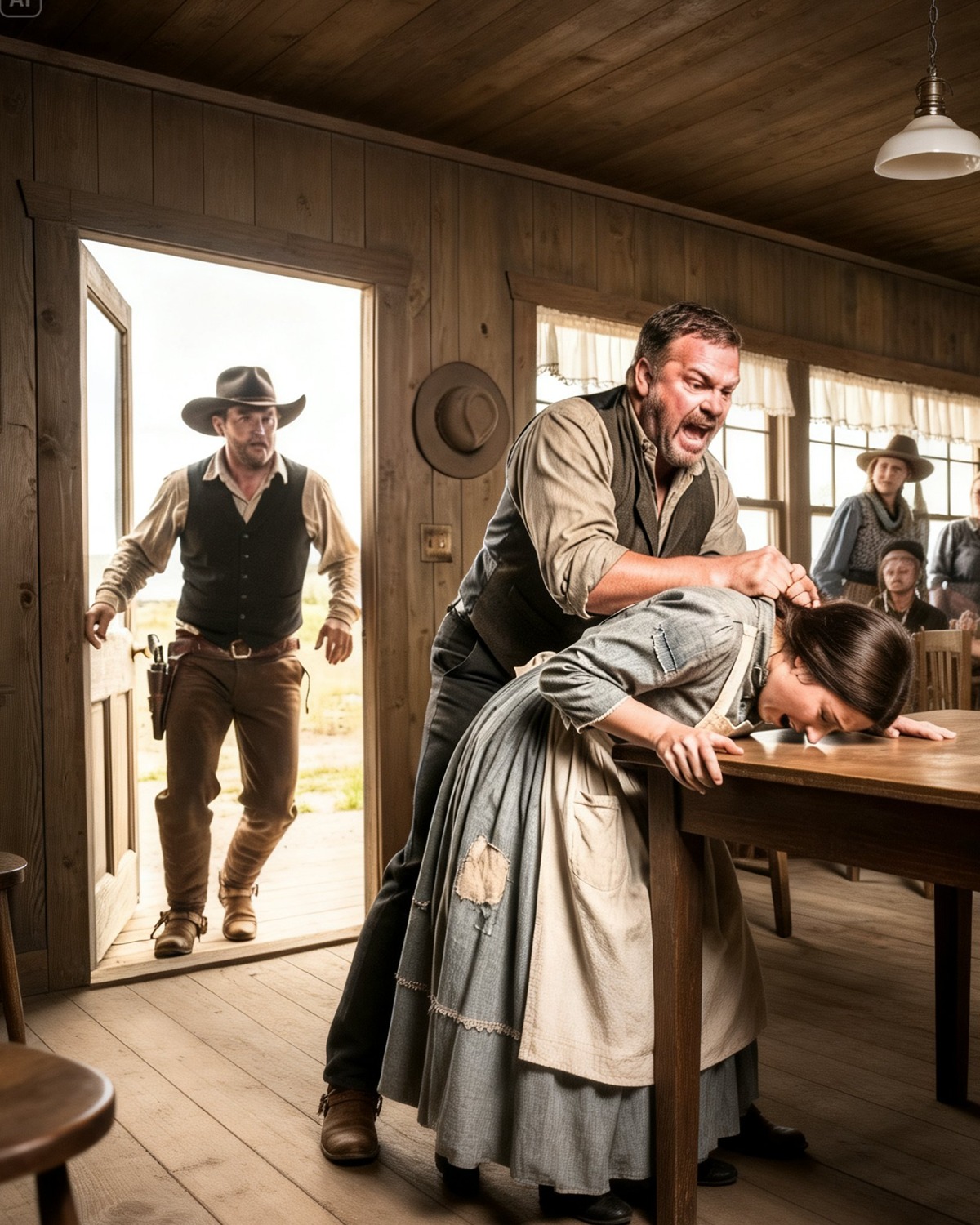

Emma Louise Hartley’s hand trembled as she pressed the cold edge of a kitchen knife against her own throat—not to harm herself, but to stop him. Vernon McCrae had her pinned against the wall of the Red Canyon saloon kitchen, his whiskey-soured breath hot against her face, his thick fingers digging into her arms and reaching where no man had any right to reach.
“I’ll do it,” she whispered, tears streaking down her cheeks. “I swear to God, I’ll do it.”
Vernon laughed, low and cruel. “Go ahead, sweetheart. Save me the trouble of breaking you in.”
The kitchen door slammed open.
“Step away from her.”
The voice rolled through the room like distant thunder. Vernon’s grip loosened, not from fear but from irritation. He turned his heavy head toward the doorway.
The morning had begun like every other morning in Dusty Springs, Texas, in the summer of 1878. Emma had woken before dawn, dread settling into her stomach before her eyes even opened. The heat already pressed through the thin walls of her back room at the Red Canyon saloon and diner.
The room was small: a narrow cot, a cracked mirror, a chipped wash basin. It was not truly hers. It was what she paid for with 70 hours of labor each week.
She washed her face in tepid water and studied her reflection. At 22, she looked older than her years. Her father used to say she had her mother’s eyes—green as spring grass. Her mother had run off when Emma was 12. Her father had worked himself to death in the silver mines trying to fill the silence she left behind.
He had died 4 months ago.
Emma had borrowed $300 from the bank—Vernon McCrae’s bank—to bury him properly. In doing so, she had bound herself to Vernon in a way she did not fully understand until it was too late.
She tied back her honey-colored hair, smoothed her plain calico dress, and stepped into the dining room to begin breakfast service.
Clyde, the aging owner of the Red Canyon, wiped down tables without looking up. He had run the place for 30 years. He was kind enough, but kindness did not stand up to men like Vernon McCrae.
“Full house expected,” Clyde muttered. “Railroad surveyors coming through.”
“Yes, sir.”
Emma moved into the kitchen. Bacon hissed in iron pans. Coffee boiled strong enough to strip paint. She worked with quiet efficiency. The railroad men were loud, but they kept their hands to themselves and tipped decently. For a brief hour, she almost allowed herself to relax.
That was her mistake.
Vernon McCrae entered at 11:00.
The air shifted before she saw him. Conversations dulled. Men found sudden fascination with their cups.
Vernon was 40, broad and thick through the shoulders, built like a bull. He owned the silver mine, the bank, and half the buildings in Dusty Springs. Three weeks earlier, he had decided he wanted to own Emma as well.
He took his usual table in the center of the room.
“Emma, darling,” he called, voice carrying like a gunshot. “Come take my order.”
Her fingers went numb as she lifted her notepad.
“Yes, Mr. McCrae.”
She approached with eyes lowered.
“Look at me when I’m talking to you.”
She obeyed. His face was flushed from drink, his eyes pale and muddy. He smiled in a way that made her stomach churn.
“You’re a pretty thing when you smile,” he said. “Why don’t you smile for me?”
“What can I get you today, Mr. McCrae?”
“I already told you what I want. A smile.”
She forced her lips upward. It felt like dragging barbed wire across her face.
“Better,” he said. “Now I’ll have the steak, rare, and coffee. And bring it careful. Remember last time you spilled on my boots?”
He had kicked over his own cup and docked her wages.
“I remember, sir.”
His hand shot out, gripping her wrist. “Next time I might have to teach you a lesson.”
“Please let go.”
He held her there a moment longer, simply to prove he could. Then he released her.
When she returned with the steak 30 minutes later, she set it down perfectly. Vernon cut into it, chewed slowly, then spat the bite onto the plate.
“This is burned.”
“You asked for—”
“I asked for rare. Are you stupid?”
“I’ll get you another.”
“You’ll do more than that.”
He rose. The chair scraped loudly across the floorboards. Twenty men watched in silence.
“On your knees,” he said.
The room froze.
“Please,” Emma whispered.
“On your knees.”
His hand pressed against the back of her neck, forcing her downward.
“Let her go.”
Every head turned.
The man in the doorway did not appear remarkable at first glance. He was about 6 ft tall, lean from hard living. Dust covered his dark hat and range clothes. A gun belt sat low on his hips, worn but well kept.
His eyes were pale blue, cold as winter water.
Vernon’s grip loosened slightly.
“Who the hell are you?”
“Cole Harrison.”
He stepped forward with unhurried confidence.
“And I’m asking politely. Let the lady go.”
“You’re asking?” Vernon sneered.
“I’m asking.”
“This is my employee. My town.”
“Doesn’t look like she’s enjoying the employment.”
Vernon’s ranch hands—Cutter, Snake, and Bull—rose from their chairs.
“Four against one,” Cutter muttered.
“Won’t be four against one,” Vernon said loudly. “Every man in this room works for me.”
Silence answered him.
Cole’s hand moved.
In a blink, his Colt Peacemaker was drawn, hammer back, barrel leveled at Vernon’s forehead.
“Let her go. Now.”
Vernon released Emma instantly.
“You just made the biggest mistake of your life,” Vernon said.
“Won’t be my first.”
Cole did not lower the gun.
“Ma’am, you all right?”
Emma nodded.
“You want to finish your shift or leave?”
She looked at Clyde, who could not meet her eyes. She looked at Vernon’s men. She understood what staying meant.
“I want to leave.”
“Get your things.”
She ran to her back room. She owned little: 2 dresses, a shawl, a photograph of her father, her mother’s Bible. She bundled them quickly.
When she returned, Cole had not moved.
“You ready?” he asked.
“Yes.”
“Walk out that door. Don’t run.”
She walked. The sunlight blinded her. She heard Vernon’s voice behind her.
“You won’t make it out of town alive, Harrison. Neither will she.”
“We’ll see,” Cole replied.
Then he backed out, gun still raised.
The moment they cleared the doorway, he seized her arm.
“Now we run.”
They sprinted down the dusty street. Cole pulled her into the livery stable, saddled a buckskin horse with swift precision.
“You know how to ride?”
“Yes.”
“Good. Get on.”
They mounted. Gunfire cracked behind them as they burst from the alley and galloped toward the open prairie.
Three miles out, they reached the cottonwoods lining Mustang Creek. Cole slowed at last beneath the shade.
Emma slid down, legs buckling.
“I just lost everything,” she said. “My home. My job. $500 in debt.”
“You weren’t going to pay that debt,” Cole said.
“You don’t know that.”
“I know men like Vernon McCrae. He wasn’t waiting for money.”
She could not deny it.
“How much?” he asked.
“$300 principal. $150 in interest. $50 in rent.”
“$500.”
“Yes.”
Cole pulled a leather pouch from his coat and tossed it to her.
“There’s $400. Gold certificates and silver.”
She stared at it.
“Why?”
“Consider it payment.”
“For what?”
“For reminding me why I’m still alive.”
He turned toward the creek.
“I used to walk past people who needed help,” he said quietly. “Told myself it wasn’t my problem. Then I lost my wife Rebecca and my daughter Caroline because no one stood up for them.”
Emma swallowed.
“They were killed?”
He nodded.
“Dutch Carver’s gang. I hunted them down. All 7 of them.”
She saw no pride in his eyes. Only exhaustion.
“You can go back to town, clear your debt, and start over somewhere safe,” he said. “Or you can ride north. Alone.”
“Take me with you,” Emma said.
He stared at her.
“You don’t know me.”
“I know you didn’t take advantage of me when you could have. I know you risked your life for a stranger. That’s enough.”
“If you ride with me, Vernon will put a price on both our heads.”
“I’m already hunted,” she said. “At least this way it’s for something I chose.”
After a long silence, he nodded.
“We leave at dawn. I’ll settle your debt legal and clean.”
They camped by the creek that night.
“Why didn’t you kill him?” she asked later, watching the fire.
“Because I’m trying to be a different man than I was,” Cole said. “The old me would have.”
In the morning he rode into town alone.
He returned near mid-afternoon, blood staining his shirt.
“Not mine,” he said.
He handed her a receipt: Paid in full. Emma Hartley. $450. V. McCrae.
“His men were waiting outside the bank,” he added. “They won’t be riding for a while.”
They rode north into the foothills.
By the second day, bounty hunters were tracking them.
In a narrow gorge, four men cornered them: Cutter, Snake, Bull, and a fourth stranger—a bounty hunter.
“You’re worth $500 in New Mexico,” the stranger told Cole. “Dead or alive.”
“You come peaceful,” he added, “the girl doesn’t get hurt.”
Emma saw Cole calculating.
“Don’t,” she said.
He lowered his rifle.
Bull charged.
Gunfire erupted.
Emma seized a rock and struck the bounty hunter from behind, splitting his skull.
Cole shot Bull.
Two fled wounded.
The fight ended in blood and echoing silence.
Cole swayed, blood spreading across his side.
“You saved my life,” he said faintly.
He collapsed moments later.
Emma dragged him to the horse, rode north until they found a hidden cave.
There, with trembling hands, she dug the bullet from his side, stitched the wound, and sat vigil through the night.
When riders approached at dawn, she lifted Cole’s Colt and prepared to kill again if necessary.
She did not have to.
The riders passed.
But Cole’s fever did not.
By the second day, infection set in.
Emma left him hidden, gathered willow bark and herbs under moonlight, brewed bitter tea, fought to keep him alive.
On the third night, she forced him back into the saddle.
They rode toward a cabin 15 miles north belonging to Jack Sterling—a man Cole once rode with.
They barely made it.
Jack cut away infected flesh, cauterized the wound, and by morning the fever broke.
Cole would live.
But Vernon McCrae was not finished.
By the next day, word came: $1,000 bounty. Dead or alive.
Jack fortified his cabin.
When professional hunters came at dusk, they fought through the night.
Jack was shot. Cole nearly bled out again.
The cabin burned.
They escaped through a root cellar tunnel as the roof collapsed in flame.
At dawn, Vernon himself arrived with 15 armed men.
Emma stepped out from hiding.
“I’m here,” she called.
Vernon raised his gun.
A shot rang out from the hills.
Marshall Marcus Webb and his deputies surrounded them.
Vernon was arrested.
It seemed finished.
It was not.
The murder charges against Cole in New Mexico resurfaced.
Vernon’s influence reached the territorial capital.
Emma chose to testify anyway.
Cole agreed to a deal: full pardon in exchange for testimony against Dutch Carver’s operations.
The trial lasted one long day.
Vernon’s lawyer tried to destroy Emma’s character.
Cole produced a stolen ledger proving Vernon had paid criminals for “special services.”
The jury deliberated 20 minutes.
Guilty.
Vernon was sentenced to 15 years in territorial prison.
Outside the courthouse, Emma trembled with relief.
“It’s over,” Cole said.
“We won,” she answered.
He asked her to marry him.
She said yes.
But on the day of their wedding, as vows were about to be spoken, the church doors burst open.
A veiled woman stood at the threshold.
“I object,” she said.
She lifted her veil.
Rebecca.
Cole’s wife.
Alive
The church fell into stunned silence.
Cole Harrison stood as though struck by lightning. The color drained from his face, leaving him pale beneath the high Texas sun filtering through the chapel windows.
Rebecca.
The name he had buried alongside a crude wooden cross in New Mexico.
The name he had spoken in quiet grief beside campfires and under lonely stars.
The name he had believed belonged to the dead.
Emma felt her breath catch painfully in her throat. She had known about Rebecca and Caroline. She had heard the story of Dutch Carver’s gang, the charred cabin, the bodies never properly recovered. She had watched the way Cole’s voice broke when he spoke of them.
Now Rebecca stood 20 feet away—thin, sunburned, and very much alive.
“You’re dead,” Cole said hoarsely.
Rebecca stepped forward. “No. I wasn’t.”
The minister shifted uncomfortably. Townspeople whispered. The marshal, present as a guest rather than an officer, watched carefully but did not intervene.
Emma’s hands felt suddenly cold.
“What happened?” Cole asked.
Rebecca removed her gloves slowly, revealing scarred wrists.
“Dutch Carver didn’t kill me,” she said. “He sold me.”
A ripple passed through the congregation.
“Caroline?” Cole asked, dread pooling in his voice.
Rebecca’s eyes filled with tears.
“She died of fever in Santa Fe. I buried her myself.”
The words struck Cole like a physical blow. He staggered backward and gripped the edge of a pew.
Emma felt something inside her fracture—but not from jealousy. From understanding.
Rebecca had survived something monstrous.
“Why didn’t you send word?” Cole demanded.
Rebecca’s expression hardened.
“You think I didn’t try? I escaped once. They caught me. They made an example of me.” She lifted her sleeve slightly to reveal lash marks. “By the time I got free for good, two years had passed. I heard you’d hunted down Carver’s men. I thought… I thought you’d moved on.”
“I thought you were dead.”
“I know.”
The silence stretched painfully.
The minister cleared his throat. “It seems this ceremony cannot proceed.”
Emma finally found her voice.
“No,” she said quietly. “It cannot.”
She turned to Cole.
“Go to her.”
“Emma—”
“Go.”
There was no anger in her tone. Only dignity.
Cole looked torn in half. Every instinct in him pulled toward Rebecca—the woman he had once loved, the woman he had believed lost to the grave. But he also looked at Emma, the woman who had saved his life, fought beside him, and stood firm when the world tried to crush them.
“I don’t know what to do,” he admitted.
Emma’s chin lifted slightly.
“Yes, you do.”
She stepped back from the altar.
The guests slowly dispersed, murmuring in shock. The wedding flowers drooped in the humid air, abandoned symbols of a promise that could not be kept.
Outside the church, Emma stood alone beneath a mesquite tree.
Cole approached cautiously.
“I never stopped loving her,” he said quietly.
“I know.”
“But I love you.”
Emma closed her eyes briefly.
“Love doesn’t erase history,” she said. “She’s your wife. You never buried her properly. You buried an idea.”
Cole swallowed hard.
“You saved me,” he said. “You fought for me.”
“I didn’t fight to replace her.”
He flinched at that.
“What will you do?” he asked.
Emma looked out over Dusty Springs—the town that had once tried to break her and now whispered about her courage.
“I’ll stay,” she said. “Clyde offered me partnership in the Red Canyon. He says business has never been better.”
“And us?”
She met his eyes.
“We were real,” she said. “But sometimes what’s real isn’t meant to last forever.”
Behind him, Rebecca waited quietly near the church steps.
Cole hesitated only a moment longer before turning back toward his wife.
Emma watched him go.
It hurt—but it did not break her.
She had once believed she needed saving. Now she understood she had saved herself long before Cole Harrison ever walked through the saloon doors.
The months that followed were complicated.
Rebecca struggled to reintegrate into a world that had buried her. She startled at loud noises. She rarely slept through the night. Cole stayed close, patient, haunted by guilt he did not know how to resolve.
Emma threw herself into work.
With Vernon McCrae imprisoned and his holdings auctioned, the town shifted. The bank passed to new management. The Red Canyon expanded. Emma negotiated contracts with railroad suppliers and proved sharper with numbers than anyone expected.
Men who had once looked past her now removed their hats when she passed.
One evening, as she closed the books, Marshall Marcus Webb stepped into the saloon.
“You did something rare,” he said.
“What’s that?”
“You let a man go without destroying yourself.”
Emma smiled faintly.
“I was never his shadow,” she replied. “I was his partner. And now I’m my own.”
The marshal nodded with quiet respect.
Spring returned.
Cole and Rebecca prepared to leave Dusty Springs for a small ranch 40 miles east. The town held a modest farewell gathering.
Emma attended.
There was no bitterness in her heart—only a soft ache and a quiet pride.
Cole approached her privately near the hitching posts.
“I’ll never forget you,” he said.
“You’d better not,” she replied lightly. “I still have that receipt from your bank visit.”
He laughed softly.
“I meant it when I asked you.”
“I know.”
Rebecca joined them, her expression hesitant but sincere.
“Thank you,” she said to Emma.
“For what?”
“For keeping him alive. For giving him something to fight for when I couldn’t.”
Emma studied the woman before her—not a ghost, not a rival, but a survivor.
“We both did what we had to,” Emma said.
Rebecca extended her hand.
Emma shook it.
It was the cleanest ending she could have hoped for.
Two years later, Dusty Springs had changed in ways no one could have predicted.
The railroad line ran through town. Commerce flourished. The Red Canyon had become the most reputable establishment in three counties—clean rooms, proper meals, no exploitation tolerated.
Emma owned 60% of it.
On a warm afternoon in 1880, a stranger rode into town.
He dismounted outside the Red Canyon and removed his hat.
He was younger than Cole had been, with sandy hair and observant gray eyes. His coat bore the badge of a deputy from El Paso.
“Miss Hartley?” he asked when she stepped onto the porch.
“That depends,” she replied. “Who’s asking?”
“Deputy Samuel Reed. I’ve heard you’re the one who stood up to Vernon McCrae.”
“I had help.”
“So I heard.”
He hesitated, then added, “I was hoping to speak with you about investing in a new rail spur south of here.”
Emma arched a brow.
“Business, then?”
“Business,” he confirmed.
There was something steady about him—not a rescuer, not a shadow of someone else’s grief. Just a man standing on his own ground.
Emma considered him for a moment.
“Well,” she said, stepping aside, “come inside. We can discuss terms.”
As the door swung open, sunlight filled the entryway.
Emma Louise Hartley had once pressed a knife to her own throat to survive a man’s cruelty. She had ridden into danger, fought off bounty hunters, lit fuses, testified against power, and stood at an altar only to step away with her dignity intact.
She had not been rescued.
She had chosen.
And that choice had shaped everything that followed.
Outside, the Texas wind moved through Dusty Springs—not as a threat, but as promise.
Deputy Samuel Reed remained in Dusty Springs longer than he had intended.
What began as a discussion of rail spurs and supply contracts became a series of conversations that stretched late into the evening, long after the last customer had drifted home. He was deliberate in speech, careful with figures, and respectful in a way Emma had once believed only existed in fiction.
He did not look at her as though she were something fragile or something to be conquered. He looked at her as though she were an equal across a negotiating table.
That alone unsettled her at first.
“I don’t need saving,” she told him bluntly on the third evening, when business talk gave way to something quieter.
“I can see that,” Samuel replied.
“And I won’t leave this town for anyone.”
“I’m not asking you to.”
“Good.”
He smiled slightly. “I was going to suggest we expand it.”
That caught her attention.
Samuel laid out a proposal: a secondary freight spur south of Dusty Springs that would turn the town into a transfer point for cattle and silver shipments. It would bring jobs, security, and independence from the larger rail hubs that often dictated prices.
“Vernon controlled this place by controlling access,” Samuel said. “You break that pattern, no one man can hold the town hostage again.”
Emma studied the maps he had unrolled across her desk.
“You’re not just a deputy,” she said.
“No,” he admitted. “I’m a deputy because it keeps certain men honest. But I invest where I see growth.”
“And you see growth here?”
“I see a woman who turned a saloon into the most respectable establishment in three counties. That’s growth.”
She did not blush. She considered.
“If I put money into this,” she said carefully, “I expect transparency. Full partnership. No hidden clauses.”
“You’ll have it.”
“And if it fails?”
“Then we fail honestly.”
She extended her hand.
“Then we begin.”
Construction began that summer.
Dusty Springs buzzed with activity—surveyors, carpenters, rail crews. Emma negotiated supply contracts with a firmness that left even seasoned railroad men blinking in surprise. Samuel managed security and ensured outside interests did not attempt to sabotage the project.
Whispers traveled, as they always did.
Some claimed Emma had simply replaced one powerful man with another.
They were wrong.
Samuel did not take control. He advised. He asked. He listened.
When disagreements arose—and they did—Emma did not back down. Neither did he. They argued over figures, over timelines, over which suppliers could be trusted.
But they argued as partners.
One evening, as they stood overlooking the half-laid tracks stretching toward the southern hills, Samuel spoke quietly.
“You ever regret letting him go?”
Emma knew immediately who he meant.
“Sometimes,” she answered honestly. “But not in the way people think.”
“How so?”
“I don’t regret loving him,” she said. “I regret believing that love had to end in ownership.”
Samuel absorbed that.
“And now?”
“Now I know better.”
The wind lifted her hair, and for a moment she thought of Cole and Rebecca—two survivors building something of their own somewhere beyond the horizon. There was no bitterness in the thought. Only a distant gratitude.
She had been part of a chapter. Not the entire story.
By autumn, the rail spur was complete.
The first freight train rolled into Dusty Springs under a cloud of steam and cheers. Farmers and miners lined the tracks. Children waved hats in the air.
Emma stood beside Samuel as the locomotive ground to a halt.
“You did this,” he said.
“We did this,” she corrected.
Clyde, older now and slower on his feet, wiped his eyes with a handkerchief.
“I always said she was the toughest one in town,” he muttered proudly.
The prosperity that followed changed Dusty Springs permanently. Small businesses flourished. Families moved in. The Red Canyon expanded again—adding guest rooms for travelers and a proper dining hall that rivaled establishments in larger cities.
Emma invested carefully, refusing to overextend. She remembered too clearly what debt could become in the wrong hands.
Late one evening, months after the rail line opened, Samuel approached her on the porch of the Red Canyon.
The sky burned orange and violet over the prairie.
“I’ve been offered a promotion,” he said.
She stiffened slightly.
“Where?”
“Austin. State-level work.”
“That’s good,” she said, keeping her tone steady.
“It is.”
Silence stretched between them.
“I turned it down,” he added.
Her eyes lifted.
“Why?”
“Because I’m building something here,” he said simply. “And because I don’t want to leave unless you’re beside me.”
Emma studied him carefully.
“This isn’t a rescue?” she asked.
“No.”
“This isn’t obligation?”
“No.”
“What is it?”
“It’s a choice.”
The word settled between them with quiet power.
Emma had once chosen to leave humiliation behind. She had chosen to stand against violence. She had chosen to testify when silence would have been easier. She had chosen to step away from a man she loved because it was right.
Now she considered this choice.
“I won’t shrink myself for anyone,” she said at last.
“I don’t want you smaller,” Samuel replied. “I want you exactly as you are.”
She smiled then—slowly, genuinely.
“Then we can try.”
Their wedding was not grand, but it was deliberate.
There were no dramatic objections, no ghosts from the past rising to interrupt. The church doors remained closed and steady.
Clyde walked her down the aisle.
Marshall Marcus Webb attended as a friend.
When the minister asked if she entered the union freely, Emma’s voice rang clear.
“I do.”
Samuel’s answer followed without hesitation.
Afterward, as they stepped out into the sunlight, the town gathered in celebration—not because a scandal had ended or a feud had been settled, but because something steady had taken root.
Years later, Emma would sometimes stand at the edge of the rail yard and watch the trains come and go.
She would remember the girl pressed against a kitchen wall, knife trembling in her hand. She would remember riding through gunfire, lighting fuses, standing in courtrooms, and walking away from an altar.
She would remember that strength did not arrive all at once. It arrived decision by decision.
Samuel would join her, resting a hand at the small of her back—not possessive, not guiding. Simply present.
Dusty Springs no longer belonged to men like Vernon McCrae.
It belonged to the people who had chosen to stand.
Emma Louise Hartley had once believed survival was the highest victory.
She learned that building something lasting was greater still.
And the wind that once carried threats across the Texas prairie now carried the steady whistle of trains—moving forward, always forward, into whatever came next.