I signed the final document just as my phone vibrated across the polished conference table.
The screen showed Daniel’s name. For a moment, I could picture him clearly—sitting behind his sleek desk, expensive watch catching the light, jaw tight with that familiar anger he mistook for strength. Outside, New York was sharp with winter cold. Inside, everything was already done. The buyer’s lawyer had signed. Legally, the house in Westchester was no longer his.
My attorney, Rachel Bennett, slid the last page toward me.
“You can answer now,” she said.
I picked up on the fourth ring—not out of duty, but because timing mattered. Daniel exploded the second I spoke.
“Who the hell is in my house?”
I leaned back, glancing at the signed transfer. The brown paper package with the restored watch sat quietly beside me, still sealed—holding more dignity than my son had shown the night before.
“They’re representatives of the new owner,” I said evenly. “Try not to keep them waiting.”
Silence.
Then denial. He insisted it couldn’t be real. Said there had to be a mistake. I could hear Lauren in the background—someone in a navy coat, a locksmith, security at the gate.
I let him talk until panic pushed him to the question I expected.
“By what right did you sell my house?”
That word—my—almost made me smile.
I had watched him change in that house. Marble floors, imported wood, a private theater, a wine cellar—luxury had turned into ego, and ego into weakness. He had confused ownership with entitlement.
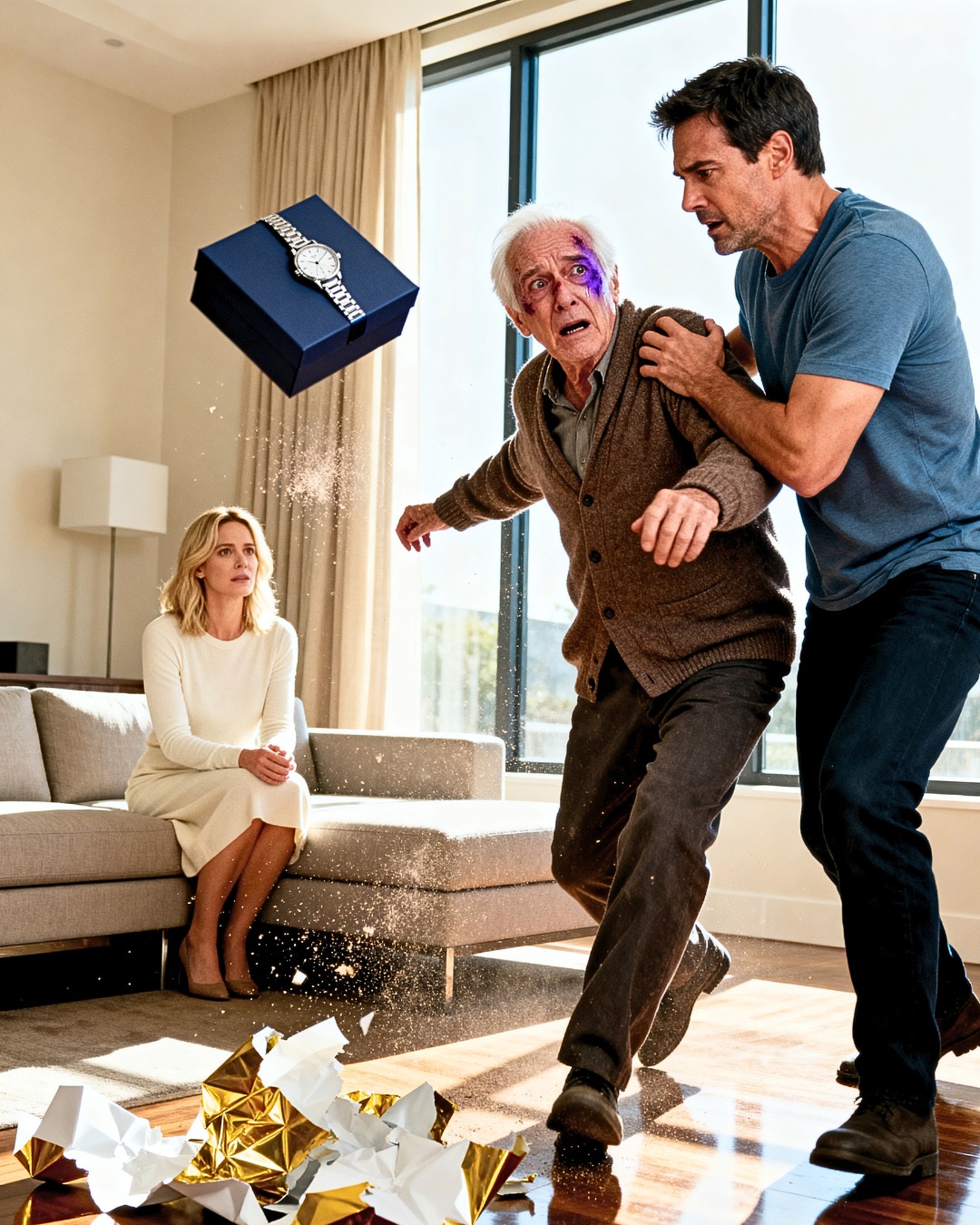
“The same right I had when I paid for it,” I said. “The same right I had when I registered it under my company. The same right I had yesterday when you hit me thirty times in a house that was never yours.”
He went quiet.
Not regret. Just shock.
“You wouldn’t do that,” he said finally.
“I already did.”
I hung up.
Rachel didn’t ask if I was okay. She simply handed me a folder—revocations, approvals, confirmations. The sale itself had taken less time than it took my son to pick a jacket.
The buyer had been waiting for months. She wanted discretion. I wanted closure. Everything moved efficiently—calls, paperwork, signatures—driven by discipline, not ego.
By the time Daniel was pretending to run his office, I had already signed away the illusion he’d been living in.
Rachel walked me through the legal pressure that was already building. I nodded. I understood pressure. I had spent my life building things that had to hold under it—bridges, contracts, systems. Pressure reveals truth.
And my son had revealed himself the night before.
In front of guests. In front of his wife. In front of the watch I had restored by hand, hoping it would mean something.
He answered with contempt.
Then violence.
I counted the blows. Thirty. Because when clarity matters, you count.
Not a loss of control. Not an accident. Thirty deliberate strikes.
At 12:17, my phone rang again.
Lauren.
I answered out of curiosity. Her voice was tight.
“This is insane.”
I touched my bruised lip as Rachel quietly set water beside me.
“No,” I said. “What was insane was watching your husband beat a sixty-eight-year-old man while you sat there smiling.”
She ignored it.
“You can’t leave us like this. The staff is overwhelmed. We have guests this weekend.”
Guests.
No apology. No concern.
“You should cancel brunch,” I said. “Try honesty for once.”
She softened her tone, shifting strategy.
“Daniel is under pressure. Last night went too far, yes, but selling the house over a family argument is cruel.”
I closed my eyes briefly.
“Not the argument,” I said. “The people you’ve both become.”
I ended the call.
Later at the clinic, my injuries were documented—face, ribs, hands. The report went straight to my lawyer.
Because the house was only part of it.
The deeper truth came out quickly. Daniel hadn’t just lived in the house—he had used it. Listed it as his asset. Leveraged it for loans, credibility, status.
I sat with a forensic accountant, Laura Mitchell, as she explained.
He hadn’t just enjoyed the illusion.
He had monetized it.
There was more—fake reimbursements, inflated invoices, money routed through shell vendors tied to Lauren’s family.
I recognized the pattern immediately.
Fraud.
By afternoon, consequences began. Credit lines froze. Investors started asking questions. His office was notified.
That was why he panicked.
Not because he loved the house.
Because it was a mask.
And without it, he was exposed.
That evening, reports came in. Daniel had shown up furious, tearing papers, punching walls. Staff shaken. One quit on the spot.
“Unstable,” someone said.
That word stayed with me.
Because the house had been unstable for a long time.
That night, in my smaller apartment, I finally unwrapped the watch.
I had restored it myself. My father had once dreamed of owning something like it. I thought my son might understand.
He had left it on the floor.
The next morning, Daniel came to see me.
He looked the same—expensive, polished—but something underneath had cracked.
“What’s wrong with you?” he asked.
I almost laughed.
He accused me of betrayal.
I corrected him.
“I didn’t sell your house,” I said. “I sold mine.”
He paced, talking about humiliation, reputation.
I stopped him.
“You hit me thirty times,” I said. “And you’re worried about humiliation.”
Something flickered in him.
Then disappeared.
“You provoked me,” he said.
That hurt more than the blows.
I showed him the medical report.
He asked if I had gone to the police.
“Not yet,” I said.
Relief crossed his face.
“You should be grateful,” I added.
He shifted again—blaming stress, pressure.
“Just one incident,” he said.
I stepped closer.
“Not one incident. Five years of watching you mistake support for weakness.”
Silence.
“What do you want?” he finally asked.
“Leave by Friday. Cooperate legally. No interference. And remember every number from one to thirty before you ever raise your hand again.”
He mocked my apartment. My lifestyle.
And I saw it clearly.
To him, the worst fate wasn’t becoming cruel.
It was becoming ordinary.
“I live like a man who owns what he paid for,” I said. “Try it.”
He left.
And everything began to collapse.
His firm suspended him. Investors investigated. Lauren tried to negotiate, delay, manipulate.
I refused.
She dropped the act.
The pressure built. Evidence surfaced. Vendors cooperated.
The illusion fell apart.
Even the house told the truth—rented furniture, staged appearances.
Lauren left him. Efficiently. Took what she could.
Daniel was left alone.
Days later, he came to my construction site.
Dusty. Tired. Unrecognizable.
For the first time, he looked like someone lost.
“Help me,” he said.
Not “I’m sorry.”
Just help me.
I understood.
He didn’t want to change.
He wanted support.
So I offered something else.
A job. Entry level. No privileges. Hard work. Accountability. Therapy. Legal responsibility.
He refused.
At first.
Weeks passed. Things got worse.
Then one morning, before sunrise, he showed up again.
Work boots. Cheap vest. Holding a helmet awkwardly.
“Where do I start?” he asked.
I pointed to the safety board.
“Start by listening.”
The work broke him.
Not physically—mentally.
No status. No shortcuts. Just reality.
Slowly, he changed.
He signed an admission of assault.
He apologized—not perfectly, but honestly.
Later, he brought me the watch.
“I didn’t understand what it meant,” he said.
“The most valuable things look ordinary to those who haven’t earned them,” I replied.
Nothing became perfect.
But something became real.
Months later, he asked why I hadn’t called the police.
I took a long time before answering.
“Because prison would have taught you to hate me,” I said. “Work taught you to face yourself.”
He nodded quietly.
“I deserved both.”
Maybe he did.
But I chose something harder.
Not revenge.
Not punishment.
Weight.
Because I had spent my life building things that had to hold under pressure.
And when my son raised his hand against me, he thought the lesson was about anger.
It wasn’t.
It was about gravity.