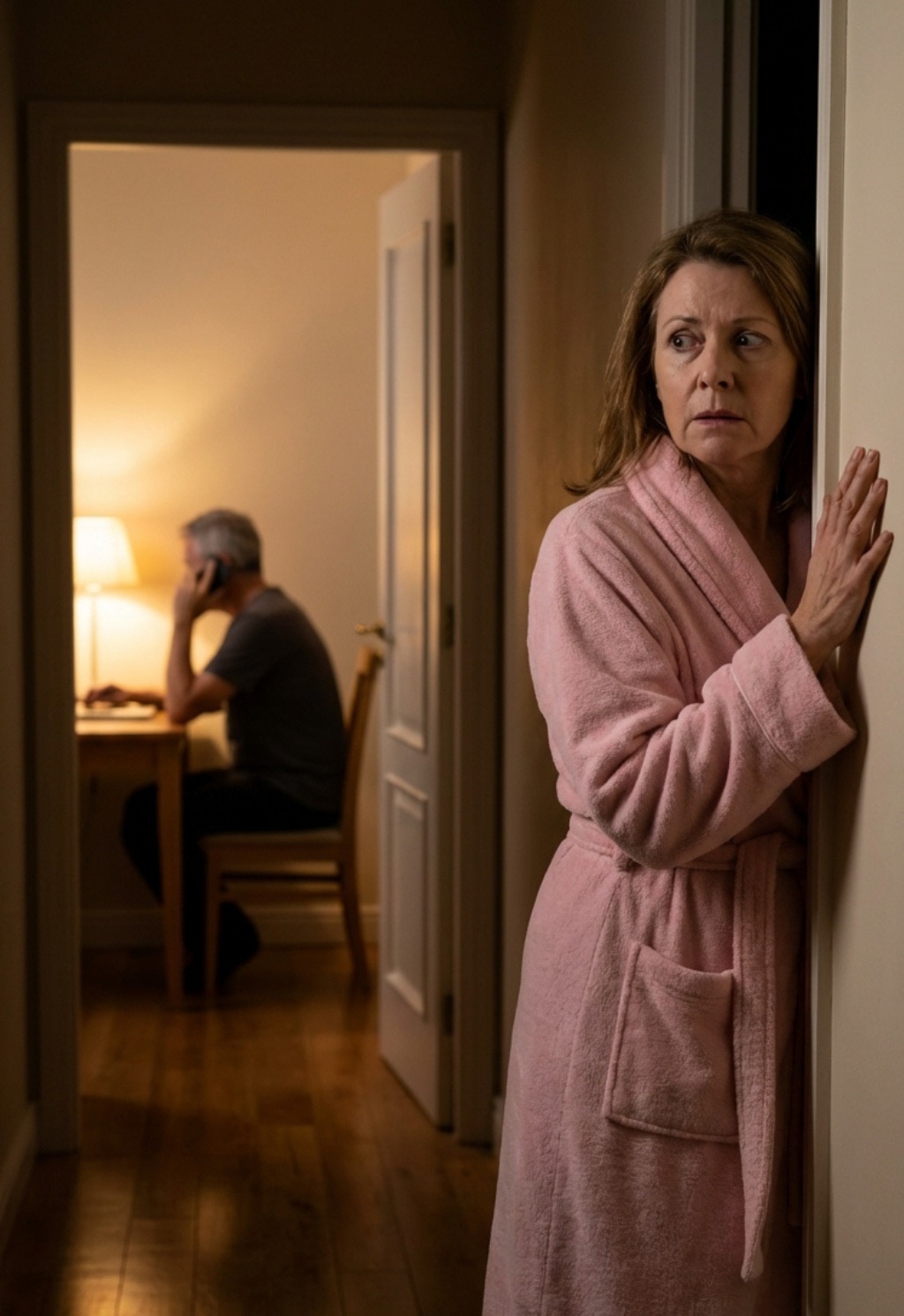
At two in the morning, I woke to cold sheets and the faint sound of my husband’s voice slipping under the bedroom door like smoke. For a few seconds I thought it was only a dream, the kind that makes your heart race before your mind catches up.
Then I heard him clearly from the study down the hall, speaking low and amused to someone on speakerphone. “She has no idea, she’s naive, she always has been.”
I sat up so fast the room tilted around me, and the digital clock glowed 2:03 a.m. in harsh red numbers. The space beside me where Julian Mercer should have been was empty and cool, which frightened me more than his words.
It meant the betrayal had already been awake before I was.
I walked barefoot down the hallway in my pale pink robe, pressing one hand against the wall because my knees suddenly refused to trust me. The study door was nearly closed, but not enough to hide what came next.
Another man’s voice asked, “And when she signs the documents?”
Julian gave a soft laugh that I had once mistaken for warmth and said, “Then it will be too late for her to understand anything.”
There are moments when life does not shatter all at once, but quietly shifts into something unrecognizable. I stayed there with my back against the cool wall, listening as the man I had spent thirty three years beside discussed me like a liability instead of a partner.
When he returned to bed, I was already lying still with my eyes closed and my breathing steady. He slipped under the covers and wrapped his arm around my waist as he always did, as if affection were a habit he could perform without believing in it.
His hand rested there with calm certainty, while I stared into the darkness and understood something irreversible. Some marriages do not end with shouting or packed suitcases, they end when one sentence rearranges everything inside you.
At breakfast he was the same man I had always known, or at least the version I had trusted for years. He wore a navy suit, carried his folded newspaper, and gave that small nod for coffee with one spoon of cream.
He did not look at me when he drank it, and instead made a quiet approving sound as if gratitude would be too personal. I watched him and realized I had confused routine with love for far too long.
After he left, the house felt unfamiliar, like a stage I had been performing on without realizing it. For the first time in my life, I opened the drawer in his desk.
Inside I found not one secret, but an archive of my own disappearance. There were account statements, investment summaries, folders marked with his initials, and beneath them traces of everything I had given up.
There was a receipt for the jewelry I sold during his surgery, loan papers for the truck he insisted he needed, and records showing my book royalties redirected into shared accounts. The pain from that discovery cut deeper than the betrayal itself because it proved none of it had been accidental.
It had been built slowly, line by line, compromise by compromise.
Two nights later, I heard him mocking my writing on the phone with someone else. “I let her write her little novels so she stays busy,” he said with a tone polished by years of quiet contempt.
That sentence told me something worse than any affair or lie could have revealed. It told me he needed me to remain small so he could feel large.
The real turning point came on Saturday morning when he left his phone on the dining table. Julian never left his phone behind, so seeing it there beside his unfinished orange juice made something cold ring inside me.
There was no passcode, because men like him believe control removes the need for caution. I opened the messages and found everything laid out in plain sight.
“All that’s left is for her to sign without reading.”
“Move the funds after the notary clears it.”
“She has been conditioned to obey for decades.”
My hands trembled so hard I had to grip the table to steady myself, but I read every word. When a lie has consumed decades of your life, survival means facing it completely.
After that, I went to his closet and found a metal box hidden behind his suits. Inside were copies of a revised will, unknown account statements, and a divorce agreement marked with small pencil arrows showing exactly where I was supposed to sign.
It was not a misunderstanding, it was a plan.
I did not cry then, because something inside me had already changed. Instead I reached for an old address book and found a name I had not spoken in years, Melissa Crane.
Back in college, I had studied literature while she had studied law, and we had taken very different paths. When she heard my voice, she did not waste time on politeness.
“Come today,” she said, “bring everything and tell no one.”
Her office in Bellevue smelled like paper and strong coffee, and I arrived with the box, documents, and almost no sleep. She read everything in silence before finally looking up at me.
“Do you understand how much money is involved here?” she asked calmly.
I swallowed and forced myself to say the number, counting properties, investments, and years of hidden income. “More than fifty million dollars,” I said quietly.
She set her pen down with a sharp sound and said, “Then we act immediately.”
My mind was still trapped in emotion, but hers had already moved into strategy. She began organizing everything into precise stacks, each one becoming a piece of the case against him.
“He believes you are unaware,” she said, “and that makes him careless, and careless men leave evidence everywhere.”
I expected comfort, but instead she gave me something better, a plan. She listed experts, accountants, legal contacts, and steps we needed to take without hesitation.
On the drive home, the city of Seattle looked sharper than usual, as if betrayal had cleared my vision. I saw people moving through their lives and realized my story was not unique, it was simply one I had not recognized yet.
When I entered the house, Julian stood in the kitchen asking what we would have for dinner. I smiled, kissed his cheek, and asked whether he preferred chicken or fish.
That night I watched him perform our marriage across the table, and for the first time I saw him as a character instead of my husband. Every word he spoke sounded rehearsed.
The next morning, Melissa called with new information about a shell company created less than a year earlier. It had been receiving transfers from our shared assets under a signature that looked like mine but was not.
“Are you saying he forged my signature?” I asked, my voice barely steady.
“I am saying we now have reason to ask serious questions,” she replied calmly.
By noon, more evidence surfaced including changes to life insurance, hidden withdrawals, and patterns tied directly to my book royalties. Each discovery made his deception clearer and more deliberate.
On Monday morning, Julian casually mentioned signing documents later that week. “Just routine planning,” he said, cutting fruit with careful precision.
I nodded and asked if I needed to dress formally, while inside I understood the advantage of being underestimated.
Melissa instructed me to act normally, gather evidence, and let him continue believing I knew nothing. So I played the role perfectly while preparing for the truth.
On Friday, I wore a cream blouse and a soft rose jacket, choosing something that reminded me of who I was before everything changed. We met in a private room at a business club in Bellevue with his associates and a notary.
He smiled warmly and said, “Let’s make this quick and simple.”
The documents were placed in front of me with tabs marking where I needed to sign. Instead of picking up the pen, I looked at him and asked, “Why is my signature already on the transfer dated last October?”
The room shifted instantly.
Before he could respond, the door opened and Melissa entered with her team. She introduced herself and placed legal documents on the table announcing an emergency filing.
Julian stood up in shock and said, “This is ridiculous, she doesn’t understand what she is doing.”
I met his eyes and replied calmly, “No, you just assumed I never would.”
Everything collapsed quickly after that as evidence was presented and witnesses stepped back. Deals were halted, the notary withdrew, and his confidence began to unravel in front of everyone.
In the weeks that followed, the case exposed layers of deception, hidden accounts, and forged documents. The house we lived in had been partially funded by my own writing income, something he had mocked for years.
At the hearing, I spoke calmly and clearly, presenting facts instead of emotion. His lawyer tried to dismiss me, but truth proved stronger than any argument.
Eventually, the court restricted his access to assets and validated the evidence we had gathered. The life he built on my silence began to fall apart.
Months later, we reached a settlement that reflected reality instead of illusion. I gained control over what was mine, while he lost the illusion of absolute power.
I chose not to stay in the house and instead moved into a smaller apartment filled with light and quiet. For the first time in years, I could hear my own thoughts clearly.
I returned to writing with a sharper voice and clearer purpose. My next book came easily, shaped by everything I had lived through.
At the launch event, a woman asked me how my character knew she was ready to change her life. I smiled and said, “She was not ready, she was simply done being underestimated.”
Now, when I look back at that night at 2:03 a.m., I understand something clearly. The most dangerous lie is not the one told in secret, but the one told by someone who believes you will never question it.
And in the end, the man who thought he trained me to obey had actually trained me to watch, remember, and finally tell the truth.