The garage sale had been my idea, and it felt like a noble act for exactly five minutes before the reality of the heat and the memories started to weigh me down.
My mother had been gone for twenty-three days, and her ranch-style house in Fairwood Hills still smelled like the specific blend of almond lotion, lemon wax, and the lavender spray she used before service at Grace Chapel.
I spent the first week walking through the rooms with a yellow notepad, cataloging mundane items like casserole dishes and winter coats. By the second week, the list changed from objects to memories, noting things like the stained apron she wore every Christmas or the ceramic piggy bank she used for the “rainy day fund” that usually went toward my school trips.
By the third weekend, the process of grieving had officially transitioned into the brutal logistics of sorting through a life.
My sister, Melanie, showed up that first Saturday wearing oversized designer glasses and a look of deep annoyance, as if being there was a massive inconvenience to her social calendar. She helped move exactly three small boxes, wept briefly over a tin of old polaroids, and then spent the rest of the afternoon smoking on the porch while scrolling through her phone.
The next morning, she sent a short text saying she couldn’t make it because it was “too emotionally draining,” and then she went completely silent.
Our brother, Justin, made a brief appearance in his muddy construction boots, giving me a stiff, one-armed hug and offering a hollow apology that sounded like he was reading from a script. He immediately gravitated toward the garage to inspect Mom’s high-end power tools, asked if anyone had claimed the miter saw, and loaded the best equipment into his Ford Raptor before noon.
He promised he’d be back the following day to help with the heavy lifting, but I never saw his truck pull back into the driveway.
I ended up doing everything by myself, unfolding heavy plastic tables at dawn while the morning dew still clung to the grass. I spent hours tagging vintage porcelain with masking tape and arranging her colorful silk blouses on a rolling rack because it felt wrong to just throw them in a pile.
People from all over the neighborhood showed up with coffee and an appetite for bargains, running their hands over her belongings while haggling over a couple of dollars.
I kept a polite smile plastered on my face until my jaw literally ached from the effort of being a “good hostess.”
By late Sunday afternoon, the yard was nearly empty and the sun was beating down on the pavement, making the world feel blurry and uncomfortably hot. I had managed to sell almost everything, from the heavy oak dresser to a weirdly painted lawn gnome she’d kept by the back door for a decade.
Hidden safely under my folding chair was a dented metal cash box containing $1,847 in crumpled bills and loose change.
I knew the exact total because I had kept a meticulous ledger just like Mom used to do, noting every item and every cent received. I noticed that my handwriting was starting to look just like hers, a realization that made my chest tighten in a way I wasn’t prepared for.
The plan for the money was simple: it was going to pay for her bronze memorial plaque at Willow Grove Cemetery.
Mom had been cremated because she hated the idea of a flashy funeral, but she had specifically told me she wanted a nice marker next to her parents’ plot. We had driven past the cemetery a few months before she passed, and she had looked me dead in the eye and said, “Don’t let your father be cheap with my stone.”
That sentence had been looping in my head like a warning siren ever since the hospital.
Our father, Raymond, hadn’t lifted a single finger to help with the estate or the house, preferring to spend his time at his girlfriend Kimberly’s place on the other side of town. He only called once to ask if I had found Mom’s engagement ring yet, and when I told him I was busy sorting clothes, he got defensive.
“Well, I hope you’re keeping a tight record of the money, because that’s family property,” he barked into the phone.
I didn’t argue with him because I had spent my entire life watching Mom manage his moods like she was walking through a minefield. I remembered the sound of his voice rising during dinner and the way Mom would catch my eye, silently telling me to just keep my head down and finish my meal.
She had been the only buffer between his temper and the three of us, and now that she was gone, the air in the family felt thin and dangerous.
Around four o’clock, just as I was collapseing the last table, I heard the familiar, aggressive rumble of Raymond’s old Silverado coming down the street. He pulled into the driveway too fast, his tires crunching over the gravel and a stray flyer I hadn’t picked up yet.
My body went rigid on instinct as he climbed out of the cab, smelling of stale tobacco and cheap beer even in the open air.
“Looks like you cleared the place out,” he said, squinting at the empty lawn with a look of calculation.
“Most of it is gone,” I replied, trying to keep my voice as flat and uninteresting as possible.
He wiped sweat from his forehead with the back of his hand and stepped closer. “So, what’s the take? How much did we make today?”
“It’s about eighteen hundred dollars,” I said, immediately wishing I had rounded down or lied.
His eyes lit up with a sudden, hungry intensity that made my stomach turn. “You’re kidding. Eighteen hundred in cash right there?”
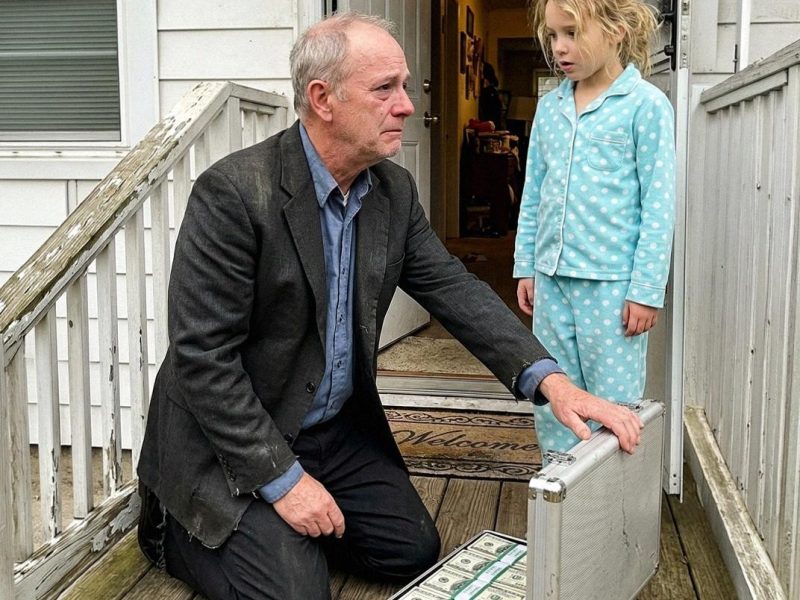
I reached down and grabbed the metal box, holding it tight against my side. “I’m taking it to the monument office tomorrow to put it toward the memorial Mom wanted.”
He held out a calloused hand, his fingers twitching. “Give me the box, kid. That money belongs to me as her legal husband.”
His voice dropped into that low, gravelly register that signaled a storm was coming, the same voice that used to precede broken dishes and slammed doors.
“It’s for her headstone, Raymond. She asked me to make sure it happened,” I said, my heart hammering against my ribs.
He took a step toward me, his face turning a blotchy shade of red. “Melanie is behind on her car note, and I’ve got bills piling up at the house. The living come before the dead.”
The heat of the afternoon felt suffocating as I looked at the man who had spent thirty years letting my mother carry his weight.
“She worked for these things, and she wanted a marker. I’m not giving you the money,” I said, surprised by the steady tone of my own voice.
“I’m not going to ask you again,” he snarled, moving so fast I didn’t have time to retreat.
He lunged for the box, his fingers catching the corner of the lid and yanking it upward. The latch snapped, and a cloud of twenty-dollar bills exploded into the air, caught by the afternoon breeze.
We both scrambled for the money, crawling on the hot pavement like desperate animals while the cash skittered toward the street.
“This is mine!” he shouted, shoving me aside as he grabbed a handful of bills from under the table leg.
“It belongs to her memory!” I yelled back, my hands shaking as I tried to pin down a stack of tens near his front tire.
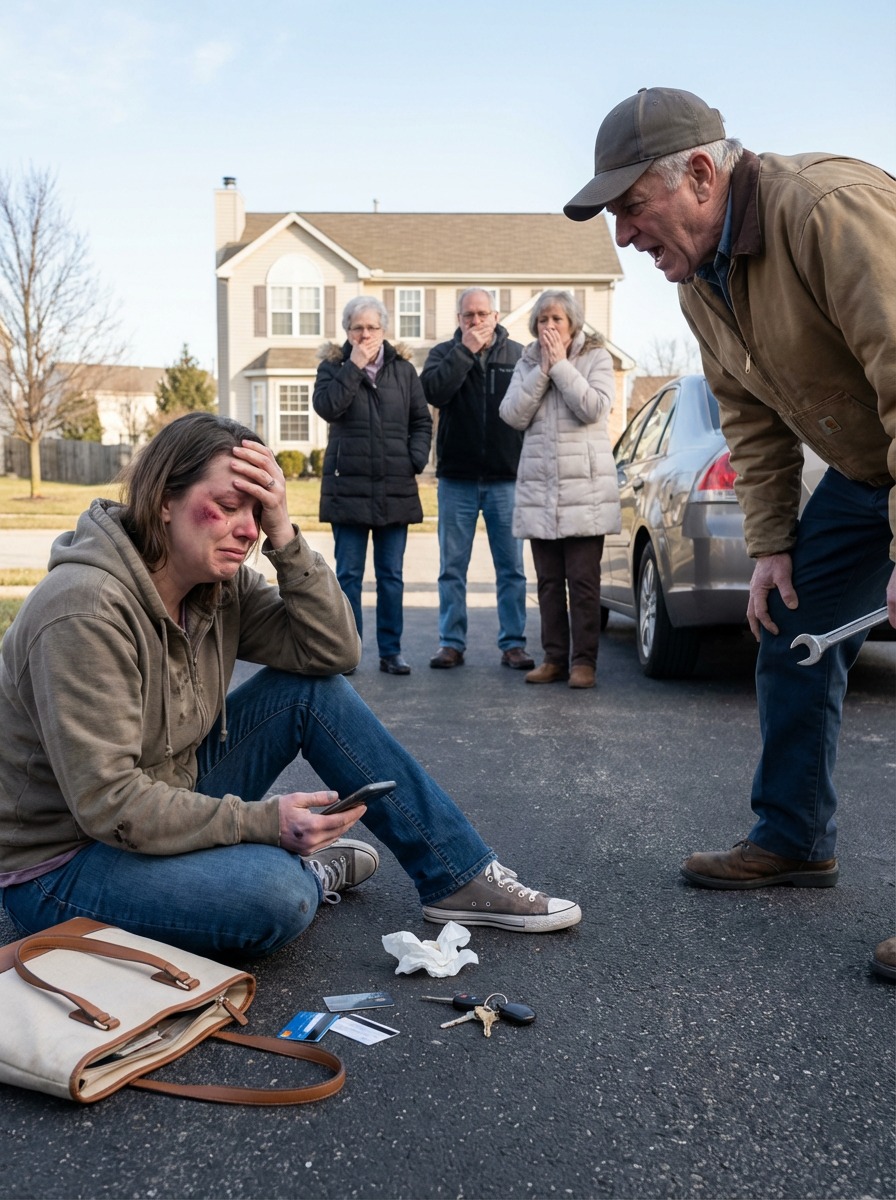
He stood up abruptly, his chest heaving, and for a second I thought he was going to walk away. Instead, he reached into the bed of his truck and pulled out a heavy, rusted pipe wrench he kept in his tool bag.
I didn’t even have time to scream before the world turned into a blinding flash of white light and a sickening, wet thud.
The sound was the worst part, a sharp crack that echoed inside my skull like a piece of dry wood snapping in half. I hit the concrete hard, the rough surface scraping the skin off my shoulder as my vision swam and turned a dark, bruised purple.
My mouth filled with the metallic taste of copper and a strange, gritty texture that I realized, with a wave of horror, were pieces of my own teeth.
“You always were a stubborn brat, just like she was,” he spat, standing over me while the sun cast a long, jagged shadow across my body.
I tried to speak, to call for help, but my jaw felt like it had been unhooked from my head, shifting uselessly to the side in a spray of blood. I watched through a haze of tears as he knelt down and began calmly picking up the rest of the money, even the bills stained with my own blood.
He didn’t look at me again as he climbed back into his truck, started the engine, and backed out of the driveway without a single backward glance.
I lay there on the hot pavement for what felt like hours, watching a ladybug crawl across a stray five-dollar bill while the world went quiet. My phone was lying a few feet away, and I dragged myself toward it, my fingers slick with blood as I managed to hit the camera app.
I took photos of everything—the wrench he had dropped, the blood on the concrete, and my own shattered face in the reflection of the truck’s oil leak.
I hit the “upload” button to my cloud drive just as the sound of sirens began to wail in the distance, growing louder until the red and blue lights filled the street.
The next few days were a blur of sterile white ceilings, the smell of antiseptic, and the constant, throbbing agony in my face. I was at Mercy Oaks Memorial Hospital, and a surgeon named Dr. Sterling informed me that my jaw was broken in four places and required immediate reconstruction.
“We’re going to have to use titanium plates to hold everything together,” he said, looking at me with a mixture of pity and professional focus.
I couldn’t talk, so I spent my time typing messages into my phone to communicate with the police and the nurses. Detective Miller came by my room and told me that they had found Raymond at a local bar with the cash still in his pocket and my blood on his boots.
“The photos you took are the reason he’s not getting out on bail,” the detective said, his voice grim.
My sister Melanie called me once to tell me that I was “destroying the family” by pressing charges, but I hung up on her without a second thought. My brother Justin showed up at the hospital looking ashamed, but he stayed long enough to bring me a milkshake and promise to testify.
The recovery was a brutal, slow process involving liquid diets, multiple surgeries, and the realization that my face would never look exactly the same again.
When the trial finally came around, I sat in the witness stand and looked directly at Raymond, who was wearing a cheap suit and a look of practiced innocence. His lawyer tried to claim it was an accident, a tragic family dispute that went too far, but the evidence was overwhelming.
The jury didn’t buy his story, and the judge sentenced him to fifteen years for aggravated assault and robbery.
A few months after the sentencing, I finally received the recovered money from the police evidence locker—exactly $1,847, still tucked in a plastic bag. I took it directly to the monument shop and ordered the most beautiful, solid gray granite stone they had in stock.
I went to the cemetery on a cool autumn morning to see the marker being placed, the polished surface reflecting the orange leaves of the maple trees.
The stone was simple and elegant, and it bore the words “A Life of Grace” right above her name. I stood there for a long time, the cold wind biting at my cheeks, but for the first time in months, my jaw didn’t feel like it was holding a heavy weight.
I had kept my promise to her, and I had finally stopped holding the weight of a man who never deserved the space he took up in our lives.
As I walked back to my car, I felt the small titanium plates in my jaw click slightly, a permanent reminder of what I had endured to get here. I wasn’t the same person I was before that Sunday afternoon, but as I looked at the horizon, I realized I was finally free to become whoever I wanted to be.