PART 1
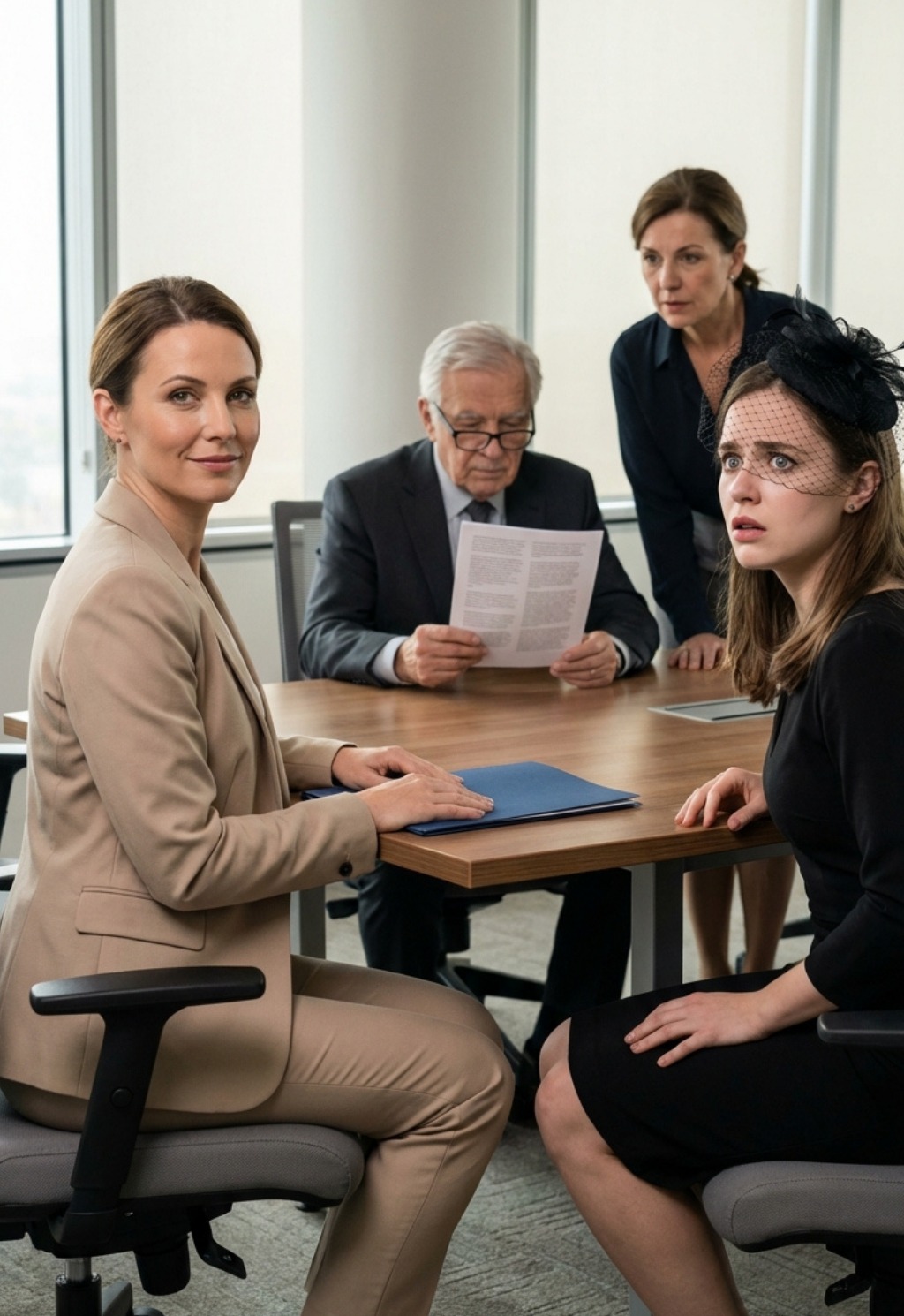
“Read that section again, sir, because I want to hear exactly how she finally understands her place in all of this,” Brielle Dawson said, her voice slicing cleanly through the quiet notary office with a confidence wrapped in expensive perfume and impatience.
She wore a fitted black dress that clung too tightly for mourning, a delicate veil barely shading her eyes, and deep burgundy nails that gleamed with every movement, as if she had already stepped into the life she believed was hers to claim.
I sat across from her in a simple beige blazer, hands folded neatly on the polished wooden table, choosing not to meet her gaze just yet while I watched the traffic outside rolling through the streets of Maple Ridge, sunlight flashing across windshields as if nothing in my world had collapsed three weeks earlier when my husband died on a highway outside Austin, leaving behind a fractured marriage, a restless lover, and more lies than truth.
Attorney Franklin Hayes, a seasoned notary and longtime acquaintance of my husband’s family, cleared his throat before continuing in a measured tone that tried to maintain professionalism despite the tension thickening the room.
“I declare Miss Brielle Dawson as the sole and universal heir to all my movable and immovable property, accounts, rights, and shares,” he read slowly, each word settling heavily into the silence.
Brielle exhaled with satisfaction, letting a slow smile spread across her face as if each syllable confirmed the story she had been telling herself for years.
“Do you hear that,” she said softly without fully turning toward me, her tone dripping with triumph, “he finally made his feelings official, because you were just routine while I was the one he truly loved.”
I did not respond because I had learned long ago that arguing with someone who builds their reality on illusions only leaves you speaking to your own reflection.
The attorney continued reading, listing the apartment in Silver Lake, the vacation property in Aspen Grove, and a luxury SUV, while Brielle pressed a hand dramatically to her chest and whispered, “I knew you would never leave me with nothing.”
From the back of the room, my sister in law Charlotte Reed tightened her jaw, clearly wanting me to fight, to challenge everything, to drag Brielle out by force, yet I remained still because I had not come to argue, I had come to watch a carefully built illusion reach its breaking point.
“We will also need to formalize the acceptance of the inheritance,” the attorney added carefully, glancing between us as if anticipating what might follow.
“Of course I accept it,” Brielle replied immediately, lifting her chin with certainty, “everything he left behind belongs to me.”
She leaned slightly closer to me with a smile that carried quiet cruelty and said, “I will let you collect your personal things from the apartment, since I am not heartless, although he always said you made that place feel dull and lifeless.”
My mother in law, Mrs. Dawson, murmured weakly, “Brielle, please,” though her concern seemed more about appearances than anything else, because her grief had always been tied to reputation rather than truth.
I opened my bag slowly, remembering every moment my husband had asked me to be patient, to wait for deals that never materialized, while he spent freely on luxury gifts, vacations, and dinners that existed far beyond our means.
I placed a blue folder firmly on the table, the sharp sound echoing just enough to shift everyone’s attention toward me.
“Before anything gets signed,” I said calmly with a faint smile, “I believe we should review the part that was never included in those promises you believed so completely.”
Brielle’s expression flickered for just a second, though she quickly masked it with confidence, unaware that the most important part of that inheritance had nothing to do with property and everything to do with truth.
PART 2
Brielle stared at the folder with irritation, as though it had disrupted the perfect ending she had already imagined.
“What is this supposed to be,” she asked sharply, “another attempt to make yourself look important when everything is already decided.”
“It is documentation,” I replied evenly, “something he never managed properly and something you never thought to question.”
Attorney Hayes opened the folder carefully, revealing organized stacks of bank statements, loan agreements, overdue notices, legal claims, and financial records spanning several years of steady collapse, each section marked with precise detail.
As he turned the pages, the color slowly drained from Brielle’s face while he spoke in a quieter tone, “Miss Dawson, these documents indicate significant liabilities involving multiple financial institutions and private lenders.”
“That does not mean anything,” she insisted, though her voice had already lost its earlier confidence, “people with money use debt all the time.”
“Some people do,” I answered calmly, “but the difference is that some manage it responsibly while others use it to maintain an illusion until everything falls apart.”
I slid another document forward and explained that the apartment carried two separate mortgages, then another showing the vacation home had a lien, and finally one more confirming the vehicle was tied to a shell company used to secure additional credit.
The room fell completely silent as reality began to replace fantasy.
Mrs. Dawson whispered a quiet prayer while Charlotte let out a dry, humorless laugh, barely disguising it as a cough, and Brielle flipped through the documents with trembling hands.
“This cannot be right,” she said, shaking her head, “he told me those properties were ours, that we would live there once everything settled.”
“He told me similar things,” I replied without emotion, “while I was selling personal belongings to cover basic expenses, he was funding your lifestyle.”
“Stop talking,” she snapped, slamming her hand against the table, “you were always bitter and that is why he chose me.”
“He did not choose you,” I said quietly, “he chose the version of himself that you encouraged, the one who appeared successful and generous without ever being real.”
Attorney Hayes adjusted his glasses and spoke carefully, “If you accept this inheritance, you are also accepting all associated liabilities, and based on these records, the debts exceed the total value of the assets.”
Brielle stared at him, struggling to process what she was hearing.
“You mean if I sign this, I inherit everything including the debts,” she asked slowly.
“Yes,” I answered simply, “everything he left behind belongs to you, including every obligation he never fulfilled.”
Mrs. Dawson looked at me with disbelief and asked why I had never revealed this earlier, and I met her gaze for the first time that morning before replying that no one had ever wanted to listen when I warned them.
Brielle suddenly looked up and demanded to know about a specific document, and I reached into the folder to pull out a sealed envelope that immediately caught the attorney’s attention.
He recognized it instantly and murmured under his breath, clearly unsettled, while I placed it directly in front of Brielle and told her that this was the one decision my husband made that ultimately changed everything.
PART 3
Attorney Hayes opened the document and read slowly, each word carrying increasing weight as he explained it was a legal separation and asset liquidation agreement signed in San Antonio, Texas, just two weeks before my husband’s death.
Brielle looked confused while Mrs. Dawson frowned and Charlotte leaned forward, sensing the shift in everything they believed was certain.
“He told everyone he was traveling for business,” I explained, “but he was actually signing this agreement to remove me from his financial obligations and keep what he could under his control.”
Brielle tightened her grip on the paper and asked what it meant for her, and I explained that any remaining assets were separated from me while all liabilities remained tied to his estate.
The attorney confirmed this interpretation, stating that I retained my own financial independence while the estate remained responsible for outstanding debts, and Brielle’s expression collapsed completely.
“So if I accept,” she whispered, “I take everything including the losses.”
“Yes,” I replied, “you inherit the entire reality, not just the version he showed you.”
This time her tears were real, no longer dramatic or controlled, but raw and desperate as she realized the life she imagined had never existed in the way she believed.
“He told me you were cold and unsupportive,” she said through sobs, “that you never believed in him.”
“I told him the truth,” I answered quietly, “and that was something he never wanted to hear.”
Mrs. Dawson began to cry softly, finally seeing the full picture of her son’s choices, while Charlotte spoke bitterly about the debts and the inevitable consequences that had finally caught up with him.
Attorney Hayes placed the acceptance papers in front of Brielle and asked for her final decision, and she looked at me with fear replacing every trace of arrogance before whispering that she declined.
The attorney nodded and confirmed that the legal succession would then pass to the surviving spouse, which caused Brielle to look up in shock as she realized everything now shifted back to me.
I stood and gathered my belongings, shaking my head gently when she accused me of winning, because there was nothing victorious in watching someone destroy themselves through illusion.
“I will not keep any of it,” I said calmly, “whatever remains after settling debts will be directed toward helping women affected by financial abuse.”
Brielle stared at me, unable to understand, because people who build their lives on illusion rarely recognize the value of dignity when they finally encounter it.
I walked toward the door and paused before leaving, turning back once to say that she had fallen in love with promises while I had survived the consequences, and that was the only difference between us.
Months later I closed accounts, sold what remained, and walked away from a name that carried more weight than any debt, while people around me claimed it was justice or luck, though the truth was far more complicated.
No one escapes unscathed from a life built on deception, but there is a moment when the final lie collapses and truth becomes loud enough that it no longer needs anyone to defend it.
Sometimes silence is not surrender but patience, and when truth finally speaks, it does so with enough force to rewrite everything.